South Korea's Stock Market Has Returned 213% in One Year. Here Is What Is Actually Driving It
 Join Us
 Follow Us
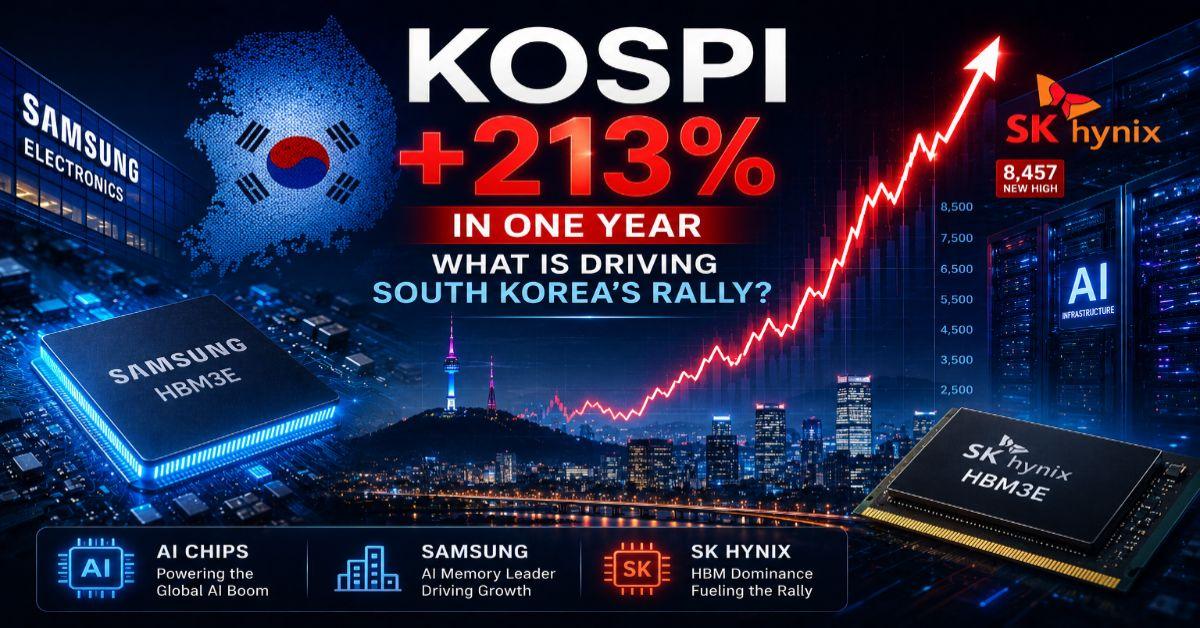
The KOSPI is not a broad economic story. It is an AI hardware story and two companies are doing most of the work
✨ Key Takeaways
The KOSPI Composite Index has delivered 212.84 per cent over the past year. Year to date the return is 94.78 per cent. Over six months, 105.96 per cent. The index now trades between 8,220 and 8,457 after spending most of the past decade below 3,000. Its 52-week low was 2,643 and today it sits around 8,228.70.
These are not normal stock market numbers. They are the kind of returns that demand a specific explanation not a general one about growth prospects or monetary policy, but a precise account of what changed and why capital flooded into South Korean equities at this scale and speed.
The answer, almost entirely, is artificial intelligence.
The Mechanism: How AI Spending Becomes Korean Earnings
The chain of causality is direct enough to state plainly. American technology companies — Microsoft, Google, Meta, Amazon are committing hundreds of billions of dollars to AI infrastructure. That infrastructure requires data centres. Data centres require servers. Servers require GPUs. GPUs require high-bandwidth memory chips. The two companies that dominate global HBM chip supply are Samsung Electronics and SK Hynix both South Korean, both KOSPI index heavyweights.
In simple terms: the US builds AI models, Nvidia sells the GPUs that run them, and South Korea supplies the memory that makes those GPUs function at the required performance levels. Every dollar spent on AI infrastructure in California or Virginia eventually touches a memory chip manufactured in Icheon or Hwaseong.
This positioning sitting at the hardware foundation of the AI buildout is what separated South Korea from other emerging markets over the past twelve months. India, for comparison, is a services economy. Its listed IT companies benefit from AI implementation work but are not in the supply chain of AI hardware itself. South Korea is embedded in the physical infrastructure layer of the AI economy in a way that has no close equivalent among other major markets.
The Two Companies That Explain Most of the Rally
The top 10 KOSPI constituents by market cap tell the story precisely.
|
Company |
Market Cap |
Price |
Sector |
Return 1M (%) |
Return 6M (%) |
Return YTD (%) |
Return 1Y (%) |
|
Samsung Electronics Co., Ltd. |
1.23 T USD |
307,000 KRW |
Electronic technology |
39.55 |
195.76 |
155.41 |
466.42 |
|
SK hynix Inc. |
929.59 B USD |
2,243,000 KRW |
Electronic technology |
79.01 |
307.08 |
244.55 |
1018.7 |
|
SK Square Co., Ltd. |
102.64 B USD |
1,276,000 KRW |
Finance |
70.82 |
319.05 |
246.27 |
1173.45 |
|
Hyundai Motor Company |
102.3 B USD |
681,000 KRW |
Automobiles |
30.96 |
160.42 |
127.38 |
276.87 |
|
Samsung Electro-Mechanics Co., Ltd |
76.41 B USD |
1,630,000 KRW |
Electronic Components |
105.81 |
544.27 |
535.48 |
1254.95 |
|
LG Energy Solution Ltd. |
61.7 B USD |
383,500 KRW |
Batteries |
-19.85 |
-13.14 |
4.07 |
39.2 |
|
HD Hyundai Heavy Industries Co., Ltd. |
51.61 B USD |
744,000 KRW |
Shipbuilding |
8.61 |
33.57 |
44.75 |
80.58 |
|
Doosan Enerbility Co., Ltd. |
47.6 B USD |
108,500 KRW |
Power/Energy |
-16.73 |
39.46 |
43.14 |
165.93 |
|
SAMSUNG BIOLOGICS Co., Ltd. |
43.54 B USD |
1,384,000 KRW |
Health technology |
-9.42 |
-16.27 |
-18.35 |
-12.91 |
|
Hanwha Aerospace Co., Ltd. |
42.48 B USD |
1,244,000 KRW |
Defence |
-15.14 |
43.65 |
30.54 |
47.74 |
Source: Tradingview & Investing
Samsung Electronics and SK Hynix together account for the two largest weights in the KOSPI index. Their combined one-year returns — 466 per cent and 1,019 per cent respectively have driven an index-level return that does not reflect broad Korean economic improvement. It reflects AI memory chip demand concentrated into two companies that happen to dominate a critical global supply chain.
SK Hynix crossed USD 1 trillion in market capitalisation today, joining Samsung Electronics and Micron Technology in the trillion-dollar memory chip club — a milestone that would have been unimaginable two years ago when the memory cycle was in a severe downcycle. SK Hynix is up 9.31 per cent today alone. Samsung is up 2.68 per cent. SK Square, which holds a significant stake in SK Hynix, is up 8.04 per cent — a reflection of the holding company discount narrowing as the underlying asset surges.
Samsung Electro-Mechanics a maker of multilayer ceramic capacitors and camera modules has returned 1,255 per cent over one year, reflecting the broader electronics component supply chain benefiting from AI hardware demand beyond just memory chips.
The Korea Discount Narrowing
For decades, Korean stocks traded at a persistent discount to global peers a phenomenon institutional investors called the Korea Discount. The reasons were structural: weak minority shareholder rights, opaque conglomerate governance through the chaebol structure, low Dividend payouts, excessive cross-shareholdings and limited accountability to outside investors.
The current administration under President Lee Jae Myung has pushed corporate governance reforms aimed at improving shareholder returns, increasing transparency and encouraging companies to reduce unnecessary cross-holdings and return more capital to shareholders. These reforms are not complete — Korean corporate governance remains considerably behind international standards in several respects but the direction of travel has given foreign institutional investors a reason to revisit valuations they had long written off.
The combination of Semiconductor earnings acceleration and governance reform expectations created a double rerating. First, the earnings multiple expanded as foreign capital rotated in. Second, the underlying earnings themselves expanded dramatically as HBM chip pricing and volumes surged with AI demand. When both the multiple and the earnings move in the same direction simultaneously, the result is the kind of index performance that the KOSPI has delivered over the past twelve months.
Foreign Capital Rotation Into AI Supply Chain Markets
Global fund managers allocating to emerging markets faced a clear choice over the past year: invest in markets that benefit from AI adoption or invest in markets that benefit from AI infrastructure. India falls primarily in the first category — its IT services sector helps enterprises adopt and deploy AI. South Korea falls in the second its semiconductor companies manufacture the physical components without which AI infrastructure cannot exist.
When capital is rotating toward the infrastructure layer of the AI boom, it gravitates toward Taiwan and South Korea before it gravitates toward India. Taiwan Semiconductor Manufacturing Company sits at the chip fabrication layer. Samsung and SK Hynix sit at the memory layer. These are not substitutes for each other they are complementary nodes in the same supply chain but for a fund manager seeking direct AI hardware exposure, Korea and Taiwan offer something the Indian market currently cannot.
This is not a permanent judgement on India's trajectory. It is a description of where capital has been going in a specific phase of the technology cycle.
The Concentration Risk That Cannot Be Ignored
The same concentration that drove the rally is the primary risk embedded in the KOSPI at current levels. Samsung Electronics and SK Hynix are not just large they are the rally. If AI capex cycles slow, if HBM chip pricing softens as more supply comes online, or if any of the major US technology companies reduce their infrastructure spending commitments, the earnings assumptions supporting these valuations change rapidly.
The KOSPI at 8,400 is pricing a world where AI hardware demand continues to grow at the pace it has set over the past two years. That is a reasonable base case but not a certainty. A market that has returned 212 per cent in a year on the back of two semiconductor stocks is a market where concentration risk and mean reversion risk are both elevated regardless of how justified the underlying earnings expansion has been.
The companies that have not participated in the rally — LG Energy Solution down 19 per cent over six months, Samsung Biologics down 13 per cent over one year are a reminder that the KOSPI story is not a rising tide lifting all ships. It is a targeted, sector-specific surge driven by one theme: AI memory chips.
What This Means Beyond South Korea
The KOSPI's performance over the past year is one of the clearest market demonstrations of the AI hardware thesis that has been building globally. It shows what happens when a country's corporate earnings base is directly embedded in the physical supply chain of the most capital-intensive technology buildout in modern history.
For Indian investors watching this from the outside, the lesson is about positioning in a technology cycle rather than about buying Korean stocks. The question it raises for India's own market is whether the data centre buildout now underway — Reliance at Jamnagar, AdaniConneX, Airtel Nxtra eventually creates a similar AI hardware supply chain effect in Indian listed equities, or whether India's primary role remains in the services and implementation layer above the hardware.
South Korea's rally happened because its companies were already inside the hardware. India's opportunity is to build that presence over the next five to seven years.
Disclaimer: This article is for informational purposes only and not investment advice.