The Jio IPO Story Is Not What Most People Think It Is
 Join Us
 Follow Us
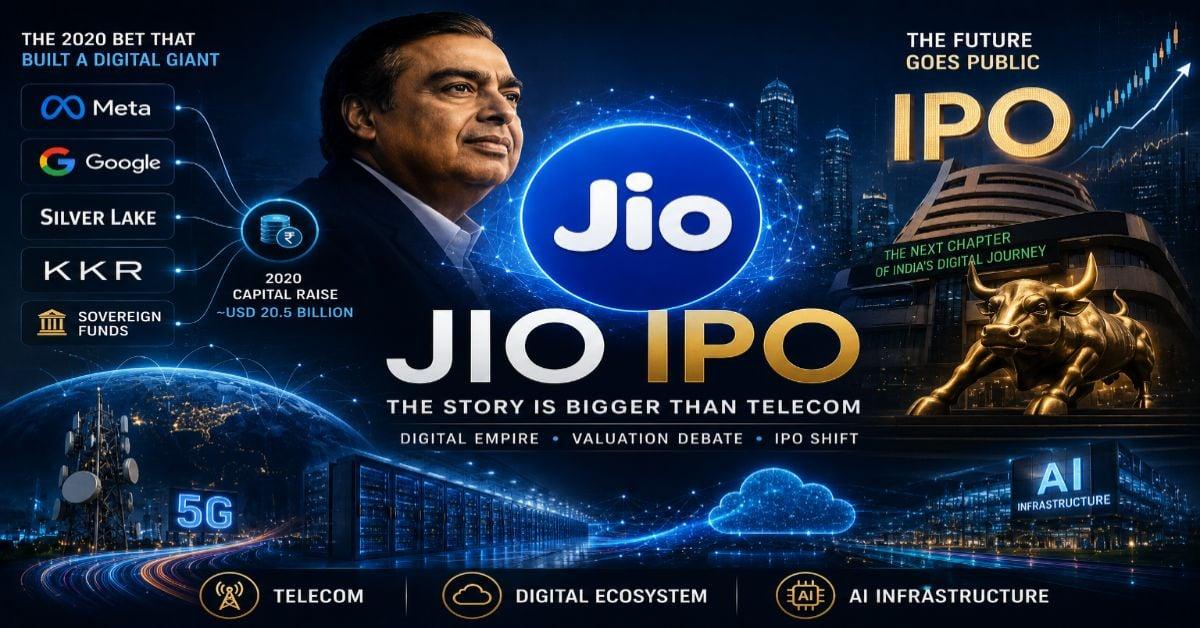
A shift in issue structure, a conglomerate discount unwinding and a valuation question that has no easy answer here is what investors actually need to understand
✨ Key Takeaways
Jio Platforms has been on the IPO radar for years. Reports now suggest the listing could happen around mid-2026, though the exact timing remains contingent on SEBI approvals and market conditions. When it does arrive, it is expected to be among the largest IPOs in Indian history with valuations being discussed in the range of USD 130 to USD 180 billion based on media and analyst estimates, though no official filing has confirmed these numbers yet. But the more important story is not the size. It is the structure and what that structure reveals about who benefits and how.
The 2020 Capital Raise That Set Up This Moment
The backstory matters. In 2020, Jio Platforms raised approximately USD 20.5 billion from a group of marquee investors — Meta, Google, Silver Lake, KKR, ADIA, Abu Dhabi and Saudi sovereign funds among others at a valuation of roughly USD 57 to USD 65 billion. These were large, strategic bets on India's digital infrastructure by some of the world's most sophisticated capital allocators.
If Jio lists at the upper end of the valuation range being discussed, the paper returns for those 2020 investors would be approximately two to three times their original investment. These are significant returns on significant capital and how those investors eventually monetise their positions is one of the central questions the IPO structure must address.
OFS Versus Fresh Issue: Why the Distinction Matters
The original IPO blueprint, as widely reported, was expected to be structured largely as an Offer for Sale meaning existing shareholders would sell a portion of their stake to public investors. In that model, proceeds go to the selling shareholders, not to Jio Platforms itself. The company receives no new capital. Investors in the IPO are essentially buying out a portion of the early-stage investors' positions.
Multiple media reports now suggest Reliance is reworking this structure toward a fresh issue model, where new shares are created and sold, with all proceeds going directly into Jio Platforms for capex, debt reduction and growth initiatives. It is important to note that no DRHP has been filed yet until the official filing, the structure should be treated as reported and under discussion rather than confirmed.
The logic being discussed in the market for this shift relates to two considerations. First, very large Offer for Sale IPOs where retail capital is channelled toward existing investor exits rather than company growth have faced scrutiny after some high-profile examples of weak post-listing performance created losses for retail participants. Second, a fresh issue structure is seen as signalling better alignment between IPO investors and the company's growth trajectory.
One important clarification on what this does not mean: a fresh issue structure does not eliminate exits for early investors. Meta, Google, Silver Lake and the sovereign funds that invested in 2020 can still monetise their positions through secondary market sales, block deals or post-lock-in transactions after listing. The structure delays the exit mechanism it does not remove it.
What Jio Platforms Actually Is
Most coverage of the Jio IPO describes it as a telecom listing. That framing is incomplete and matters for how the business should be valued.
Jio Platforms is a holding company ecosystem that sits above multiple digital businesses simultaneously — Jio Infocomm for mobility, JioFibre for broadband, enterprise connectivity services, cloud infrastructure ambitions, data centres and an emerging AI and digital services layer. Investors buying into a Jio IPO are not simply buying a telecom operator with subscriber growth and ARPU metrics. They are buying exposure to a digital ecosystem where the eventual monetisation pathways extend well beyond traditional telecom economics.
This distinction changes the valuation framework. Traditional telecom operators are typically valued on cash flow generation, subscriber growth and ARPU trajectory. Digital platform businesses and technology ecosystems command different and often higher multiples because the market is pricing future monetisation opportunities rather than current cash flows. Whether Jio ultimately earns a telecom valuation, a digital platform valuation or something in between is the central debate the IPO will force investors to resolve.
The Conglomerate Discount Angle
For years, Reliance Industries has housed its legacy oil-to-chemicals business and its high-growth digital assets under the same listed entity. This bundling creates a structural valuation problem known as the conglomerate discount the market typically values diversified conglomerates at a discount to the sum of their individual parts because investors cannot get clean, independent exposure to the businesses they want.
A standalone Jio listing changes this dynamic. It creates a separately traded entity through which the market can independently price Reliance's digital business without the oil-to-chemicals weight attached. Investors who want exposure to India's digital infrastructure can own Jio directly rather than buying Reliance Industries and getting the petrochemicals business alongside it.
For Reliance Industries shareholders, this separation could be meaningful in both directions. The digital business, if valued at platform multiples, could trade at a premium to what it currently receives inside the conglomerate. The legacy Reliance business, shorn of the digital growth story, may trade at a more muted multiple. How the market ultimately allocates value between the two entities is one of the most interesting pricing questions the Indian market will face when the listing arrives.
The Capital Use Question
If the IPO does proceed as a fresh issue, the deployment of proceeds matters as much as the valuation debate. Jio's balance sheet carries meaningful debt reducing it improves financial flexibility and reduces interest costs. Simultaneously, the buildout of data centre infrastructure, 5G network deepening, enterprise cloud services and AI-related digital infrastructure all require sustained capital investment.
The reported shift toward fresh issue means the IPO debate shifts from "at what price are early investors exiting" to "what does this capital enable the business to do next." That is a fundamentally different investment question and arguably a more productive one for long-term investors to engage with.
The data centre piece is particularly relevant given the broader India AI infrastructure buildout. Jio's ambitions in cloud and data centre infrastructure including the reported Jamnagar AI campus with significant GPU-based compute make it a potential direct play on the AI infrastructure theme rather than just a telecom subscriber story.
The Valuation Question Nobody Can Answer Yet
The biggest debate around Jio will not be whether the IPO is large or small. It will be what framework investors should use to value it.
A telecom operator framework produces one number. A digital platform framework produces another. A technology ecosystem framework with optionality on AI infrastructure, cloud services and the India digital economy produces a third and likely the highest. Management and Bankers will present the most favourable framework. Investors will push back with the most conservative one. The listing price will reflect wherever that negotiation lands.
The most important document when it arrives will not be the valuation headline on the cover page of the DRHP. It will be the use-of-proceeds section and the business description because the answers to those two questions determine which valuation framework is actually appropriate. A company using IPO capital to build AI infrastructure and digital services is a different investment from one using it primarily to repay debt or enable exits.
Until the filing arrives, the structure remains in discussion and the valuation remains an estimate. What is not in discussion is that the Jio IPO, whenever it comes, will be one of the most consequential pricing events the Indian capital market has seen and understanding the structure before the headline number will separate informed investors from everyone else reacting to a number on a screen.
Disclaimer: This article is for informational purposes only and not investment advice.