The Treasure Map of Investing: Understanding Intrinsic Value
 Join Us
 Follow Us
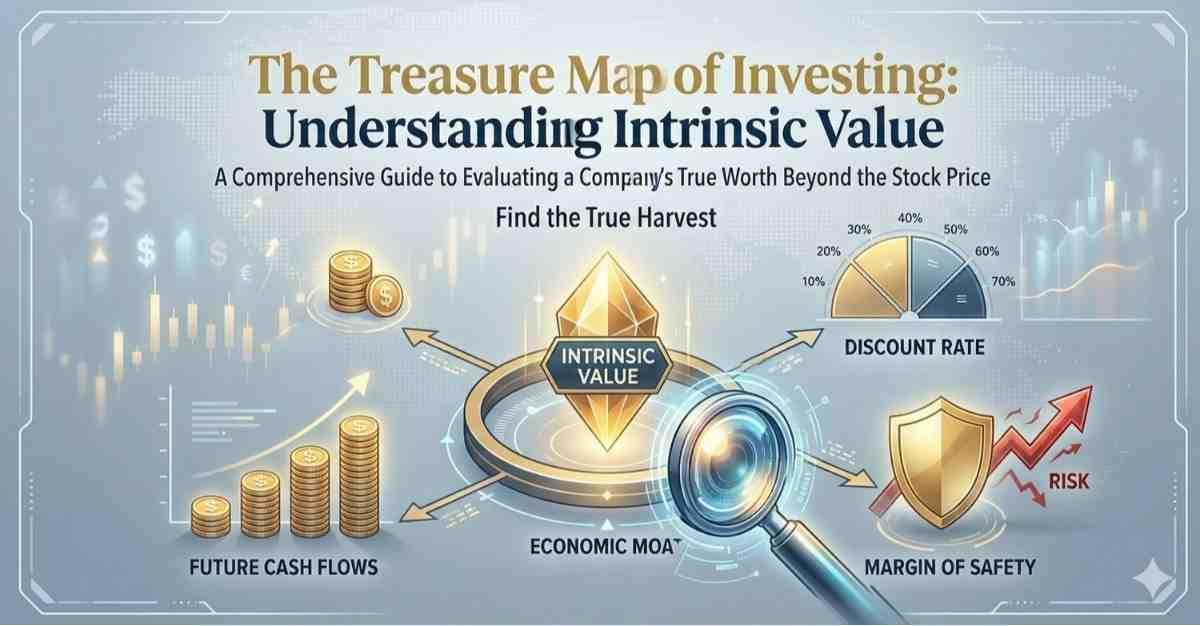
A Comprehensive Guide to Evaluating a Company’s True Worth Beyond the Stock Price
✨ Key Takeaways
Imagine you are looking to buy a small Mango Orchard in a village. The current owner has put up a "For Sale" sign with a price tag of Rs 10,00,000.
Most people passing by look at the sign and walk away. Some say, "Ten lakhs is too much for a few trees!" Others say, "It’s a fair price; the soil looks decent." But you do something different. You don't just look at the sign; you walk into the orchard with a notebook. You count the trees, check the age of the roots, and look at the past five years of harvest records.
Here is what you discover:
- The trees are young and will produce premium Alphonso mangoes for the next 20 years.
- After paying for water, fertilisers, and labour, you realise this orchard will put Rs 1,00,000 of pure profit into your pocket every single year.
- You also know that the timber from the trees and the land itself will be worth a lot in the future.
After doing some "discounting" math (realising that the profit 10 years from now is worth slightly less than profit today), you calculate that the total value of all those future mango harvests plus the land is actually Rs 15,00,000.
- The Intrinsic Value: Rs 15,00,000 (The "True Worth" based on the fruit it will produce).
- The Market Price: Rs 10,00,000 (The "Asking Price" on the sign).
In the world of the stock market, successful investing is the art of buying the "Orchard" when the owner is frustrated or tired and offers it to you for much less than the value of the fruit it will grow.
What Exactly is Intrinsic Value?
In simple terms, Intrinsic Value is the "true, inherent worth" of an asset. It is what a business is actually worth, regardless of whether the stock market is crashing or booming today.
Warren Buffett, one of the greatest investors of all time, describes it beautifully: “Intrinsic value is the discounted value of the cash that can be taken out of a business during its remaining life.”
Think of a business as a money-printing machine. If you knew for a fact that a machine would print Rs 100 every year for the next 10 years and then break down, how much would you pay for it today? You certainly wouldn't pay Rs 2,000, because you’d only get Rs 1,000 back. But would you pay Rs 1,000? Probably not, because you’d have to wait 10 years just to get your money back with zero profit.
You would want to pay something like Rs 700. That gap between what you pay (Rs 700) and what it’s worth (Rs 1,000) is where you make your money.
The Two Main Ingredients
To calculate the intrinsic value of a company, you need to look at two things:
1. Future Cash Flows (The "Gold Coins")
A company isn't just a name or a logo; it’s a living entity that generates cash. To find its value, you must estimate how much "Free Cash Flow" it will produce in the future. This is the money left over after the company pays for its electricity, staff, Taxes, and new equipment. This is the cash that actually belongs to you, the owner.
2. The Discount Rate (The "Time Factor")
This is where it gets interesting. A dollar today is worth more than a dollar five years from now. Why? Because you can take a dollar today, put it in a Bank, and earn interest.
Therefore, when we estimate that a company will earn Rs 100 in the year 2030, we have to "shrink" that value to see what it is worth in today’s money. This "shrinking" process is called Discounting. The riskier the business, the more we "discount" those future earnings.
Why Does Intrinsic Value Matter?
The stock market is like a moody roommate. Some days it is incredibly optimistic and marks prices up way too high (Overvalued). Other days, it gets scared and marks prices down way too low (Undervalued). If you only look at the Market Price, you are at the mercy of the market's mood swings. But if you understand Intrinsic Value, you have an anchor.
- Scenario A: The market price is Rs 150, but your research shows the intrinsic value is Rs 100. Action: Stay away! You are overpaying.
- Scenario B: The market price is Rs 70, but the intrinsic value is Rs 100. Action: This is an opportunity.
The "Margin of Safety"
Even the smartest analysts can’t predict the future perfectly. A company might lose a big contract, or a new competitor might arrive. Because our estimates of "Intrinsic Value" are just educated guesses, we need a cushion.
This cushion is called the Margin of Safety.
If you calculate a stock’s intrinsic value to be Rs 100, you don't buy it at Rs 95. You wait until it hits Rs 70 or Rs 60. That way, even if your math was slightly off and the value is actually only Rs 85, you still bought it at a price that guarantees a profit.
Summary: The Investor’s Job
Investing isn't about gambling on which way a candle on a chart will move tomorrow. It is about becoming a business detective.
Your job is to:
- Analyse the business to see how much cash it can generate.
- Account for risk by discounting that cash back to today.
- Compare that value to the current market price.
- Wait patiently for a "Margin of Safety" before you buy.
Intrinsic value is the North Star of fundamental research. It reminds us that behind every ticker symbol is a real business with real cash, and the secret to wealth is simply paying less for that cash than it is actually worth.
Disclaimer: The article is for informational purposes only and not investment advice.