CDMO vs CRO vs CMO: What They Mean, Which Indian Companies Play Here, and Why It Matters for Your Portfolio- Part 2
 Join Us
 Follow Us
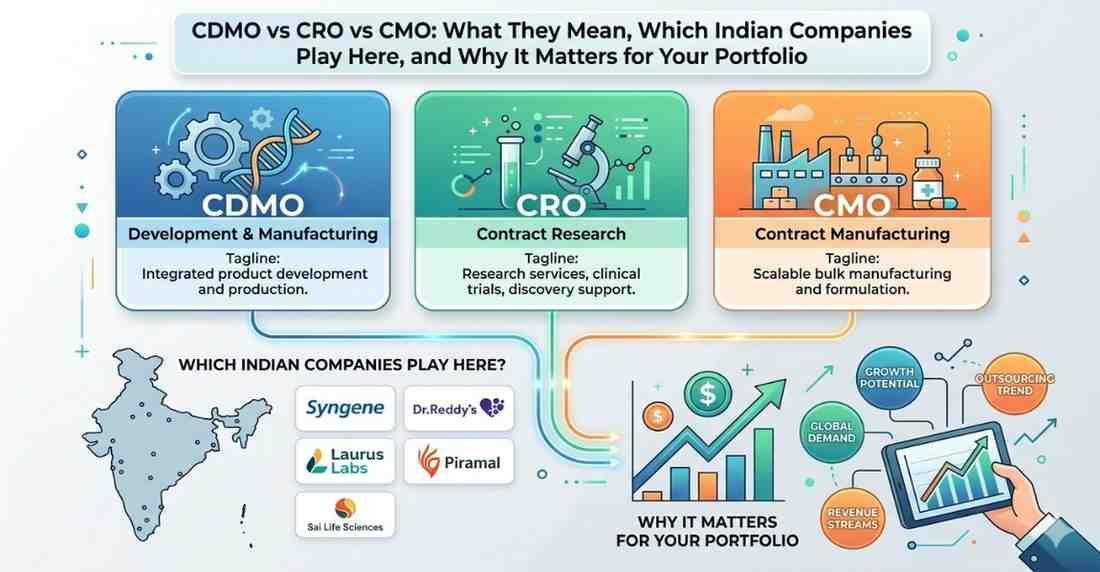
India's pharma services industry is riding a global supply chain shift away from China. Here's how to make sense of the players, the business models, and the opportunity.
✨ Key Takeaways
The Pharma Industry Has a Services Side, and It Is Growing Fast
In Part 1, we covered the companies that own their drugs innovators, generic players, specialty pharma, and API manufacturers. But there is an entirely different layer of the industry that rarely gets discussed in plain language: the companies that exist specifically to help drug makers do their job faster, cheaper, and better.
These are the contract service players CMOs, CDMOs, CROs, and CRDMOs. The terminology can feel like alphabet soup, but the underlying logic is simple. Building a drug is complicated enough. Building and running a world-class manufacturing plant or a clinical trial operation on top of that is enormously capital intensive. Many companies, especially smaller biotech firms and even large multinationals looking to reduce fixed costs, prefer to outsource parts of that work to specialists.
That outsourcing industry is where some of India's most interesting investment opportunities now sit.
CMO: The Factory for Hire
Start with the simplest model. A CMO Contract Manufacturing Organization is essentially a pharmaceutical factory that manufactures drugs for other companies. The client walks in with a finished formula, and the CMO produces it at scale. No R&D involvement, no product ownership, no marketing. Just precise, compliant, large-scale manufacturing.
The CMO owns the plant, trains the workforce, and is responsible for meeting GMP standards. The drug's intellectual property belongs entirely to the client. Think of it like contract manufacturing in any other industry the factory does not own what it produces.
Why does this model exist? Because not every pharma company wants to own a manufacturing plant. A small biotech that just got regulatory approval for its first product needs commercial-scale production immediately but it does not have the capital or the time to build a plant. A large multinational may want to free up its own plants for higher-margin work and outsource standard products. The CMO fills that gap cleanly.
Gland Pharma, which has built a focused injectable manufacturing business, is one of the more prominent CMO examples on Indian exchanges. Strides Pharma operates similarly across regulated markets.
CDMO: Earlier, Deeper, More Valuable
A CDMO does everything a CMO does but it gets involved much earlier. Rather than waiting to receive a finished formula, a CDMO works alongside the client during the development phase itself. It helps design the formulation, optimises the manufacturing process, produces material needed for clinical trials, and then scales up to full commercial volumes once the drug gets approved.
This seemingly small difference has large consequences for the quality of the business.
First, the relationship is stickier. A company that helped you figure out how to make your drug is not easily replaced when production starts. The institutional knowledge the process parameters, the scale-up quirks, the sourcing decisions lives inside the CDMO's team. Switching vendors at that stage is expensive and risky.
Second, CDMOs sit higher on the value chain. They are not just running a factory; they are contributing intellectual and scientific effort. That typically translates into better margins and longer-duration contracts compared to plain CMOs.
This is precisely why CDMO has become the most talked-about theme in Indian pharma investing over the past few years. The global push to diversify supply chains away from China driven by geopolitical concerns and COVID-era lessons has pushed multinational innovators to send more of this work to India. Divi's Laboratories, Laurus Labs, Suven Pharmaceuticals, Piramal Pharma Solutions, and Sai Life Sciences have all been direct beneficiaries of this shift.
CRO: The Science Behind the Clinical Trials
Go back even further in the drug development timeline before any manufacturing begins and you find the CRO.
A Contract Research Organization manages the research and clinical trial work that a drug must go through before it can be approved. This includes preclinical studies in labs and animals, Phase 1 trials testing safety in healthy volunteers, Phase 2 trials testing whether the drug actually works, and Phase 3 large-scale trials generating the statistical evidence regulators require. All of this produces mountains of data that must be collected, cleaned, and submitted in the right regulatory format.
A CRO's output is not a product. It is data clinical trial reports, safety filings, regulatory dossiers that the innovator company uses to apply for drug approval. In that sense, a CRO is more like a specialised scientific consulting firm than a manufacturer.
Syngene International, part of the Biocon group and one of the few listed CROs in India, has built a strong reputation serving global pharma and biotech clients. Aragen Life Sciences (formerly GVK Biosciences), VIMTA Labs, and Siro Clinpharm are other names in this space.
CRDMO: The Full-Stack Model
Some companies have gone further and built capabilities that span the entire chain research, development, and manufacturing all under one roof. The logic is compelling: if one organisation handles a drug from early synthesis all the way to commercial production, there are no handover gaps, no knowledge lost between vendors, and no coordination delays.
This integrated model is called a CRDMO Contract Research, Development and Manufacturing Organization and it is the direction several Indian players are now deliberately building toward. Syngene, for instance, has invested in proprietary platforms for biologics research and progressively added manufacturing depth. Laurus Labs has made similar moves. The ambition is not just to be a vendor but to be a long-term scientific and operational partner for global innovators.
The CRDMO model also makes strategic sense for clients. Global pharma companies managing dozens of pipeline assets would rather work with fewer, deeper relationships than manage a fragmented list of vendors across different countries.
Biosimilars: The Generics of Biological Drugs
One more category deserves its own space, because it sits at the intersection of generic pharma and advanced science. Not all drugs are small molecules synthesised from chemicals. Increasingly, some of the most important medicines in the world, cancer immunotherapies, autoimmune treatments, and insulin are biologics, produced using living cells. Copying a small molecule is difficult. Copying a biologic is a different order of challenge entirely, because the product is defined by the living-cell process used to make it. Tiny variations in conditions produce different outputs. The result can never be chemically identical to the original, only "highly similar" in structure and function.
These copies are called biosimilars. Developing one requires deep cell biology expertise, expensive bioreactor infrastructure, and clinical validation work that is far more demanding than standard generic approvals.
Biocon Biologics has built one of the most credible biosimilar franchises globally, with approved versions of trastuzumab, bevacizumab, and adalimumab among the most prescribed biologics in the world. Dr. Reddy's and Zydus also have biosimilar pipelines, though at a different scale.
Why the Services Side Now Matters as Much as the Product Side
For most of the last two decades, Indian pharma investing was largely a story about generics which companies had the best US pipeline, the cleanest compliance record, and the strongest domestic franchise. That story is not over, but it is maturing. Price erosion in US generics has been a persistent headwind, and the easy wins from first-wave molecules are largely behind the industry.
The services side CDMO, CRO, CRDMO, biosimilars offers a different kind of opportunity. Revenue is contract-backed and more predictable. Switching costs are high. Margins tend to be more durable. And India's combination of scientific talent, cost competitiveness, and English-language capability makes it genuinely attractive to global pharma companies looking to reduce China exposure.
That structural shift is not a short-term trade. It is a multi-year reorientation of where global pharma does its development and manufacturing work and Indian companies are well-placed to capture a meaningful share of it.