Understanding The Magical Power Of Compounding
 Join Us
 Follow Us
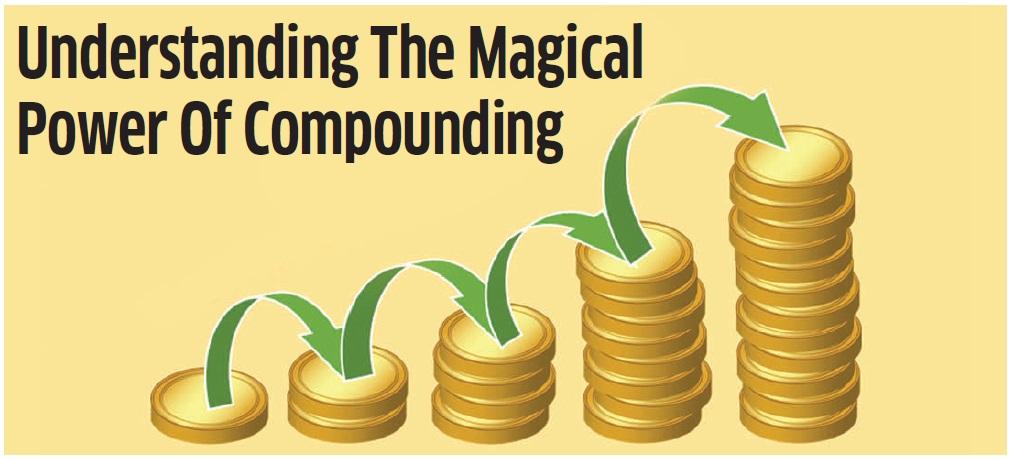
People often overlook simple and straightforward concepts, assuming they won’t lead to significant wealth, and instead, they seek out more complex strategies, particularly in the financial markets. Compounding, although simple, is a potent concept frequently forgotten during investments. Rakesh Deshmukh takes a closer look at compounding and its significance in an investment journey
✨ Key Takeaways
People often overlook simple and straightforward concepts, assuming they won’t lead to significant wealth, and instead, they seek out more complex strategies, particularly in the financial markets. Compounding, although simple, is a potent concept frequently forgotten during investments. Rakesh Deshmukh takes a closer look at compounding and its significance in an investment journey
Compounding is a term you have likely encountered not only in the financial market but also in schools or colleges. Perhaps you can recall learning how to calculate compound interest and distinguishing it from simple interest. In the context of the stock market, we often refer to compounding as a magic for investments through which investors can generate significant wealth over time by patiently holding on to their good investments. When we talk about the financial market, either regarding equity or mutual funds, and think about investing money, it’s hard not to admire Warren Buffett, an investor who is really good at it.
He has made a lot of money, running into billions, by investing smartly. He’s been doing this for a long, long time. Imagine, he started investing when he was just 10 years old! If he had waited until he was 30 to start investing, he would have had way less money, almost 100 times less than what he currently has. Now, let’s talk about another investor, Jim Simons. He is also a smart investor. In fact, he made even more money than Buffett each year for 20 years! But here’s the thing: Jim started investing when he was 50. So, even though he made a lot of money, he still has way less than Buffett.
This all goes to show the power compounding over a period when it comes to making money through investing. It’s like planting a seed early and watching it grow into a big tree over time. It was the renowned scientist and theoretical physicist Albert Einstein who said, “Compound interest is the eighth wonder of the world. He who understands it, earns it. He who doesn’t, pays it.” In his autobiography, Buffett simplifies the term, likening it to a snowball rolling down a lengthy slope, accumulating more snow and momentum with each rotation until it transforms into a colossal snowball.
As the chairman and CEO of Berkshire Hathaway, Buffett holds compound interest in high regard due to its seamless alignment with his investment philosophy. His status as one of the wealthiest individuals globally at 93 serves as a tangible testament to the success compound interest can achieve. Turning attention away from the stories of Warren Buffett and Jim Simons, let’s now delve into compounding in detail to reap its benefits in our investment journey.
All about Compounding
Compound interest is the process where the interest earned on an investment is added back to the principal amount, allowing interest to accrue on both the initial principal and the accumulated interest from previous periods. Over time, this compounding effect can significantly increase the value of the investment. Compounding is the process where an asset’s returns are reinvested in a bid to earn higher returns. This compounding effect can lead to exponential growth over time. The reinvested returns themselves start generating additional returns, creating a snowball effect. As a result, the longer you keep your money invested and reinvest the returns, the more pronounced the compounding effect becomes, potentially resulting in significant wealth accumulation.
How Compounding Works?
Compound interest operates on the principle of reinvesting earned interest, leading to exponential growth. Consider this scenario: You deposit ₹1,00,000 in a bank account earning 10 per cent interest annually. After the first year, your balance becomes ₹1,10,000, including the earned interest. In the second year, you earn interest not only on the initial ₹1,00,000 but also on the previously earned ₹10,000, totalling ₹11,000. This sum gets added to your initial investment, resulting in ₹1,21,000.
Subsequently, the cycle repeats, with each iteration generating more significant returns due to the compounding effect. However, compounding isn’t always straightforward. It may involve uneven cash flows or growth rates that fluctuate. In such cases, understanding the compounding process can prove to be a challenging task. Nonetheless, the fundamental principle remains that money generates more money, and the accumulated earnings further contribute to future growth.
Compounding in Mutual Funds
In the case of your own investment, where you buy securities, manage and sell according to your exit strategy, during the holding tenure, your holding company might announce some corporate actions, which include dividends, bonus shares and stock splits, among others. These actions either provide benefits to you in terms of cash or in terms of shares (in the case of splits or bonuses). Whatever cash benefit you earn, you reinvest it. This is essentially the ‘behind-the-scenes’ setup for your mutual fund investment.
Your role is simply to initiate the investment, whether through a lump sum or smaller periodic amounts via SIP, and to continue without interruption. The fund managers take charge from there, managing the fund by devising strategies, purchasing shares, capitalising on corporate actions, and selling when deemed necessary according to the strategy or when it is called for. When the AMC receives benefits from stocks, either through generating returns or obtaining additional benefits from corporate actions such as bonus issues, dividends, splits, and so forth, they reinvest it. This is how the fund’s NAV grows over time, consequently reflecting the growth of your investment portfolio.
The increase in NAV illustrates the compounding effects associated with investing in mutual funds. Probably you have heard these lines from your friends, colleagues, or other people: “If you had invested ₹1 lakh in that fund, it would now be valued at around ₹ 7 lakhs.” But what happens during this period? The mutual fund company doesn’t just hand you money from their bank account, right? This is where compounding comes in. At the beginning of your investment, let us assume that the fund’s NAV was ₹10 per unit. Over the investment tenure, this NAV grows as well as your investment, as we discussed in the above paragraph.
Power of Time in Compounding
One of the key factors that determine the effectiveness of compounding is time. The longer your money is allowed to compound, the greater the impact it will have on your investment. This is because compounding is not only about earning a return on your initial investment but also about earning returns on the returns that have been reinvested over time. Read the last line once again to understand it properly. Let’s illustrate this with another example. Suppose two individuals, Praveen and Gyanesh, each invest ₹10,000 in a mutual fund with an annual return of 7 per cent. Praveen starts investing at the age of 25 and continues to invest ₹10,000 annually for 10 years until he is 35. After that, he stops adding new money to his investment and lets it grow through compounding.
Gyanesh, on the other hand, waits until he is 30 to start investing ₹10,000 annually and continues to do so until he is 65. Even though both Praveen and Gyanesh invested the same amount of money, Praveen ends up with significantly more wealth at the age of 65. This is because Praveen’s investments had more time to compound, allowing his money to grow exponentially over several decades. Let’s analyse what would happen if an investor invested ₹1 lakh across different time periods, say 10 years, 15 years and 20 years ago. We will examine the returns in 10 years, 15 years and 20 years separately.

In 10 years, the investor has made around ₹486,445, representing a gain of around 386.45 per cent on an initial investment of ₹100,000. Sounds great, right? Wait for the next one.

In 15 years, the investor has crossed the significant level of ₹1 million and made around ₹11,12,267, representing a remarkable gain of around 10,12.27 per cent on his initial investment of ₹1,00,000. His investment has grown over 10 times in 15 years; earlier in 10 years, it was only around four times. Let’s move towards the last timeframe, which represents the power of time and compounding magic.

In 20 years, an investment of ₹1,00,000 has grown to ₹53,67,681, representing a gain of around 5,267 per cent. The investment has grown by around 52.67 times in 20 years. Just imagine, an investment of ₹1 lakh has grown to ₹53 lakhs! It’s incredible how time works in favour of investors, despite the ups and downs encountered in the market during this period, generating significant wealth for investors.
Tips to Maximise the Benefits of Compounding
1. Start Early — When you begin investing sooner, you give your money more time to grow. This means even small amounts can turn into big savings over time. So, start saving for things like retirement as soon as you can.
2. Stay Invested — Try not to take out your investments unless you really need to. Every time you withdraw money, you are missing out on the chance for your investment to grow more through compounding.
3. Increase Your Investments — If you can afford it, think about boosting the contribution to your investments over time. As your income grows, you can put more into your savings. This way, you will benefit even more from compounding in the long run.
Conclusion
In conclusion, compounding is like a secret weapon in the world of finance, known for its ability to turn small investments into substantial wealth over time. We have explored how it works, seen its impact through the success stories of investors like Warren Buffett and Jim Simons, and understood its significance in mutual fund investments. Compounding isn’t just about earning returns; it’s about reinvesting those returns to generate even more returns, creating a snowball effect of wealth accumulation.
The power of compounding is evident in the examples provided, where investments grow exponentially over the years, showcasing the importance of starting early and staying invested. Whether you are investing for retirement or other goals, the key is to begin as soon as possible, let your investments grow, and avoid withdrawing funds unnecessarily. By maximising the benefits of compounding through early investment, patience, and consistent contributions, individuals can secure their financial futures and achieve their long-term financial goals.
Furthermore, it doesn't demand ignorance; it simply suggests that you shouldn’t overlook evaluating your fund’s performance every day. It also doesn’t imply that you should ignore material factors that could affect your investment portfolio. Instead, it means you should filter out the noise that might unsettle you and maintain a calm approach, staying invested over time to reap the fruits of compounding. Finally, remember to start early, stay invested, and increase your contributions over time to make the most of the compounding magic.