Q4 FY26: Numbers Begin Talking
 અમારી સાથે જોડાઓ
 અમને અનુસરો
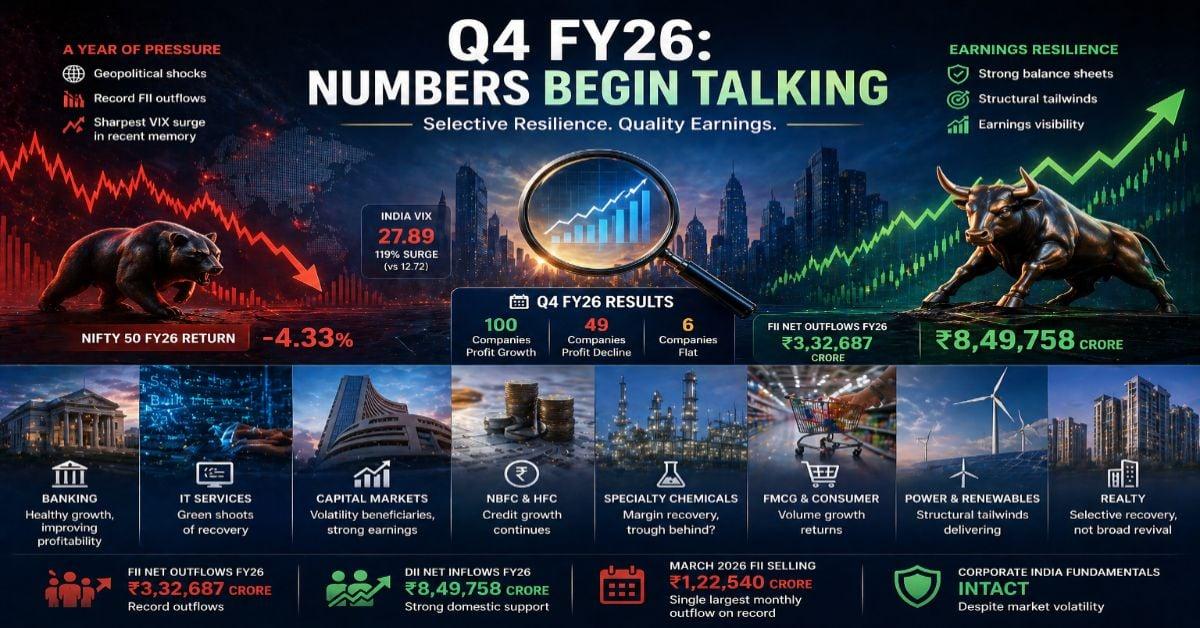
After a year defined by geopolitical shocks, record FII outflows and the sharpest VIX surge in recent memory, Q4 FY26 earnings season arrives as the first real test of whether Corporate India held its ground. Early results across banking, IT, capital markets, finance, FMCG and specialty chemicals tell a story of selective resilience, where the strong got stronger and the sectors already under pressure confirmed what markets had long feared.
✨ આઇ સંચાલિત સારાંશ
Setting the Stage: What Q4 FY26 Must Answer
Every earnings season carries a specific question that markets want answered. In Q4 FY24, the question was whether India's growth momentum could sustain amid global rate tightening. In Q4 FY25, it was whether corporate margins could hold as FII selling accelerated. Q4 FY26 carries a different and more fundamental question: after a year in which the Nifty 50 fell 4.33 per cent, the India VIX doubled and foreign investors pulled out Rs 3.32 lakh crore, what do actual corporate earnings look like beneath the noise?
The early results from Q4 FY26, representing companies across banking, financial services, capital markets, information technology, consumer goods, specialty chemicals, power, realty and several other sectors, provide the first structured answer to that question. The picture that emerges is not one of broad-based distress. It is one of meaningful divergence. Sectors that entered FY26 with clean balance sheets, structural tailwinds and earnings visibility have reported strong quarterly numbers. Sectors that were already navigating structural headwinds have seen those headwinds intensify. The market was not wrong about what it priced in. It was simply pricing it ahead of the earnings confirmation.
March Ending Results
As of the time of reporting, 156 companies have announced their Q4 FY26 results, out of which 100 companies have shown positive profit growth, 49 companies have shown degrowth in their profits and 6 companies have given flat numbers. This report analyses performance across the key sectors where multiple companies have reported, drawing out the patterns that matter most for investors assessing portfolio positioning as FY27 begins.
|
Snapshot: Q4 FY26, The Macro Backdrop |
|
Nifty 50 FY26 return: -4.33 per cent | India VIX: surged 119 per cent to 27.89 from 12.72 FII net outflows FY26: Rs 3,32,687 crore | DII net inflows FY26: Rs 8,49,758 crore March 2026 FII selling alone: Rs 1,22,540 crore, single largest monthly outflow on record Primary driver: Geopolitical stress (West Asia conflict, India-Pakistan tensions), not domestic economic deterioration Corporate India enters Q4 results season with domestic fundamentals broadly intact despite surface-level index pain |
Banking Sector: Resilience With Nuance
The banking sector enters Q4 FY26 results season as one of the most closely watched segments of the market. After PSU banks delivered the best sectoral return of FY26 at 26.61 per cent and private banks faced a difficult year with the Nifty Private Bank index falling 5.59 per cent, Q4 numbers are being read as a verdict on whether that divergence was justified.
Early results from a cross-section of private sector and public sector banks reveal a sector that is broadly healthy but navigating a more complex environment than the headline numbers of FY24 suggested.
|
Bank |
Net Revenue Q4 FY26 (Rs Cr) |
Net Revenue Q4 FY25 (Rs Cr) |
YoY Change % |
PAT Q4 FY26 (Rs Cr) |
PAT Q4 FY25 (Rs Cr) |
YoY Change % |
|
HDFC Bank |
87,182 |
86,779 |
+0.5% |
20,351 |
18,835 |
+8.0% |
|
ICICI Bank |
49,594 |
48,387 |
+2.5% |
14,755 |
13,502 |
+9.3% |
|
Axis Bank |
34,171 |
32,452 |
+5.3% |
7,603 |
7,475 |
+1.7% |
|
Yes Bank |
7,662 |
7,623 |
+0.5% |
1,082 |
745 |
+45.2% |
|
IDFC First Bank |
10,553 |
9,413 |
+12.1% |
319 |
304 |
+4.9% |
|
IndusInd Bank |
11,005 |
10,634 |
+3.5% |
594 |
-2,329 |
- |
|
Bank of Maharashtra |
7,755 |
6,731 |
+15.2% |
2,045 |
1,502 |
+36.1% |
|
DCB Bank |
1,907 |
1,742 |
+9.5% |
206 |
177 |
+16.1% |
HDFC Bank's Q4 FY26 numbers tell the story of a bank that has successfully navigated the post-merger integration phase. Revenue grew marginally at 0.5 per cent year on year, reflecting the high base of a merged entity, but PAT growth of 8 per cent signals that profitability is firming up. The bank's sheer scale, with net revenue crossing Rs 87,000 crore in a single quarter, underscores why it remains the anchor of most Large-Cap portfolios.
ICICI Bank delivered the most consistently strong numbers among large private banks. Revenue growth of 2.5 per cent and PAT growth of 9.3 per cent reflect a bank that is compounding well, with clean asset quality and improving return ratios. The bank continues to benefit from its retail franchise, diversified loan book and disciplined provisioning culture built over the last five years.
The standout performer in the banking universe this quarter was Bank of Maharashtra. The PSU bank reported PAT growth of 36.1 per cent year on year, a reflection of the broader PSU banking turnaround story that drove the sector's strong FY26 index performance. With NPA ratios at multi-year lows and credit growth supported by government-linked lending, Bank of Maharashtra exemplifies why patient investors in the PSU banking space were rewarded.
IndusInd Bank's numbers deserve special mention, though not for positive reasons. The bank reported a PAT of Rs 594 crore against a loss of Rs 2,329 crore in the preceding quarter, a statistical recovery, but one that needs to be read in the context of the serious governance and accounting concerns that had emerged earlier in FY26. Recovery is underway, but the trust deficit with investors will take more than one quarter of positive numbers to fully repair.
The overall banking picture is one of moderate revenue growth, improving profitability and broadly stable asset quality. The RBI's accommodative stance, including rate cuts and liquidity support measures, is beginning to create more headroom for credit expansion. The sector enters FY27 in structurally better shape than it has been in most of the previous decade.
Information Technology: Green Shoots After a Difficult Year
No sector absorbed more punishment in FY26 than information technology. The Nifty IT index fell 20.21 per cent, second only to realty among the major sectoral declines. The causes were well documented: global demand softness, client caution on discretionary technology spending, margin pressure and the early but real impact of AI on traditional IT services demand. Q4 FY26 results are therefore being read with unusual scrutiny. Investors want to know whether the sector has found a floor. The early data from Q4 FY26 suggests something more positive than many expected.
|
Company |
Revenue Q4 FY26 (Rs Cr) |
Revenue Q4 FY25 (Rs Cr) |
YoY % |
PAT Q4 FY26 (Rs Cr) |
PAT Q4 FY25 (Rs Cr) |
YoY % |
|
TCS |
70,698 |
64,479 |
+9.6% |
13,718 |
12,224 |
+12.2% |
|
Infosys |
46,402 |
40,925 |
+13.4% |
8,501 |
7,033 |
+20.9% |
|
HCL Technologies |
33,981 |
30,246 |
+12.3% |
4,488 |
4,307 |
+4.2% |
|
Wipro |
24,236 |
22,504 |
+7.7% |
3,502 |
3,570 |
-1.9% |
|
Tech Mahindra |
15,076 |
13,384 |
+12.6% |
1,354 |
1,167 |
+16.0% |
|
LTIMindtree |
11,292 |
9,772 |
+15.6% |
1,347 |
1,129 |
+19.3% |
|
Persistent Systems |
4,056 |
3,242 |
+25.1% |
529 |
396 |
+33.6% |
|
Oracle Fin. Services |
2,065 |
1,716 |
+20.3% |
842 |
644 |
+30.7% |
The numbers are materially better than what FY26's index performance would suggest. TCS, India's largest IT company and the bellwether for the sector, reported revenue growth of 9.6 per cent and PAT growth of 12.2 per cent year on year. This is a meaningful acceleration from the 5.3 per cent revenue growth it reported in Q4 FY25.
Infosys delivered an even stronger quarter, 13.4 per cent revenue growth and a 20.9 per cent jump in PAT, a sharp recovery from the negative PAT growth it reported in the same quarter last year. The pattern across the sector is consistent: revenue growth has re-accelerated while profitability is recovering.
Tech Mahindra, which had been among the weakest performers over the last two years, reported 12.6 per cent revenue growth and 16 per cent PAT growth, a genuine turnaround signal. LTIMindtree at 15.6 per cent revenue growth and 19.3 per cent PAT growth, Persistent Systems with 25.1 per cent revenue growth and 33.6 per cent PAT growth, and Oracle Financial Services with 20.3 per cent revenue growth and 30.7 per cent PAT growth are the standouts. Both are niche players with pricing power in their specific domains, representing the mid-tier segment that consistently delivers faster growth than large-cap peers.
The context for interpreting these numbers is important. These are year-on-year comparisons against a weak Q4 FY25 base. The base effect is flattering some of the growth rates. But the direction is unambiguous. Clients who paused discretionary technology spending through FY26 are beginning to release that spending. The AI-related work, building AI infrastructure, integrating AI into enterprise systems, training and consulting, is beginning to generate meaningful revenue for the larger IT firms that invested in AI capabilities.
The lesson from IT in Q4 FY26 is that the sector found its floor faster than the index decline suggested it would. Companies that invested in repositioning their services around AI rather than defending the old model are reporting the strongest numbers. The sector still faces structural challenges from automation, but the Q4 data confirms that a recovery is underway.
Capital Markets and Financial Services: The Volatility Beneficiaries
If there is one sector that benefits directly from elevated market volatility and rising equity participation, it is the capital markets ecosystem. FY26's spike in India VIX to 27.89 combined with record DII inflows of Rs 8.49 lakh crore created an extraordinary operating environment for brokers, asset managers, wealth managers and exchanges. Q4 FY26 results from this universe confirm that the earnings harvest from that environment has been exceptional.
|
Company |
Revenue Q4 FY26 (Rs Cr) |
Revenue Q4 FY25 (Rs Cr) |
YoY % |
PAT Q4 FY26 (Rs Cr) |
PAT Q4 FY25 (Rs Cr) |
YoY % |
|
Billionbrains (Groww) |
1,505 |
801 |
+87.9% |
686 |
309 |
+122.0% |
|
Angel One |
1,459 |
1,056 |
+38.2% |
320 |
175 |
+83.4% |
|
ICICI AMC |
1,517 |
1,269 |
+19.5% |
763 |
692 |
+10.3% |
|
HDFC AMC |
1,050 |
901 |
+16.6% |
623 |
639 |
-2.4% |
|
360 ONE |
1,115 |
821 |
+35.9% |
289 |
250 |
+15.7% |
|
Anand Rathi Wealth |
277 |
213 |
+30.0% |
102 |
72 |
+41.1% |
|
Anand Rathi Share |
255 |
199 |
+28.2% |
42 |
19 |
+125.1% |
|
CRISIL |
1,058 |
813 |
+30.1% |
233 |
160 |
+45.9% |
Billionbrains, the parent company of Groww, India's largest retail brokerage by active client count, delivered the most striking numbers in this universe. Revenue nearly doubled at 87.9 per cent year on year and PAT more than doubled at 122 per cent. This is a direct reflection of the explosion in retail equity participation that characterised FY26. The irony of the year is sharp: while FII selling drove the index lower, retail investors, many of them using platforms like Groww, created the very volumes that enriched the platforms facilitating their participation.
Angel One, at 83 per cent PAT growth, and Anand Rathi Share and Stock Brokers, at 125 per cent PAT growth, confirm the theme. The stockbroking universe had one of its strongest earnings years in recent memory, powered by high volatility, elevated trading volumes and a structural expansion in the number of demat accounts across India.
The asset management companies tell a slightly more nuanced story. ICICI AMC and HDFC AMC both grew revenues as rising AUM, driven by mark-to-market gains and consistent SIP inflows, supported fee income. However, competitive pressure on fees and the shift toward passive products are beginning to create headwinds at the margin level. HDFC AMC's PAT actually declined marginally, suggesting that even in a strong market for AUM growth, the monetisation challenge is real.
CRISIL's 45.9 per cent PAT growth reflects the broader strength in financial services activity, as credit markets remain active and corporate bond issuances continue, rating and research businesses benefit directly.
NBFC and Housing Finance: Credit Growth Continues
The non-banking financial company and housing finance universe reported a broadly positive quarter, reflecting continued credit demand, stable asset quality and improving return ratios across most players.
|
Company |
Revenue Q4 FY26 (Rs Cr) |
Revenue Q4 FY25 (Rs Cr) |
YoY % |
PAT Q4 FY26 (Rs Cr) |
PAT Q4 FY25 (Rs Cr) |
YoY % |
|
Shriram Finance |
12,513 |
11,454 |
+9.2% |
3,021 |
2,144 |
+40.9% |
|
Tata Capital |
8,160 |
7,478 |
+9.1% |
1,502 |
1,052 |
+42.8% |
|
L&T Finance |
4,771 |
4,023 |
+18.6% |
807 |
636 |
+26.9% |
|
HDB Financial Services |
4,745 |
4,266 |
+11.2% |
751 |
531 |
+41.4% |
|
PNB Housing Finance |
2,182 |
2,022 |
+7.9% |
656 |
550 |
+19.2% |
|
Can Fin Homes |
1,074 |
999 |
+7.5% |
346 |
234 |
+47.8% |
|
M&M Financial Services |
5,539 |
4,886 |
+13.4% |
938 |
457 |
+105.3% |
Shriram Finance delivered 40.9 per cent PAT growth on 9.2 per cent revenue growth, a reflection of both an expanding loan book and improving credit quality across its commercial vehicle and small business lending portfolio. Tata Capital, reporting its first full set of quarterly numbers as a listed entity, delivered 42.8 per cent PAT growth, establishing early credibility with investors.
M&M Financial Services reported a PAT more than double at 105.3 per cent year on year, the strongest growth in this cohort. The company had faced significant stress in its agricultural lending portfolio in prior quarters, and the recovery reflects both a better agricultural cycle and improved collection efficiencies. Can Fin Homes, at 47.8 per cent PAT growth, continues its steady compounding story in the affordable housing finance space.
The common thread across the NBFC universe is that credit quality has broadly held. The feared deterioration in retail and SME credit quality, driven by income stress and geopolitically linked economic uncertainty, has not materialised at scale. Gross NPA ratios across most of this universe remain within manageable ranges. This is a critical data point for the broader market: if credit quality is holding despite a difficult macro year, the risk of broader financial system stress is contained.
Specialty Chemicals: A Quiet Recovery Taking Shape
The specialty chemicals sector had a difficult FY25 and first half of FY26, characterised by weak global demand, Chinese dumping pressure and compressed margins. Q4 FY26 results suggest that the trough may be behind the sector, with several companies reporting meaningful earnings recovery.
|
Company |
Revenue Q4 FY26 (Rs Cr) |
Revenue Q4 FY25 (Rs Cr) |
YoY % |
PAT Q4 FY26 (Rs Cr) |
PAT Q4 FY25 (Rs Cr) |
YoY % |
|
Atul Ltd |
1,670 |
1,452 |
+15.0% |
210 |
127 |
+66.1% |
|
Himadri Speciality |
1,288 |
1,135 |
+13.5% |
201 |
156 |
+29.1% |
|
Supreme Petrochem |
1,587 |
1,539 |
+3.1% |
170 |
107 |
+59.2% |
|
Bhansali Engineering |
342 |
345 |
-1.0% |
52 |
40 |
+30.6% |
Atul Ltd's 66.1 per cent PAT growth on 15 per cent revenue growth is the headline number. Atul is a high-quality specialty chemicals conglomerate with diversified product lines across agrochemicals, pharmaceutical intermediates and performance chemicals. The recovery in its PAT margin suggests that raw material cost pressures are easing and product pricing is improving. Supreme Petrochem's 59.2 per cent PAT growth similarly reflects margin expansion rather than pure volume growth, a healthier and more durable form of earnings recovery.
Himadri Speciality Chemical, at 29.1 per cent PAT growth, is also notable. The company is a key player in coal tar pitch and specialty carbon materials, which are increasingly relevant to lithium-ion battery manufacturing and advanced materials for EV applications. As the EV supply chain deepens in India, Himadri's positioning becomes more strategic.
The specialty chemicals recovery is still nascent. Not every company in the sector has turned the corner, volume growth remains modest across most players. But the margin recovery data from Q4 FY26 is a genuine positive signal that the worst of the Chinese competition pressure may have passed.
Consumer and FMCG: Volume Growth Returns, But Challenges Persist
The FMCG sector endured one of its most difficult years in recent memory in FY26, with the Nifty FMCG index declining 15.06 per cent. As discussed through the year, the challenge is not simply macroeconomic, it reflects a structural shift in consumer behaviour as new-age focused brands capture premium demand that large conglomerates had assumed was theirs by default. Q4 FY26 results provide partial relief but do not fundamentally alter this narrative.
|
Company |
Revenue Q4 FY26 (Rs Cr) |
Revenue Q4 FY25 (Rs Cr) |
YoY % |
PAT Q4 FY26 (Rs Cr) |
PAT Q4 FY25 (Rs Cr) |
YoY % |
|
Nestle India |
6,748 |
5,504 |
+22.6% |
1,141 |
885 |
+28.8% |
|
Trent |
5,028 |
4,217 |
+19.2% |
400 |
318 |
+25.8% |
|
Bajaj Consumer Care |
327 |
250 |
+30.4% |
64 |
31 |
+105.3% |
|
VST Industries |
457 |
349 |
+30.9% |
117 |
53 |
+120.2% |
Nestle India's Q4 FY26 numbers are the most significant in this cohort, 22.6 per cent revenue growth and 28.8 per cent PAT growth represent the company's strongest quarterly performance in several years. The numbers reflect a combination of volume recovery, new product launches and easing input cost pressure. For a business that reported flat to declining profits through much of FY25 and early FY26, this is a meaningful turnaround signal.
Trent's 25.8 per cent PAT growth confirms that the organised retail and fashion segment is expanding strongly, driven by the formalisation of retail and Trent's own rapid store rollout strategy. Trent remains one of the most consistent growth stories in Indian consumer discretionary, and the Q4 numbers reinforce that positioning.
Bajaj Consumer Care's 105.3 per cent PAT growth and VST Industries' 120.2 per cent PAT growth are both partly base-effect driven, both companies had weak comparable quarters a year ago. But the directional recovery is genuine. It reflects that volume growth across FMCG is returning as rural income conditions improve and urban consumption finds firmer footing.
The broader FMCG challenge, competition from focused new-age brands, is not resolved by one strong quarter. But Q4 FY26 at least confirms that the underlying consumption market is healthy. The question for large FMCG companies remains one of market share, not market size.
Power and Renewables: Structural Tailwinds Delivering Earnings
The power and renewable energy sector continued its earnings momentum in Q4 FY26, reflecting India's sustained push toward grid modernisation, renewable capacity addition and energy security.
|
Company |
Revenue Q4 FY26 (Rs Cr) |
Revenue Q4 FY25 (Rs Cr) |
YoY % |
PAT Q4 FY26 (Rs Cr) |
PAT Q4 FY25 (Rs Cr) |
YoY % |
|
Adani Green Energy |
3,502 |
3,073 |
+14.0% |
469 |
301 |
+55.7% |
|
Adani Energy Solutions |
7,443 |
6,375 |
+16.8% |
684 |
647 |
+5.7% |
|
Waaree Renewables |
1,102 |
477 |
+131.3% |
156 |
97 |
+60.7% |
|
Hindustan Zinc |
13,488 |
9,041 |
+49.2% |
4,997 |
2,976 |
+67.9% |
Adani Green's 55.7 per cent PAT growth reflects the operating leverage inherent in renewable energy. As new capacity commissions and becomes operational, incremental revenue flows to the bottom line with high margins. The company added significant capacity through FY26, and the Q4 numbers are beginning to reflect that addition.
Waaree Renewables' 131 per cent revenue growth is the standout in the power universe, driven by the acceleration in Solar panel installations and the company's strong domestic and export Order Book. The renewable energy supply chain is operating at high utilisation, and Waaree, as a domestic solar manufacturing leader, is capturing that demand.
Hindustan Zinc deserves particular mention even though it sits in the metals rather than power sector. Revenue growth of 49.2 per cent and PAT growth of 67.9 per cent reflect both higher zinc prices and the company's operational efficiency. At current levels, Hindustan Zinc also carries one of the most attractive Dividend yields in the market, making it a dual proposition, earnings growth and income.
Realty: Selective Recovery, Not Broad Revival
The Nifty Realty index was FY26's worst-performing sector, falling 23.59 per cent. Q4 results from the sector suggest that the reality is more nuanced than the index decline implies; quality developers with strong execution track records continue to report solid numbers, while weaker players struggle.
|
Company |
Revenue Q4 FY26 (Rs Cr) |
Revenue Q4 FY25 (Rs Cr) |
YoY % |
PAT Q4 FY26 (Rs Cr) |
PAT Q4 FY25 (Rs Cr) |
YoY % |
|
Lodha Developers |
4,714 |
4,224 |
+11.6% |
1,008 |
922 |
+9.4% |
|
Sunteck Realty |
339 |
206 |
+64.5% |
64 |
50 |
+26.5% |
Lodha Developers maintained its consistent delivery cadence with 11.6 per cent revenue growth and 9.4 per cent PAT growth, modest but reliable numbers from one of India's largest listed Real Estate developers. Sunteck Realty's 64.5 per cent revenue surge reflects project completion and revenue recognition timing rather than a sudden demand spike. The realty sector's Q4 story is one of execution by the strong rather than recovery across the board.
Reliance Industries: A Conglomerate Navigating a Complex Quarter
No analysis of India's corporate earnings landscape is complete without examining Reliance Industries, the country's largest company by market capitalisation and a business that today spans energy, retail, digital services and media in roughly equal strategic importance. Q4 FY26 delivered a mixed but instructive set of numbers for RIL, one that reflects both the complexity of running a diversified conglomerate and the very real impact that geopolitical disruption had on its core energy business during the year.
The company posted a consolidated net profit of Rs 16,971 crore in Q4 FY26, down 12.5 per cent YoY compared to Rs 19,407 crore. On a sequential basis, profit declined 8 per cent from Rs 18,645 crore in the December quarter. Despite the fall in profit, revenue from operations rose 13 per cent year-on-year to Rs 2.98 lakh crore, supported by double-digit growth across key segments including Oil-to-Chemicals (O2C), Digital Services and Retail. Gross revenue for the quarter stood at Rs 3,25,290 crore, up 12.9 per cent year-on-year.
The decline in consolidated PAT is entirely attributable to the energy segment. The Oil and Gas exploration and production business saw revenue fall 8.9 per cent year-on-year to Rs 5,867 crore, driven by lower natural gas price realisation from the KG-D6 field and geopolitical disruptions to energy markets through the West Asia conflict. The O2C segment, while growing revenues at 12.4 per cent, supported by higher crude oil prices and domestic fuel volumes, faced margin compression from volatile feedstock costs, exactly the environment that makes energy businesses difficult to forecast in geopolitically stressed years.
The consumer-facing businesses, by contrast, performed with the consistency that has become Reliance's most important strategic asset. Jio Platforms reported that average revenue per user rose 3.8 per cent year-on-year to Rs 214, a modest but consistent improvement that reflects the gradual monetisation of India's largest telecom subscriber base. Reliance Retail grew revenues 11.1 per cent to Rs 87,344 crore, reflecting the scale and reach of India's largest organised retail network. JioStar, the combined media and streaming platform, reported Rs 9,784 crore in revenue, with PAT of Rs 420 crore.
Mukesh Ambani noted in his commentary that RIL's diversified portfolio and domestic consumption focus were precisely what helped it navigate a year of external volatility. That design was not accidental. It has been ten years in the making. FY26 was the year that design was stress-tested. It held.
Conclusion: Earnings Quality Separates the Recoveries From the Reprieves
Q4 FY26 earnings season is delivering an important message to investors who may have drawn overly pessimistic conclusions from a difficult year in the market. Corporate India's fundamentals, across the sectors that matter most to the broader economy, have held significantly better than index performance suggested.
The banking system is healthy and entering FY27 with improving profitability and stable asset quality. The IT sector is recovering not because the AI disruption challenge has gone away, but because the best companies adapted faster than markets priced. The capital markets ecosystem harvested record earnings from the very volatility that troubled equity investors. Specialty chemicals are finding their margin floor after two difficult years. Consumer demand is recovering at the volume level, even as structural competitive dynamics in FMCG remain unresolved.
What Q4 FY26 also confirms is the principle that has defined every difficult market year in India's history: earnings quality matters more than short-term price performance. The companies reporting strong Q4 numbers are, with few exceptions, the same companies that entered FY26 with clean balance sheets, genuine competitive advantages, and management teams that understood their businesses well enough to adapt when conditions changed. The companies reporting weak numbers are the ones that had hidden vulnerabilities, excessive leverage, narrative-driven valuations, or business models that required perpetual tailwinds to generate returns.
As FY27 begins, the earnings data from Q4 FY26 is the most reliable foundation available for portfolio Construction. Not index charts. Not flow data. Not geopolitical commentary. The numbers that companies have reported, the revenues, the margins, the profits, are the clearest signal of which businesses deserve capital and which ones require patience before that capital is committed. In a market that spent FY26 repricing sentiment, Q4 earnings season is beginning the process of repricing reality.
The curtain is up. The earnings season has begun. And for the first time in a year defined by noise, the signal is beginning to come through clearly.
Disclaimer: This article is for informational purposes only and not investment advice.