DMart's 40% Rally in Two Months: The Strategy Shift Nobody Saw Coming
 हमसे जुड़ें
 हमें फ़ॉलो करें
A blue-chip retail stock that was always predictable just did something unpredictable and the market is repricing it rapidly
✨ एआई संचालित सारांश
DMart is not the kind of stock that surprises you. Avenue Supermarts has spent years being the most disciplined, boring and reliable compounder in Indian retail — methodically acquiring land, constructing stores, owning the property outright and expanding at a pace that was deliberate to the point of being almost frustratingly slow. It was a 50 to 60 store per year business when everyone else was racing to grow faster.
That predictability came at a cost. The stock drifted to a 52-week low of Rs 3,528 in early March 2026 as investors questioned whether DMart's conservative expansion pace was leaving ground open for quick commerce platforms like Blinkit and Swiggy Instamart to erode its relevance in urban markets.
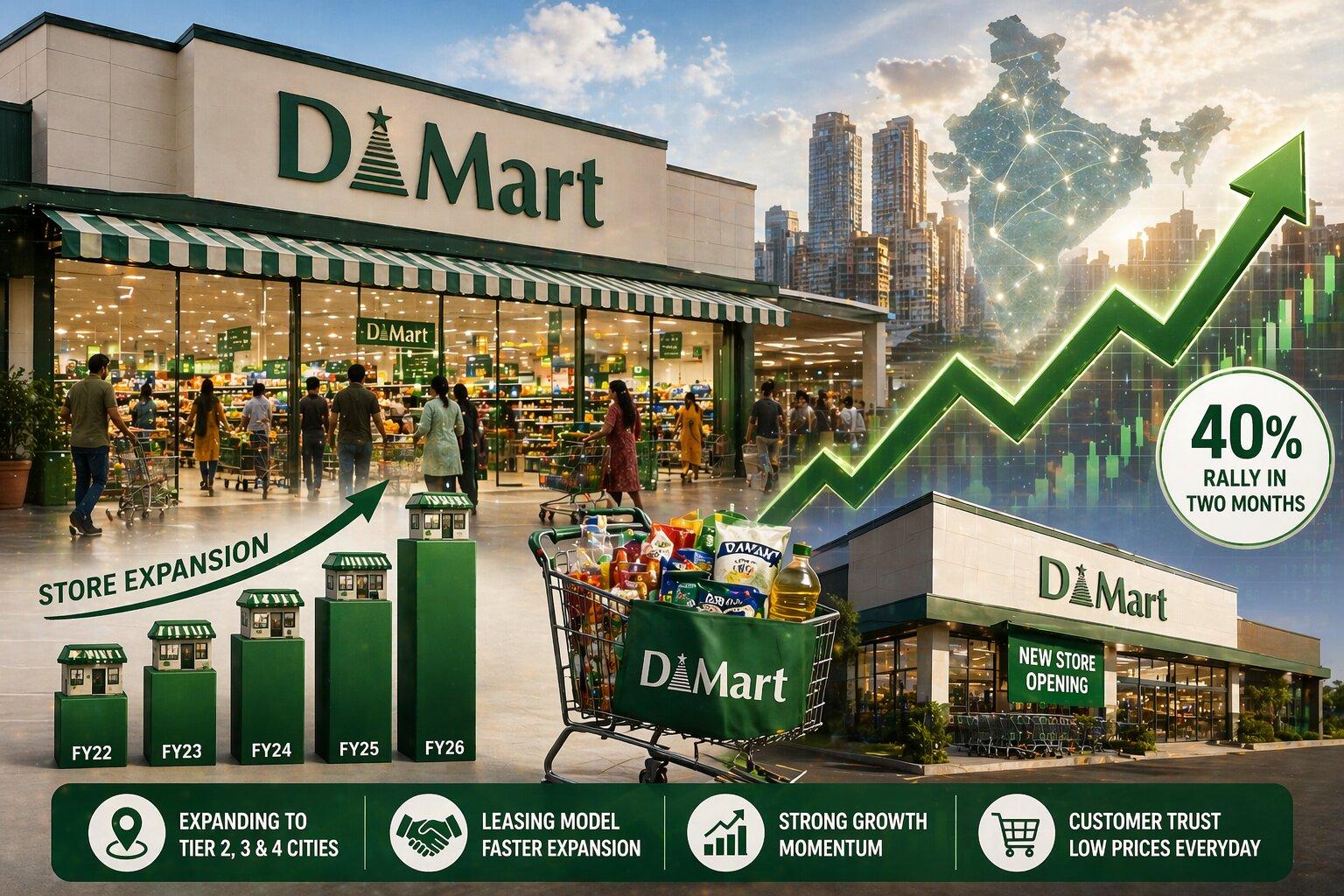
Then something changed. In approximately two months, the stock moved from that 52-week low to a 52-week high of Rs 4,916 — a 40 per cent rally. In the last one month alone, it has returned approximately 21.79 per cent. For a stock of DMart's size and stability, that is not normal. It requires explanation.
The Strategy Shift That Triggered the Re-Rating
The explanation sits in one number: 58 stores opened in Q4 FY26 alone. To understand why that is remarkable, look at the historical store addition trajectory. DMart added 284 stores cumulatively through FY22, 324 through FY23, 365 through FY24 and 415 through FY25. The company was adding roughly 40-50 stores per year on average a pace that felt measured given the deliberate land acquisition and Construction model. FY26 total store count reached approximately 500, implying around 85 stores added through the year and 58 of those came in a single quarter.
But the number of stores is only half the story. The more important shift is how those stores are being opened.
DMart's traditional model was built around ownership. The company would identify a location, acquire the land, construct the building to its own specifications and own the property outright. This gave DMart structural cost advantages — no rent escalation risk, no landlord dependency, strong balance sheet but it also meant every new store took years from concept to opening. Land acquisition alone could take multiple years in competitive urban markets.
The new approach replaces land acquisition with leasing. Several of the Q4 FY26 store additions came on leased or rented properties, including a 50,000-plus square foot store in Greater Noida at Omaxe Connaught Place. This is a fundamental change in the company's operating model, not a marginal tactical adjustment.
What Leasing Unlocks That Ownership Cannot
The shift to leasing does three things simultaneously that the ownership model could not.
First, it dramatically compresses the time between decision and opening. When you need to acquire land and construct a building, the timeline from site identification to store launch can run three to five years. When you lease an existing commercial space, that timeline collapses to months. This means DMart can now respond to market opportunities at a pace that matches or exceeds its competitors rather than always being the last player into a market because it took the longest to get there.
Second, it opens up geographies that the ownership model effectively closed off. In Tier 3 and Tier 4 towns, finding appropriately sized land parcels to purchase is difficult. But commercial retail space in these markets is available to lease. DMart can now plant its flag in smaller cities before quick commerce penetrates them and in markets where organised retail has not arrived yet, the first-mover advantage is significant. DMart has historically captured that advantage in markets it enters and held it for years.
Third, it changes the capital requirements for expansion. Building and owning stores requires heavy upfront capital deployment. Leasing requires a fraction of that capital, which means the company can fund faster expansion from operating cash flows without straining its balance sheet or requiring equity dilution. This actually improves capital efficiency even as the pace accelerates.
The CEO Transition as a Catalyst
The timing of this strategic shift is not coincidental. Neville Noronha, who had led the company for years and was the architect of the owned property model, stepped down on January 31, 2026. Anshul Asawa took over as CEO on February 1. The intensified leasing emphasis and accelerated store rollout in Q4 FY26 followed almost immediately.
This matters for how investors read the signal. A strategic pivot of this nature moving away from a model that defined the company for its entire listed history requires leadership conviction to execute. The market is reading the Q4 store additions as evidence that the new leadership is willing to move faster and differently than the old one. Whether that judgment proves correct will only become clear over multiple quarters as unit economics from leased stores are disclosed and compared to the owned-property model.
The Financial Picture Behind the Rally
Q3 FY26 revenue grew 13.1 per cent year-on-year to Rs 17,612 crore. This is a solid but not spectacular growth rate for a business of this scale. What the market is reacting to is not the current revenue it is the forward implication of a store addition trajectory that has just inflected sharply upward.
If DMart can sustain a pace of 80 to 100 store additions per year through the leasing model, the revenue growth rate over the next three to five years changes materially from what was previously priced in. Markets are forward looking instruments, and the 40 per cent rally reflects investors repricing DMart's growth potential upward from a slow and steady 10 to 12 per cent growth compounder to a business that might deliver 18 to 20 per cent revenue growth if the expansion accelerates as the store addition data suggests.
The Risks Worth Watching
The rerating is logical but not without risk. Leased stores carry structurally different economics than owned ones. Rent as a percentage of revenue will be higher, which pressures the EBITDA margins that have been one of DMart's defining competitive advantages. The company's ability to maintain pricing discipline and gross margins in leased locations particularly in smaller cities where operating leverage takes longer to build will determine whether the strategy delivers the returns the market is pricing in.
The quick commerce threat in urban markets has not disappeared. DMart's leasing push into Tier 3 and Tier 4 towns is strategically sound but it does not resolve the competitive pressure in the metros and Tier 1 cities where quick commerce is embedded in consumer behaviour.
And a 58-store quarter is impressive. But sustainability matters. One strong quarter of store additions can reflect a catch-up effect or a timing coincidence as much as a sustained capability shift. The next two to three quarters will either confirm or complicate the narrative.
The Bigger Picture
DMart's rally is a reminder that in the retail sector, strategy and leadership matter as much as the balance sheet. The company's financial discipline was never in question what was in question was whether its expansion philosophy was suited to a competitive landscape that was moving faster than it was.
The answer management has given with Q4's store count is clear. Whether the execution matches the intent is what the next chapter of this story will reveal.
Disclaimer: This article is for informational purposes only and not investment advice.