Crude Oil Grades Decoded: Why They Matter for Indian Refiners and Investors
 आमच्यासोबत जोडा
 आम्हाला फॉलो करा
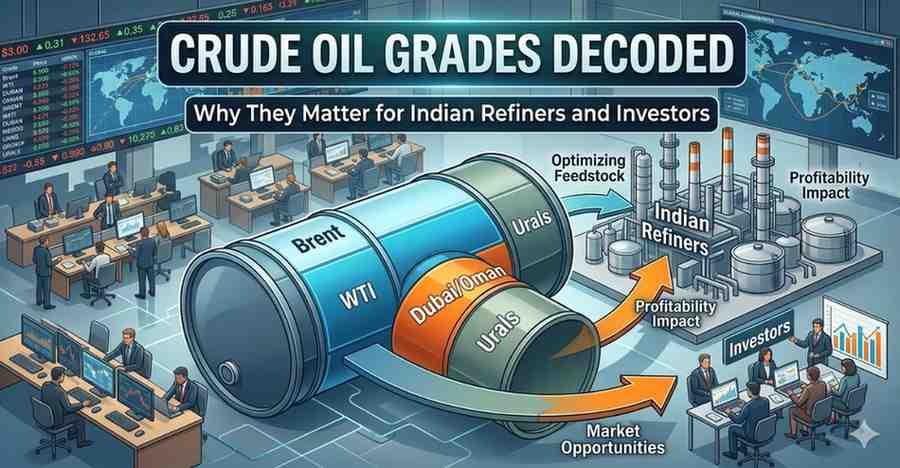
Different categories of crude oil have a direct impact on refining margins, product yield and profitability. For Indian refiners, the ability to process heavy and sour crude can become a major competitive advantage.
✨ एआय पॉवर्ड सारांश
Crude oil is not a single, uniform commodity. One barrel can be very different from another in quality, refining cost, and profitability. Broadly, crude is classified on two key parameters: density and sulphur content. Density is measured through API gravity. A higher API means light crude, while a lower API means heavy crude. Sulphur content divides crude into sweet crude and sour crude. Sweet crude has lower sulphur and is easier to refine, while sour crude contains more sulphur and needs more complex processing. In general, light sweet crude fetches a premium, while heavy sour crude trades at a discount because it is harder and costlier to process.
This distinction is crucial because the quality of crude directly affects what a refinery can produce. Light crude naturally yields more petrol, diesel and jet fuel with simpler refining. Heavy crude leaves more residue and needs advanced units such as cokers, hydrocrackers and desulphurisation facilities to extract higher-value fuels. That means the refining business is not only about crude prices, but also about refinery complexity. A more sophisticated refinery can process lower-cost crude and still produce premium fuels, improving margins.
This is where Indian refiners enter the game smartly. India’s crude basket itself shows the country’s tilt toward sour grades: the official Indian basket has historically been weighted much more toward sour crude linked to Oman and Dubai, with a smaller share of sweet crude linked to Brent. That reflects the processing pattern of Indian refineries, many of which are designed to handle Middle Eastern sour crude efficiently.
For investors, this matters because all refiners are not positioned equally. Complex refiners such as Reliance Industries, and to a large extent large public-sector players like Indian Oil, BPCL and HPCL, are better placed when discounted heavy or sour crude is available. If they can buy cheaper feedstock and convert it into high-value products, their gross refining margins can improve. On the other hand, when the discount between light and heavy crude narrows, or when sour grades become expensive, the margin advantage can be reduced. Even benchmark relationships can shift sharply depending on supply conditions, making crude sourcing a key variable for earnings.
So, for stock market readers, crude oil categories are not just technical jargon. They influence refining margins, profitability, and eventually valuations of oil marketing and refining companies. When tracking Indian refiners, investors should watch not just crude prices, but also what type of crude is becoming cheaper or costlier. In refining, the real game is not merely buying oil, it is buying the right kind of oil and having the ability to turn it into maximum value.
Disclaimer: This article is for informational purposes only and not investment advice