Amber Enterprises: The Company Behind Every AC Brand You Know And the Bigger Story Most Investors Are Missing
 எங்களுடன் சேருங்கள்
 எங்களைப் பின்தொடரவும்
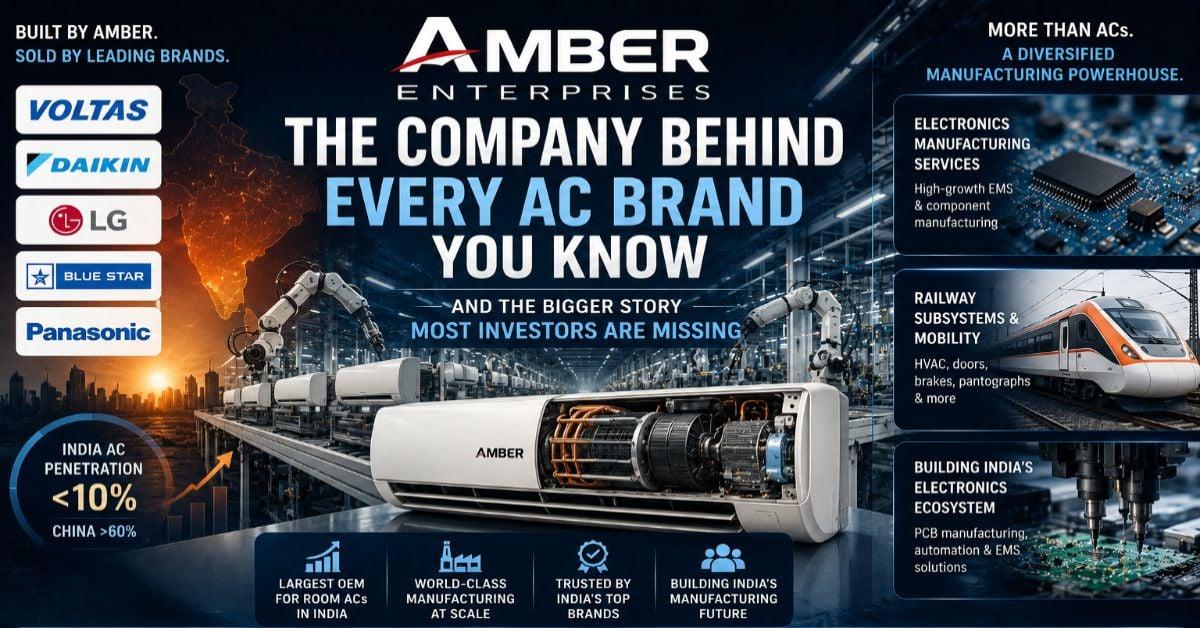
India's AC penetration is below 10 per cent while China sits above 60 per cent. The company that manufactures for Voltas, Daikin, LG and Blue Star has crossed Rs 12,000 crore in revenue for the first time. Here is the complete picture.
✨ AI இயங்கும் சுருக்கம்
Walk into any electronics store in India and you will see shelf after shelf of air conditioner brands — Voltas, Panasonic, Blue Star, Daikin, LG, Sharp. You pick a brand, negotiate a price, take it home. What almost no retail investor knows is that several of these units were not built by the brand that sold them. They were built by one company operating quietly in the background. That company is Amber Enterprises.
Amber is India's largest original equipment manufacturer for room air conditioners meaning it designs and manufactures complete AC units that are then sold under other companies' brand names. Voltas, Panasonic, Blue Star, Daikin, LG, and Sharp which began production at Amber's Dehradun and Sri City plants in March 2026 are all part of its customer portfolio. The brand takes the margin, the distribution and the customer relationship. Amber takes the manufacturing contract and the volume.
The stock currently trades at Rs 7,056, down approximately 21.3 per cent from its 52-week high of Rs 8,970. The company has just reported its strongest full-year results in its history. Understanding why the gap exists between operational performance and stock price requires looking at both the business quality and the balance sheet honestly.
The Numbers That Matter
FY26 was Amber's best year on record across every headline metric.
|
Metric |
FY25 |
FY26 |
Growth (per cent) |
|
Revenue (Rs crore) |
9973 |
12186 |
22.19 |
|
Operating EBITDA (Rs crore) |
796 |
970 |
21.86 |
|
Adjusted PAT (Rs crore) |
277 |
338 |
22.02 |
Revenue crossed Rs 12,000 crore for the first time. The consistency across all three growth rates at 22 per cent is a signal of operating leverage working as intended — revenue, EBITDA and profit growing at the same pace suggests margins are stable rather than being squeezed to drive topline.
Q4 FY26 specifically showed acceleration. Revenue of Rs 4,148 crore was the first quarter in company history to cross Rs 4,000 crore, up 10 per cent from Rs 3,754 crore in Q4 FY25. EBITDA grew 15 per cent and adjusted PAT grew 27 per cent — the PAT growth outpacing revenue growth indicates operating leverage improving sequentially even with commodity and currency pressures noted in the Consumer Durables segment.
Three Businesses, Not One
Most coverage of Amber focuses entirely on AC manufacturing. That framing missed something important two years ago and misses even more today.
The revenue breakdown for Q4 FY26 tells the story clearly. Consumer Durables — the AC and components business — contributed Rs 2,979 crore. Electronics Manufacturing Services contributed Rs 1,015 crore. Railway Subsystems and Mobility contributed Rs 153 crore. Three distinct businesses, each with different growth profiles and margin characteristics.
The Electronics Division is the fastest-growing segment and the most interesting for the medium term. Revenue grew 49 per cent year-on-year in FY26 to Rs 3,268 crore, while operating EBITDA grew 89 per cent — margins expanding from 6.9 per cent to 8.8 per cent in a single year. Management has guided approximately 40 per cent revenue growth in FY27 for this division. The acquisitions driving this — Power-One Microsystem for Solar inverters, UPS systems and EV chargers, Unitronics for industrial automation PLCs and HMIs, and Shogini Technoarts for bare PCB manufacturing are building a component manufacturing capability that sits upstream of the assembly business.
The Railway Division contributed Rs 535 crore in FY26 revenue, up 19 per cent year-on-year, with an Order Book visibility of over Rs 2,600 crore. Management guided 30 to 35 per cent revenue growth in FY27. The product portfolio here — HVAC for railways and metro systems, doors, gangways, pantographs, brakes, couplers — benefits from India's large and ongoing railway modernisation programme. The division's EBITDA margins of approximately 16.9 per cent in FY26 are the highest in the group, making it a meaningful profitability contributor despite being the smallest by revenue.
The AC Opportunity Is Structural
The India AC market was valued at approximately USD 6.15 billion in 2025 and is projected to reach USD 21.59 billion by 2034 a CAGR of approximately 15 per cent over the next decade according to IMARC Group estimates. Room ACs lead with a 48 per cent market share. Residential applications dominate at 44 per cent.
India's AC penetration today sits below 10 per cent of households. China crossed 60 per cent penetration years ago. The gap is not coincidental it reflects a combination of income levels, housing quality, climate awareness and electricity reliability that are all moving in the right direction simultaneously in India. Every incremental degree of average temperature increase, every new apartment built under PM Awas Yojana, every household crossing the income threshold that makes an AC an affordable purchase is a unit that passes through Amber's factories.
North India commands 29 per cent of the market, driven by 40 to 48 degree peak temperatures across Rajasthan, UP and Delhi-NCR. South India is the fastest-growing region, supported by tech hub expansion in Bengaluru and Hyderabad driving both commercial and residential demand. The geography of India's heat and urbanisation is Amber's long-term demand thesis.
The Competition Worth Watching
Amber is not alone in this space. Epack Durable is the second-largest original design manufacturer of room ACs in India, supplying components and full units to white-goods companies. The existence of a credible second player matters for how brands manage vendor concentration risk and negotiate pricing — Amber's market leadership position is real, but competition from Epack means the pricing environment for OEM manufacturing services has natural pressure from alternatives.
The Balance Sheet and the Questions It Raises
FY26 was an aggressive year for capital deployment. Net cash from investing activities was negative Rs 3,074 crore — more than three times the FY25 level of negative Rs 953 crore. This reflects the acquisitions and facility expansions simultaneously underway: the Ascent-K Circuit JV with Korea Circuit for HDI PCB manufacturing with Rs 3,200 crore planned investment, the Ascent Circuits expansion at Hosur with trial production expected by September-October 2026, the 100-acre land allotment secured at YEIDA near Jewar Airport, and the PCB assembly expansion in Pune.
This level of investment was funded by raising Rs 1,000 crore through a Qualified Institutions Placement at the Amber level and Rs 1,750 crore raised by ILJIN Electronics from marquee investors — bringing Rs 2,750 crore of fresh equity capital into the group in FY26. Total equity on the balance sheet expanded from Rs 2,310 crore in March 2025 to Rs 5,802 crore in March 2026 — a reflection of both the capital raise and goodwill from acquisitions.
The working capital cycle stretched meaningfully — from 9 days in March 2025 to 29 days in March 2026. Management attributed this to proactive inventory positioning amid supply chain disruptions from geopolitical uncertainty. Net cash from operating activities fell from Rs 711 crore in FY25 to Rs 240 crore in FY26. This is the tension point that explains part of the stock's 21 per cent correction from its peak — the operational performance is strong but the capital intensity and working capital expansion are absorbing the cash being generated.
The Transition Amber Is Making
The most important strategic observation about Amber is not its current numbers but what it is trying to become. In FY18, 72 per cent of the Consumer Durables division revenue came from complete AC units the assembled, branded product. In FY26, that has fallen to 47 per cent. The company has deliberately diversified toward components, sub-assemblies and adjacent segments because components carry higher margins and create deeper customer relationships than pure assembly contracts.
The Electronics Division's move into bare PCB manufacturing — through Ascent Circuits, Shogini Technoarts and the Ascent-K Circuit JV with Korea Circuit — is the most capital-intensive version of this strategy. HDI PCBs are among the most technically complex PCBs manufactured globally, used in smartphones, automotive electronics and Defence applications. India currently imports virtually all of its HDI PCB requirement. If Amber executes successfully at Jewar, it becomes one of the first meaningful domestic producers of a component that every electronics manufacturer in India currently imports.
That transition from AC contract manufacturer to diversified electronics and manufacturing platform is what the current capital programme is funding. The payoff timeline is FY27-28 for most of the new capacity coming online.
The business is stronger than it was three years ago, broader than its branding suggests and sitting in a demand environment that is structurally favourable across all three of its segments. The stock sitting 21 per cent below its 52-week high reflects the market's impatience with the transition cost rather than a verdict on the destination.
Disclaimer: This article is for informational purposes only and not investment advice.