Six Listed Manpower Services Companies Generate Rs 49,100 Crore Revenue, Trade at Just 0.3x Sales
 எங்களுடன் சேருங்கள்
 எங்களைப் பின்தொடரவும்

Together, these companies generate annual revenue of about Rs 49,100 crore, while their combined market capitalisation is roughly Rs 14,700 crore. That works out to only about 0.3 times sales.
✨ முக்கிய குறிப்புகள்
India’s outsourced manpower industry is large, essential to day-to-day business operations and still valued conservatively by the market. Some of the key listed companies in the space are Quess Corp, TeamLease Services, SIS, Updater Services, Innovision and ANI Integrated Services. Together, these companies generate annual revenue of about Rs 49,100 crore, while their combined market capitalisation is roughly Rs 14,700 crore. That works out to only about 0.3 times sales.
The sector, however, is far from uniform. It covers everything from large-scale general staffing to security services, facility management, toll operations and specialised engineering manpower. This distinction is important because some of the smaller, more focused companies are growing at a pace comparable with, and in some cases faster than, the established leaders.
The broader industry is being supported by three structural trends. Companies are increasingly outsourcing non-core roles to formal staffing providers. Stricter labour compliance is pushing business away from informal contractors towards organised players. At the same time, India’s investment cycle in infrastructure, energy and manufacturing is creating demand not only for manpower, but also for trained engineers, technicians and field crews.
Different Models, Same Structural Opportunity
Each of the major listed players has built its business around a different part of the workforce market.
Quess Corp is one of India’s largest staffing companies and ranks among the world’s top five by headcount, serving more than 3,000 clients. TeamLease Services follows a similar general-staffing model, with about 92 per cent of revenue coming from staffing, alongside its NETAP degree-apprenticeship programme.
In security and facility management, SIS is the largest company by revenue, with operations across India, Australia, New Zealand and Singapore. Updater Services is India’s second-largest outsourced facility management company and employs more than 76,000 people. Innovision, which listed in March 2026, combines security and facility management with NHAI toll plaza operations and skill-training services.
ANI Integrated Services, meanwhile, operates in a more specialised part of the market. Its business depends more on technical capability than sheer headcount. The company supplies engineers and technicians for electrical and instrumentation projects, plant operations and maintenance, shutdowns and commissioning assignments. Its workforce of more than 7,500 people serves over 150 industrial clients across oil and gas, refineries, power, renewables, data centres and Semiconductor plants in more than 20 countries. The business traces its roots to 1989.
This gives the industry two distinct growth engines. The large staffing companies benefit from the formalisation of employment, while specialised players such as ANI are more closely linked to capital expenditure in energy, infrastructure and manufacturing.
Revenue Growth
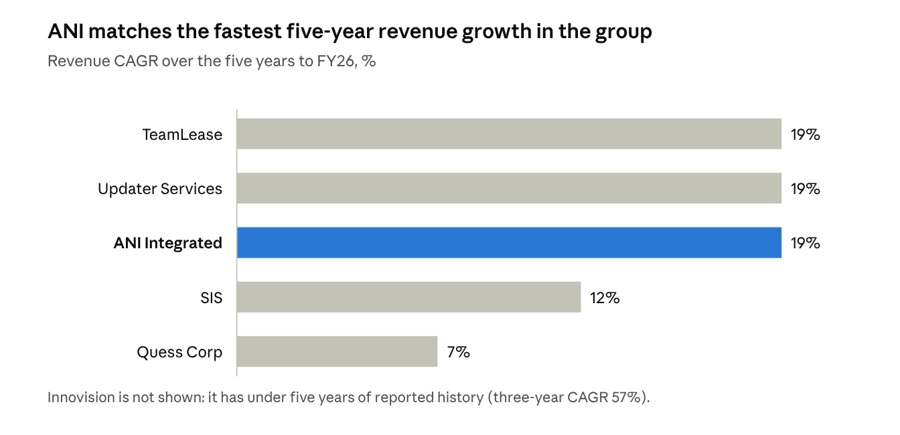
ANI standalone; others consolidated
Over a ten-year period, ANI has recorded annual revenue growth of around 20 per cent, the highest among the companies with a comparable operating history. This compares with about 17 per cent for TeamLease, 16 per cent for Quess Corp and 15 per cent for SIS.
ANI’s revenue has also increased every year since FY21, rising from Rs 102 crore to Rs 240 crore in FY26.
Recent Order Wins and Contract Visibility
Recent contract wins across the sector suggest that organised manpower providers continue to gain business from both government and private-sector clients.
| Date | Player | Client | Order | Value |
|---|---|---|---|---|
| Sep 2026 | Innovision | NHAI | Two toll plaza mandates in Madhya Pradesh | Rs 244 crore |
| Sep 2026 | ANI Integrated | ONGC Petro additions (OPaL) | Three-year contract for E&I maintenance engineers at the Dahej petrochemical complex | Rs 2.16 crore |
| Jul 2026 | ANI Integrated | Reliance Industries | Five-year O&M manpower contract from July 2026 to June 2031 | Rs 25.33 crore |
Both of ANI’s recent wins are multi-year contracts with large refining and petrochemical companies. The Reliance Industries contract is worth about Rs 5 crore of revenue annually over five years.
Under the OPaL order announced on September 1, 2026, ANI will deploy qualified engineers in rotational shifts for electrical and instrumentation maintenance at the Dahej petrochemical complex. The plant operates continuously, making the requirement recurring in nature. Managing Director Navin Korpe said the order strengthens ANI’s position in oil, gas and petrochemicals and could support similar opportunities as industrial investment expands.
ANI Integrated’s Q1 FY27 Performance
ANI’s Q1 FY27 results show continued growth in its core recurring segments. Consolidated revenue rose 3.8 per cent year-on-year to Rs 61.2 crore.
| Segment (Rs crore) | Q1 FY27 | Q1 FY26 | Change |
|---|---|---|---|
| Deputation of manpower: revenue | 39.86 | 35.98 | 10.8 per cent |
| Operation & maintenance: revenue | 9.56 | 8.57 | 11.5 per cent |
| Deputation of manpower: segment profit | 5.72 | 5.48 | 4.4 per cent |
| Operation & maintenance: segment profit | 1.06 | 0.09 | More than 11 times |
Manpower deputation and O&M together accounted for about 81 per cent of consolidated revenue in Q1 FY27, compared with about 76 per cent a year earlier. These are recurring, contract-driven businesses and provide greater revenue visibility than project-based assignments.
ANI is also expanding its presence outside India, including operations in the Middle East and South America. Management expects these markets to contribute more meaningfully as the business scales. With more than 150 industrial clients and a presence in over 20 countries, the company has built a wider international footprint than its size might suggest.
Shareholders also approved a 1:1 Bonus issue and a Rs 0.50 per share Dividend at the AGM held on September 26, 2026.
Margin Profile Across the Sector
Manpower services are fundamentally a high-volume, low-margin business. Operating margins across the peer group remained in single digits in FY26, ranging from about 1.3 per cent at TeamLease to around 6 per cent at Innovision.
Specialised manpower can earn better margins because contracts require technical expertise and are often harder to replace. In FY25, ANI’s operating margin of 4.9 per cent was more than twice that of Quess Corp at 2.1 per cent, SIS at 2.3 per cent and TeamLease at 1.2 per cent. It was also broadly comparable with Updater Services and Innovision.
Even in FY26, when ANI’s operating margin moderated to 2.3 per cent, it remained above the levels reported by the two large staffing companies.
For specialist players, the path to better profitability lies in securing larger, longer-duration contracts where technical capability carries more weight. ANI’s recent multi-year wins with Reliance Industries and OPaL fit that model.
Valuation Comparison
The entire peer group trades at well below one times sales, although valuation differs considerably depending on scale, balance-sheet strength and return ratios.
| Company | Market cap (Rs Cr) | Price/Book (x) | Market cap/Sales (x) | Dividend yield |
|---|---|---|---|---|
| SIS | 5,835 | 2.3 | 0.34 | 1.70 per cent |
| Quess Corp | 5,022 | 4.3 | 0.32 | 2.38 per cent |
| TeamLease | 1,802 | 1.90 | 0.15 | 0.00 per cent |
| Updater Services | 1,396 | 1.33 | 0.46 | 0.48 per cent |
| Innovision | 602 | 2.05 | 0.59 | 0.00 per cent |
| ANI Integrated | 78 | 0.94 | 0.30 | 0.75 per cent |
TeamLease trades at the lowest market-cap-to-sales multiple in the group, while ANI is the only company trading below one times book value. Quess Corp, in contrast, commands the highest price-to-book multiple among these peers.
Promoter Holding and Borrowings
Most companies in the sector operate with relatively light balance sheets, although borrowing levels vary significantly. Promoter ownership also remains high across several of the smaller companies.
| Company | Promoter holding | Borrowings, FY26 (Rs Cr) | Recent development |
|---|---|---|---|
| ANI Integrated | 74.98 per cent | 18 | 1:1 bonus issue and Rs 0.50 per share dividend approved in Sep 2026 |
| Innovision | 74.17 per cent | 125 | Won two NHAI toll contracts worth Rs 243.60 crore in Sep 2026 |
| SIS | 71.86 per cent | 1,789 | Share buyback under way; CRISIL reaffirmed ratings and revised outlook to Positive |
| Updater Services | 59.09 per cent | 45 | ICRA reaffirmed AA- (Stable) and A1+ ratings for Rs 214 crore facilities |
| Quess Corp | 56.82 per cent | 124 | FY26 final dividend of Rs 3 per share paid following AGM approval |
| TeamLease | 33.29 per cent | 116 | Exited Crystal HR joint venture, ending its 30 per cent stake |
ANI’s promoters hold nearly 75 per cent of the company, the highest ownership level among the peers considered here. At the same time, borrowings have declined from Rs 24 crore in FY24 to Rs 18 crore in FY26.
Updater Services also carries relatively low debt, while SIS has the largest absolute borrowing in the group, though its credit profile has improved following CRISIL’s decision to revise the outlook to Positive.
Working-capital efficiency differs across business models. Payroll-led staffing companies generally convert receivables faster, with TeamLease reporting debtor days of 17 and Quess Corp 38. For specialised contractors, where assignments are often tied to project schedules and industrial clients, collections can take longer.
Taken together, the sector offers investors exposure to two linked trends: the formalisation of India’s workforce and the rise in industrial and infrastructure spending. The larger companies offer scale and diversification, while smaller specialists such as ANI bring higher promoter ownership, niche technical capabilities and exposure to multi-year industrial contracts. The valuation gap across the group reflects those differences, but it also shows that the market continues to price manpower services at modest multiples despite steady demand and expanding Order Books.
Disclaimer: The article is for informational purposes only and not investment advice.