Why Do Stocks Fall Even After Strong Quarterly Results?
 எங்களுடன் சேருங்கள்
 எங்களைப் பின்தொடரவும்

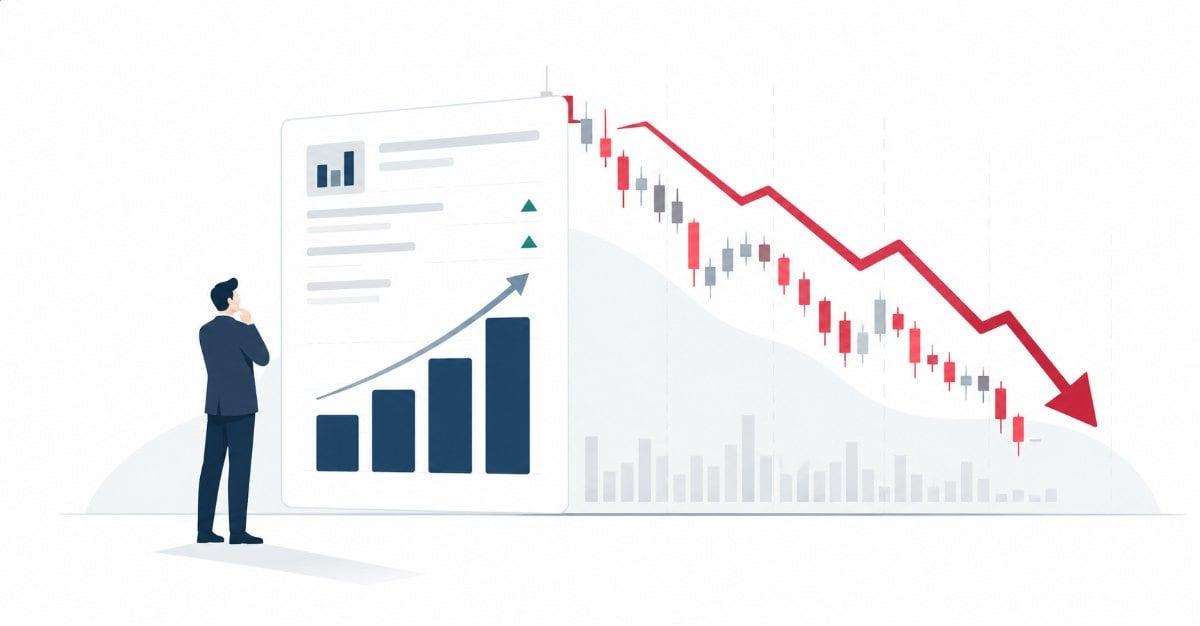
Strong earnings do not guarantee a rising share price. Here is how expectations, valuations and the quality of profits influence market reactions.
✨ முக்கிய குறிப்புகள்
A company announces record revenue and a sharp increase in profit. Yet its share price falls the following day. The reaction seems puzzling until we recognise that markets consider not only reported earnings but also prior expectations and future prospects.
To understand why stocks fall after strong Quarterly Results, investors must look beyond headline profit growth.
1. Strong Results May Still Fall Short of Expectations
Suppose a company's quarterly profit rises from ₹100 crore to ₹150 crore, or 50 per cent. But investors had expected ₹175 crore. Strong historical growth has still disappointed expectations.
Share prices incorporate forecasts before results appear. The gap between expected and actual performance can therefore matter more in the short term than the growth rate itself.
2. Good News May Already Be Reflected in the Share Price
A stock that rallies ahead of results may already reflect optimism. If earnings merely confirm expectations, there may be little fresh information to justify another rise.
Traders may also book profits after the announcement. This 'buy the rumour, sell the news' reaction is possible, not inevitable.
Pre-results price movements provide useful context. Investors can compare the movement with changes in earnings forecasts, rather than assuming the market reacted only to the announcement. A stock that has already doubled may need far more than an ordinary earnings beat to sustain its valuation.
3. Management's Future Outlook May Disappoint
Quarterly statements describe the past; share prices reflect anticipated future earnings and cash flows. Management may report slowing demand, rising costs, deferred orders or reduced revenue and margin guidance.
Such warnings can outweigh strong historical numbers because investors care about whether growth is sustainable.
4. Profit Growth May Not Reflect Operating Strength
Profit can rise through exceptional income, asset sales, Tax benefits or other non-recurring items.
For example, a company could report a 40 per cent increase in net profit while its operating profit remains nearly unchanged. If much of the improvement came from a one-time gain, investors may question whether similar growth is possible in subsequent quarters.
This is why earnings quality matters. Comparing operating profit, other income, tax expenses and operating cash flow helps distinguish recurring performance from temporary benefits. If profits increase while trade receivables rise rapidly and operating cash flow weakens, investors may question how quickly reported sales are turning into cash. Such a mismatch deserves investigation, although seasonal working-capital requirements may offer a reasonable explanation.
5. Margins May Weaken Despite Higher Sales
Revenue growth tells only part of the story. Rising raw material, labour or Logistics costs can reduce profit earned per rupee of sales.
Suppose revenue grows 20 per cent while operating profit grows only 5 per cent. The weaker growth in operating profit suggests margin pressure. Investors may worry that this trend will continue, even if the company reports its highest-ever quarterly revenue.
Strong results in one division can also conceal weakness elsewhere.
6. Expensive Valuations Leave Less Room for Disappointment
Identical earnings growth can provoke different reactions at different valuations.
A high price-to-earnings (PE) ratio often reflects ambitious expectations. Signs of slowing growth may lead investors to pay a lower multiple.
For instance, a company's profit could continue rising while its share price falls because the market assigns a lower PE ratio to its future earnings. This process is called valuation derating. It does not necessarily mean the business has become unprofitable. A declining PE multiple can more than offset a rise in earnings per share, especially when expectations were unusually optimistic. Investors should separate a change in business fundamentals from a change in the price paid for those fundamentals.
7. Broader Market Conditions Can Influence the Reaction
A market correction, rising interest rates or institutional selling can hurt a stock despite healthy results. Investors may also reduce industry exposure over regulation, commodity prices or global demand.
Price movements alone cannot establish which factor caused a decline. The timing of other market developments also matters.
What Should Investors Check After the Results?
Instead of interpreting a falling share price as proof of weak results, investors can review five questions:
- Did revenue and profit meet the expectations implied by forecasts and the earlier share-price rally?
- Were operating margins improving or deteriorating?
- Did recurring operations or one-time items drive the profit increase?
- What did management say about demand, costs, capacity and future growth?
- Is the valuation reasonable relative to the company's prospects and risks?
Comparing multiple quarters and cash flows provides valuable perspective.
Conclusion
A good quarter and a rising share price are not the same thing. Markets respond to the difference between expectations and reality, the sustainability of earnings and the price investors are willing to pay for future growth.
When stocks fall after strong quarterly results, the useful question is not merely why the price declined. It is whether the announcement changed the company's long-term business outlook or simply failed to match the optimism already built into its valuation.