A Beginner’s Guide to Index Funds and ETFs in India
 Join Us
 Follow Us
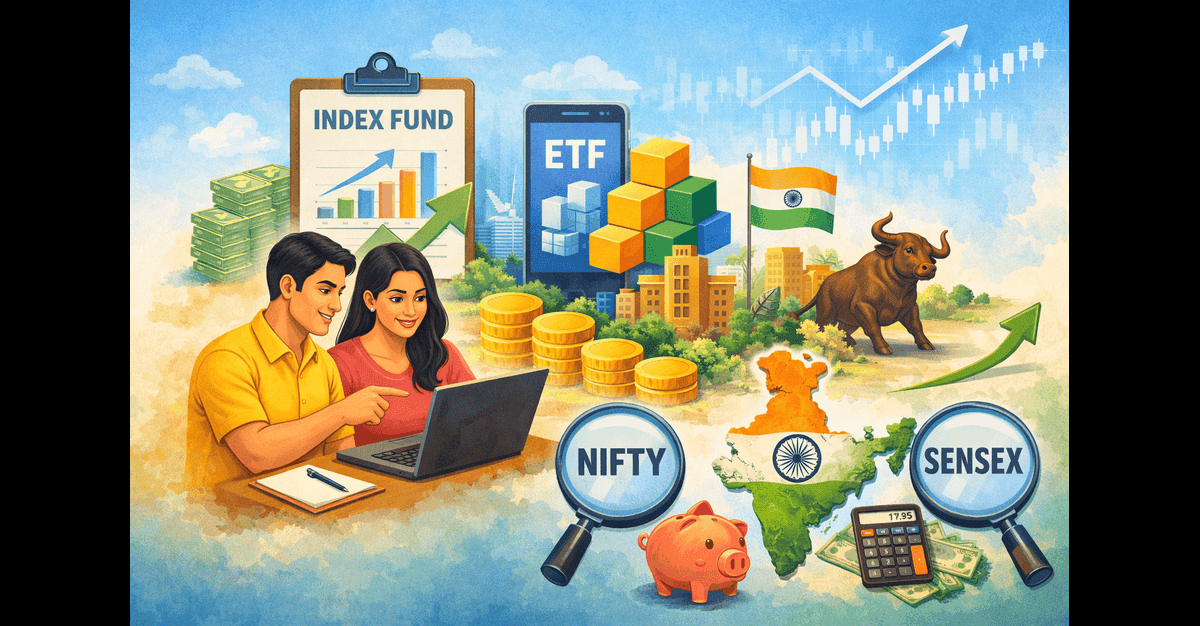
Index Funds: The Ultimate "Set It and Forget It" Investment
✨ Key Takeaways
If you’ve ever felt overwhelmed by the thousands of stocks listed on the NSE (National Stock Exchange) or BSE (Bombay Stock Exchange), you aren’t alone. Deciding whether to buy Reliance, HDFC Bank, or Infosys requires deep research.
But what if you could buy a 'basket' that contains all of them in one go? That is exactly what Index Funds and ETFs allow you to do.
What is an 'Index'?
Before we dive into the funds, you must understand the 'Index'. In India, the two most famous indices are the Nifty 50 and the Sensex.
* The Nifty 50 represents the 50 largest, most liquid companies in India.
* The Sensex represents the top 30.
Think of an index as a 'Sample Platter' at a restaurant. Instead of ordering every dish individually, the platter gives you a little bit of everything that the restaurant is famous for.
1. Index Funds: The 'Set it and Forget it' Tool
An Index Fund is a type of Mutual Fund that mimics a specific index. If you invest in a 'Nifty 50 Index Fund', the fund manager will take your money and buy all 50 stocks of the Nifty in the exact same proportion as they exist in the index.
How it works (Example):
Imagine the Nifty 50 is made of just two companies, Company A (60 per cent) and Company B (40 per cent). If you invest Rs 1,000 in an Index Fund, the fund manager automatically puts Rs 600 into Company A and Rs 400 into Company B. You don’t have to do anything.
Why Beginners Love Index Funds:
* SIP Friendly: You can start a Systematic Investment Plan (SIP) with as little as Rs 500 per month. It gets deducted from your bank account automatically.
* No Demat Required: You can buy these directly through a mutual fund app or the AMC (Asset Management Company) website.
* Simple Pricing: You get one price at the end of the day, called the NAV (Net Asset Value).
2. ETFs: The 'Stock-Like' Mutual Fund
ETF stands for Exchange-Traded Fund. Like an index fund, it also tracks an index (like the Nifty 50). However, the 'Exchange-Traded' part is the secret sauce, it trades on the stock market just like a regular share of Reliance or TCS.
How it works (Example):
If you want to buy the Nifty 50 at 11:30 AM because you see the market is dipping, you can buy a 'Nifty BeES' (a popular ETF) instantly through your broker. Its price changes every second during market hours.
Why Investors Choose ETFs:
* Real-Time Trading: You can buy and sell anytime between 9:15 AM and 3:30 PM.
* Lower Costs: ETFs generally have a lower 'Expense Ratio' (the fee you pay the fund house) than index funds.
* Flexibility: If you already have a Demat account for stocks, adding an ETF is seamless.
Which One is Right for You?
Choose an Index Fund if:
* You want a disciplined, automatic monthly SIP.
* You don't want to track the stock market every day.
* You prefer simplicity and don't want the hassle of a Demat account.
Choose an ETF if:
* You already have a Demat account and enjoy buying stocks.
* You want the lowest possible fees (Expense Ratios can be as low as 0.04 per cent).
* You want to 'buy the dip' instantly during a market crash.
Disclaimer: The article is for informational purposes only and not investment advice.