Real Rate of Return: What It Is, How to Calculate It, and Why It Matters for Investors
 Join Us
 Follow Us
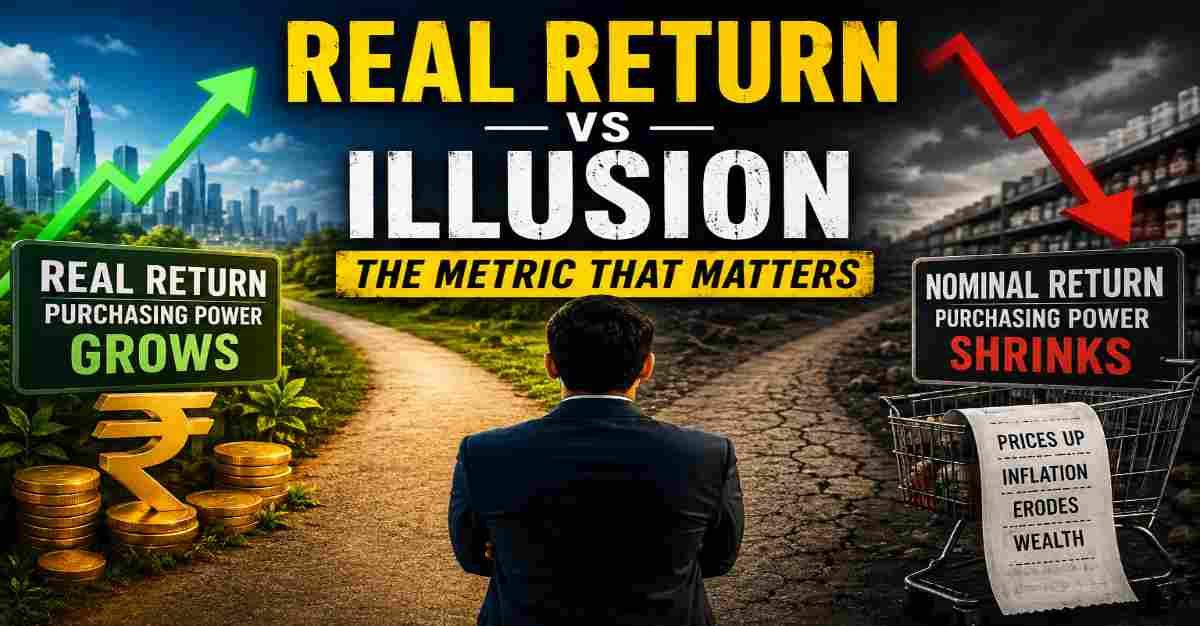
Most investors track returns. Few track real returns. The real rate of return adjusts for inflation, showing how much your investment truly grew in purchasing power rather than just on paper. Whether you are comparing fixed deposits, mutual funds, or equities, this single metric can transform how you evaluate your investments.
✨ Key Takeaways
The Metric That Separates Genuine Wealth Growth From Illusion
When you invest, the number on your account statement rarely tells the whole story. A 7 per cent return sounds impressive until you realize inflation quietly eroded most of it. This is where the real rate of return becomes essential. It cuts through the noise and tells you how much your investment actually grew in terms of purchasing power.
What Is the Real Rate of Return?
The real rate of return is the annual profit on an investment after adjusting for inflation. While the nominal rate of return shows the percentage increase in your investment's value, the real rate reveals how much your money truly grew in terms of what you can buy with it.
This distinction matters because rising prices reduce the value of money over time. An investment that grows 6 per cent while inflation runs at 5 per cent has barely moved the needle for your actual wealth.

A Practical Example
Suppose you invest Rs 50,000 in a savings account offering a nominal interest rate of 7 per cent, and the annual inflation rate is 4 per cent.

Even though your account grew by Rs 3,500 nominally, your actual increase in purchasing power was only about 2.88 per cent. You cannot buy 7 per cent more goods and services with that money. You can buy roughly 2.88 per cent more.
Nominal vs. Real: Why the Gap Matters
The nominal rate of return ignores inflation entirely. It tells you how your portfolio moved in rupee terms. The real rate of return tells you whether your standard of living actually improved.
Consider a simpler comparison. If your savings account pays 3 per cent and inflation is running at 2 per cent, your real return is approximately 1 per cent. Your money is growing, but slowly. Now imagine inflation jumps to 3.5 per cent while your rate stays at 3 per cent. Your real return turns negative, meaning your wealth is quietly shrinking even as your balance grows.
This scenario played out in the late 1970s and early 1980s globally, when double-digit inflation made high nominal interest rates on savings accounts look attractive on the surface. In reality, depositors were losing purchasing power every year.
Why Every Investor Should Track This Metric
The real rate of return matters for four key reasons:
- Accurate performance measurement -- it reflects genuine investment growth, not just the effect of a rising price level
- Smarter financial planning -- knowing your real return helps you calculate how much you actually need to save for retirement, education, or any long-term goal
- Better portfolio decisions -- if an asset consistently delivers negative real returns, it is destroying wealth regardless of how the nominal figure looks
- Fair comparison across options -- comparing a fixed deposit, equity fund, and real estate investment is only meaningful when all three are evaluated on the same inflation-adjusted basis
The Takeaway
Nominal returns are what Banks and fund houses advertise. Real returns are what you actually keep. For long-term investors, the gap between the two can be the difference between building genuine wealth and merely keeping pace with rising prices.
The next time you evaluate an investment, ask not just "what is the return?" but "what is the return after inflation?" That single question can sharpen your decision-making and keep your portfolio aligned with where you actually want to go financially.