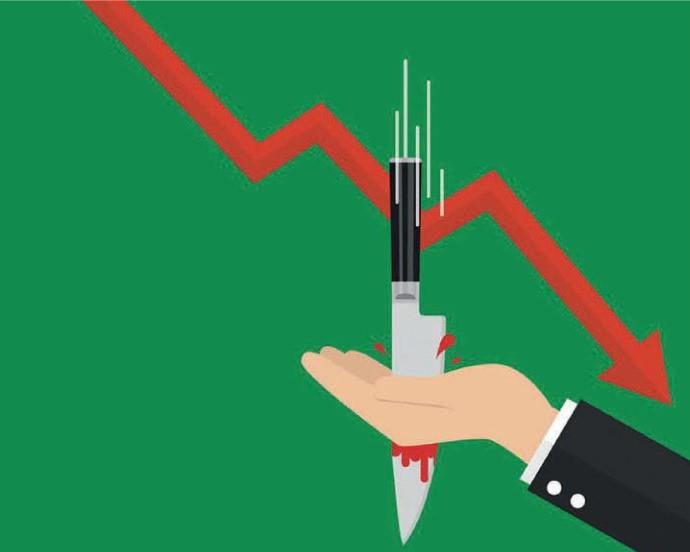
Avoid Catching The Falling Knife
 Join Us
 Follow Us
To determine which side of the argument holds more merit, we examined BSE 500 stocks that hit their 52-week low during the period between December 1, 2023 and September 6, 2024.
✨ Key Takeaways
Is buying at 52-week low a good strategy? There is always a lot of doubt and argument about whether this kind of an approach leads to maximum returns. The article takes a closer look at the scenario and concludes that it is always best to wait till the dust about a company’s poor performance has settled down.
Buying at a 52-week low is one of the debatable topics in the stock market. People often pick sides when arguing this topic. One side suggests that when stocks are at 52-week lows, they are often available at cheaper valuations, and if you buy them at these valuations, you are likely to generate very good returns. On the other hand, the opposing side argues that once a stock hits a 52-week low, it does not necessarily stop there—it may go on to make new 52-week lows. Hence, they advocate avoiding ‘catching a falling knife’. Both arguments are valid.
To determine which side of the argument holds more merit, we examined BSE 500 stocks that hit their 52-week low during the period between December 1, 2023 and September 6, 2024. We considered the first 52-week low these stocks hit and calculated the returns they generated over three-month, six-month, and nine-month periods.


What does the Data Tell?
There are a total of 72 companies that hit their 52-week low during the period mentioned. The three-month returns of all the companies are available. Out of these 72 companies, 63 companies have six-month return data available, and 37 companies have nine-month return data provided. So, let’s look at how these companies have fared.
Three-Month Returns
Out of the 72 companies, 45 have posted positive returns in the three-month duration, while the remaining 27 companies posted negative returns. Among these 45 companies, 33 have been able to outperform the benchmark BSE 500 index. These 33 companies have outperformed the benchmark index by 18 per cent, while the remaining 39 companies underperformed the benchmark index by an average of 10 per cent.
Among these companies, Hindustan Zinc outperformed the BSE 500 by 121 per cent over the three-month duration. Meanwhile, One 97 Communications (Paytm) was down 24 per cent and underperformed the benchmark by 29 per cent during the same period. Overall, all the 72 companies combined have outperformed the benchmark by 3 per cent.
Six-Month Returns
If you look at the six-month returns data, the return data for 63 companies is available. Of these, 48 companies have delivered positive returns, while 15 companies displayed negative returns. Among the 48 companies, 26 outperformed the benchmark BSE 500 index by an average of 23 per cent. The remaining 37 companies underperformed the benchmark by an average of 13 per cent.
Among these companies, The India Cements and Deepak Fertilisers were the standout performers, with an outperformance of 87 per cent and 82 per cent, respectively. VIP Industries was the top underperformer, with its shares underperforming by 34 per cent relative to the benchmark.
Nine-Month Returns Out of the 72 companies mentioned, nine-month return data is available for 37 companies. Of these, 24 companies were in the green from their 52-week lows, while 13 stayed in the red. Among the 24 stocks that posted positive returns, 16 outperformed the index, delivering an average return of 27 per cent during the nine-month duration. The remaining 21 companies underperformed the index by an average of 19 per cent.
Among these companies, Deepak Fertilisers outperformed the BSE 500 by 143 per cent over the nine-month duration. Rajesh Exports was the laggard, with its shares underperforming by 39 per cent in nine months from its 52-week low.
So, Is it a Yes or No?
If you look at the performance period-wise, from three months onward, 46 per cent of the companies outperformed the BSE 500, while 54 per cent failed to outperform the index. The picture looks the same in the six-month and nine-month returns. For the six-month period, 41 per cent of the companies outperformed, and the number is 43 per cent for the ninemonth duration.
"The temptation to chase quick gains in a declining market often leads traders to act impulsively. However, it’s essential to remember a key principle: even with a wealth of data and objective analysis, markets can behave unpredictably. As John Maynard Keynes famously said, "The markets can remain irrational longer than you can remain solvent." This idea has been validated time and again, with countless examples of trading accounts experiencing substantial losses due to irrational market movements. Therefore, traders and investors are advised to wait for clear signs of a trend reversal before taking a position in stocks at their 52-week lows"
It is clear that the majority of companies failed to outperform the BSE 500. However, the stocks that have outperformed have done so significantly. This suggests that it makes sense to invest in stocks with good future potential. But how does one determine if a company is worth investing in? Each company has a peculiar reason for hitting a 52-week low. Therefore, one should ask these questions while analysing the reason for the fall:
Why did the stock fall?
- Is it because the industry outlook or the company’s future looks bleak?
- Is it losing market share to the competition?
- Is it due to corporate governance issues, resignation of senior-level management, regulatory actions, macroeconomic factors, or bad financial performance?
After finding answers to these questions, one needs to ask two simple questions:
- Will the company be able to weather these issues, and will it be able to grow its revenues and profits at a decent rate compared to the industry?
- Is the stock available at a decent to cheap valuation compared to its peers?
If the answer is “yes” to both questions, it makes sense to invest in the company. It is wise to avoid catching a falling knife and instead invest in the company once the dust gets settled. In technical terms, do not buy when it is making lower highs and lower lows and once it makes higher highs and higher lows you may look to take a position. Once you gain confidence, you can build your position. However, if you believe the company is fundamentally strong, buy once the dust is settled.