Common Guide to Diversification: Don’t Put All Your Eggs in One Basket
 Join Us
 Follow Us
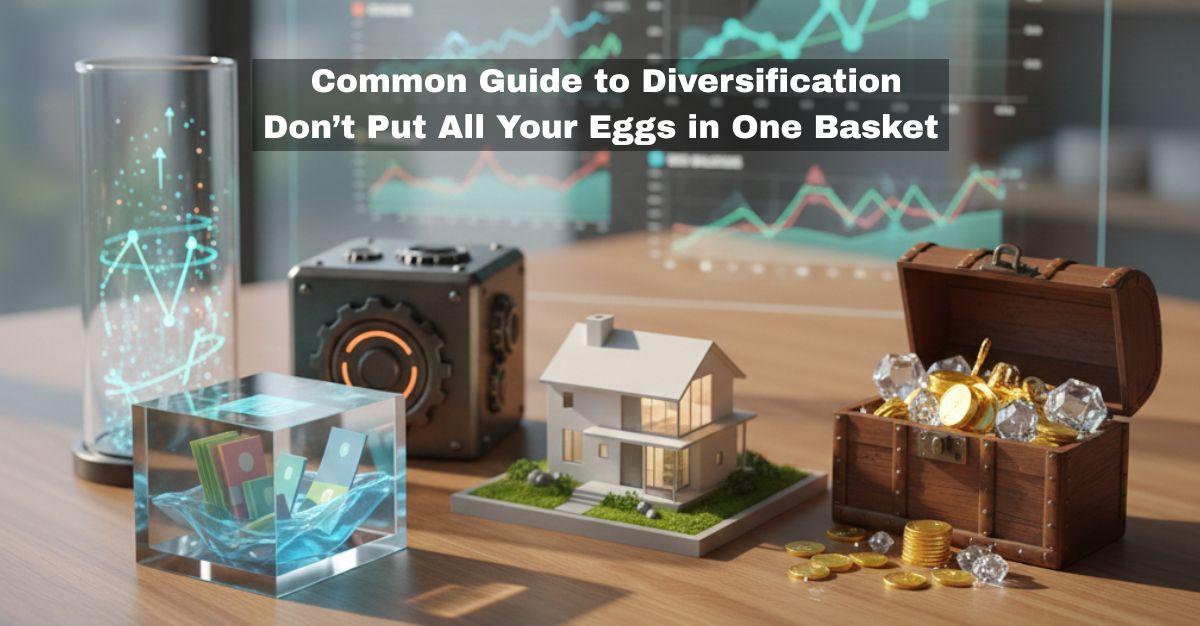
Cracking the Code: Why Your Portfolio Needs More Than One Basket
✨ Key Takeaways
Imagine you are at a local farmer’s market. You’ve spent all your hard-earned money on a single, giant basket of the finest organic eggs. You’re walking home, feeling proud of your purchase, when suddenly- crack- you trip over a stray stone. The basket flies, the eggs smash and in an instant, your entire investment is a gooey yellow mess on the sidewalk. You have nothing left.
Now, imagine a different scenario. Instead of one giant basket, you divided your eggs into five smaller containers. You put one in your backpack, held two in your hands, gave one to a friend and left one in the car. If you trip and fall now, you might lose the two eggs in your hands, but the others remain perfectly safe. You still have breakfast.
In the world of finance, this isn't just a kitchen analogy. It is a fundamental strategy called Diversification. It is perhaps the only "free lunch" in the investing world - a way to reduce your risk without necessarily sacrificing your returns.
What is Diversification, Really?
At its core, diversification is the practice of spreading your investments across different asset types so that your exposure to any one asset type is limited. This practice is designed to help reduce the volatility of your portfolio over time.
Think of your portfolio as a sports team. If your entire team consists only of strikers (offence), you might score a lot of goals, but the moment the other team attacks, you have no Defence. A winning team needs a mix: some strikers to score, some midfielders to control the pace and a goalkeeper to protect the net.
In finance, your "strikers" might be high-growth technology stocks. Your "midfielders" might be steady blue-chip companies and your "goalkeeper" might be gold or government bonds.
Why Do We Need It? (The Myth of the "Sure Thing")
The biggest enemy of diversification is overconfidence. We often feel like we "know" a company is going to succeed. We use their products every day, we like their CEO and the news says they are the future. It is incredibly tempting to put all our money into that one "sure thing."
But history is a graveyard of "sure things."
-
In the late 90s, everyone thought Nokia and Blackberry the were unbeatable kings of mobile.
-
In 2008, people thought Real Estate prices could never go down.
-
In 2022, many believed Cryptocurrency would only go up forever.
The market is unpredictable. A sudden change in government regulation, a technological breakthrough by a competitor, or a global pandemic can ruin even the best company. Diversification is the humble admission that we do not know what the future holds.
The Three Dimensions of a Diversified Portfolio
To build a truly "multi-basket" strategy, you need to look at three specific areas:
1. Asset Class Diversification
This is the most important level. It means not putting all your money into the stock market. You should spread your wealth across different types of assets:
-
Stocks: For long-term growth.
-
Bonds: For steady income and stability.
-
Real Estate: For physical value and inflation protection.
-
Gold/Commodities: As a "hedge" when the economy gets rocky.
2. Industry/Sector Diversification
If you own 10 different stocks but they are all in the "Electric Vehicle" sector, you are not diversified. If the price of lithium triples or a new battery law is passed, all 10 of your stocks will crash together. You need a mix: some tech, some healthcare, some Banking and some consumer goods.
3. Geographical Diversification
Don't just invest in your own country. If your local economy hits a recession, your entire portfolio suffers. By investing in international markets, you ensure that if one country’s economy is struggling, another might be booming.
The "Sailing" Analogy: Navigating the Storm
Imagine you are sailing across the ocean. The stock market is the wind. Sometimes the wind is behind you, pushing you forward at high speeds (a Bull Market). Sometimes the wind is a violent storm (a Bear Market/Crash).
If you have a tiny boat with one massive sail, you will go very fast in good weather, but a single storm will flip you over.
A diversified investor has a sturdy ship with multiple sails of different sizes. When the wind is good, they move steadily. When the storm hits, they can lower the "riskier" sails and rely on their heavy "anchor" (safe assets like bonds) to keep them upright. They might move more slowly than the guy with the massive sail during the sunny days, but they are the ones who actually reach the destination.
The Trap of "Over-Diversification"
While spreading your eggs is good, there is such a thing as having too many baskets.
If you buy 500 different stocks, you might find that you own so many things that your gains in one are always cancelled out by losses in another. This is called over-diversification.
The goal isn't to own everything; it's to own a variety of things that don't move in the same direction at the same time. For most individual investors, owning 15 to 30 well-chosen stocks across different industries, combined with some low-cost Index Funds, provides plenty of protection.
How to Start Diversifying Today (Even with Small Amounts)
Years ago, diversification was expensive. You had to pay a broker a fee for every single stock you bought. Today, it’s incredibly easy thanks to Mutual Funds and ETFs (Exchange Traded Funds).
When you buy one "unit" of an Index Fund, you are instantly buying a tiny slice of 50 or 500 different companies. With just a few dollars or rupees, you have already avoided the "one basket" trap.
Conclusion:
The ultimate benefit of diversification isn't just a higher number on your bank statement- it’s peace of mind.
When you are diversified, you don't need to check the stock market every ten minutes. You don't need to panic when you hear bad news about one specific company or industry. You can sleep soundly knowing that even if one of your "baskets" falls and breaks, the rest of your eggs are safe and sound.
Successful investing is a marathon, not a sprint. Diversification is the pair of high-quality running shoes that prevents you from getting injured so you can actually finish the race.
Disclaimer: The article is for informational purposes only and not investment advice.