Dollar-Rupee Fight: Impact On Indian Markets & Consumers
 Join Us
 Follow Us
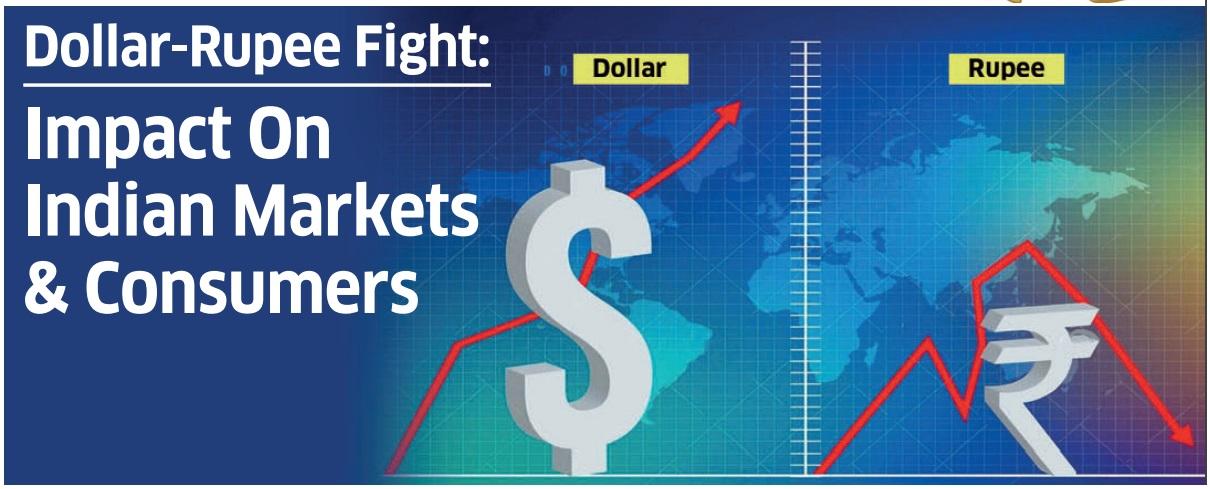
The Indian rupee has been on a consistent decline against the U.S. dollar since Donald Trump won the U.S. presidential election.
✨ Key Takeaways
The rupee-dollar equation remains a key macroeconomic variable influencing the Indian economy. While a weaker rupee benefits exporters, it influences FII flows and inflation. For investors and consumers alike, understanding these dynamics is essential to navigating currency fluctuations effectively
The Indian rupee has been on a consistent decline against the U.S. dollar since Donald Trump won the U.S. presidential election. From the day of his victory to now, the rupee has hit an all-time low of ₹87.94, depreciating by approximately 4.5 per cent, before appreciating later following measures taken by the Reserve Bank of India (RBI). In this article, let’s understand what led to the fall in the rupee and how it impacts Indian consumers and different sectors. Highlighted below are the sectors that will gain due to the current USD-INR tilt of balance as well as those that will stand to lose on its margins.
The sharp fall in the rupee can be attributed to various global and domestic factors, primarily driven by U.S. President Donald Trump’s economic policies and the reaction of foreign institutional investors (FIIs). Trump’s pro-America policies, including tax cuts, deregulation, and an aggressive stance on trade, strengthened the U.S. dollar. Additionally, higher U.S. bond yields prompted FIIs to withdraw investments from emerging markets like India. The FII sell-off was fuelled by rich valuations of Indian equities, slowing earnings growth, and better investment opportunities elsewhere.
This selling pressure intensified in September, coinciding with historically low valuations in China and uncertainty around the U.S. elections. As a result, FIIs either redirected funds to China or repatriated them back to the U.S., leading to further depreciation of the rupee. However, India is not alone in facing currency depreciation. Other developed markets and emerging markets such as Canada, Japan, Australia, China, Brazil, Mexico and South Africa have also witnessed currency weakness due to global risk aversion, rising U.S. yields, and geopolitical uncertainties.

Latest Developments
The rupee hit an all-time low of ₹87.94 per dollar on February 14, driven by continued FII outflows, a strong dollar supported by Trump’s tariffs, and global uncertainties arising from his policies. The key reasons for this depreciation include:
1. High valuations and concerns over India’s economic growth along with rupee depreciation accelerated FIIs’ exit from Indian equities.

2. Protectionist measures, corporate tax cuts, and infrastructure spending in the U.S. boosted capital inflows to America, strengthening the dollar.
3. Global uncertainty and concerns over global economic slowdown further added to the pressure on the emerging market currencies.
4. The recent 0.25 per cent rate cut decision by the RBI also contributed to the depreciation of the rupee.
RBI’s Intervention
To combat the rupee’s free fall, the Reserve Bank of India (RBI) intervened through multiple measures. It likely sold the dollar between USD 4 billion and USD 7 billion to shore up the currency. This is because the currency slipped to record lows and was at risk of falling past the ₹88 handle. Following these measures, the rupee stabilised and is currently trading at `86.89 per dollar.
Impact of High USD to INR on Indian Sectors Beneficiaries:
1. IT and Software Services: Companies like TCS, Infosys, Wipro and Tech Mahindra benefit from a weaker rupee, as they earn a significant portion of their revenue in dollars.
2. Pharmaceuticals: Export-driven pharmaceutical firms like Sun Pharma, Cipla, Dr Reddy’s, Lupin and Divis Labs see higher rupee revenues as their earnings in USD increase. 3. Textiles and Apparel: Exporters such as Trident, Vardhaman Textiles, Arvind Limited and Kitex Garments gain pricing power, making Indian products more competitive globally.
Negatively Impacted Sectors:
1. Oil and Gas: India imports over 80 per cent of its crude oil. A weaker rupee makes oil imports expensive, leading to higher fuel prices and inflation. Bharat Petroleum Corporation Limited (BPCL), Hindustan Petroleum Corporation Limited (HPCL), Indian Oil Corporation Limited (IOCL) and Reliance Industries Limited (RIL) get negatively impacted by higher dollar compared to Indian rupee.
2. Aviation: Airlines such as Interglobe Aviation, Spicejet and Afcom Holdings suffer as they pay for aircraft leases and fuel in USD, thereby increasing the operational costs.
Impact on Indian Consumers:
1. Inflationary Pressures: India imports over 16 million tonnes of edible oil every year. Increase in dollar leads to higher oil prices which in turn leads to high inflation.
2. Costlier Education and Travel: Students studying abroad and travellers face increased expenses due to higher exchange rates.
3. Slowing Economy: High inflation may prompt the RBI to keep interest rates elevated, increasing borrowing costs and slowing growth.
Indian Markets and Rupee Depreciation
While rupee depreciation can make returns for foreign investors in Indian equities less appealing, it doesn’t necessarily trigger a market downturn. The rupee has weakened by 3.1 per cent since September, coinciding with declines of 8.5 and 7.3 per cent in the Nifty and Sensex indices, respectively. However, sustained rupee depreciation over several months doesn’t always translate to market crashes.

For instance, between January 2022 and October 2022, the rupee depreciated by 10.2 per cent, yet Nifty and Sensex saw gains of 3.8 and 4.3 per cent, respectively. A similar pattern emerged from April 2018 to October 2018, when a 12 per cent rupee decline was accompanied by increases of 2.7 and 4.5 per cent in Nifty and Sensex. An analysis of five instances of multi-month rupee depreciation reveals that a weakening rupee doesn’t automatically lead to market declines. In fact, benchmark indices experienced gains in two of those five cases.
Conclusion: The Future Outlook of USD to INR
Several factors will determine the rupee’s trajectory in the coming months:
- U.S. Inflation Trends: Recently released U.S. inflation data showed that the Consumer Price Index (CPI) rose by 3 per cent in January, which is the highest in seven months. It indicates strong economic activity. If the inflation remains high in the coming months, the U.S. Federal Reserve may delay rate cuts, strengthening the dollar. Currently, the markets are pricing in a quarterpoint rate cut in 2025. If the Federal Reserve maintains a hawkish stance, it could limit rupee appreciation.
- India’s Economic Growth: A strong domestic economy and foreign investment inflows could support the rupee, while weak growth may lead to further depreciation.
- Geopolitical Risks: Uncertainties around global trade, crude oil prices and fiscal policies will influence currency movements.
While short-term volatility may persist, India’s strong forex reserves and prudent monetary policies could provide a cushion against extreme depreciation. Investors should brace for near-term fluctuations but focus on long-term economic fundamentals.