Election Impact on Markets
 Join Us
 Follow Us
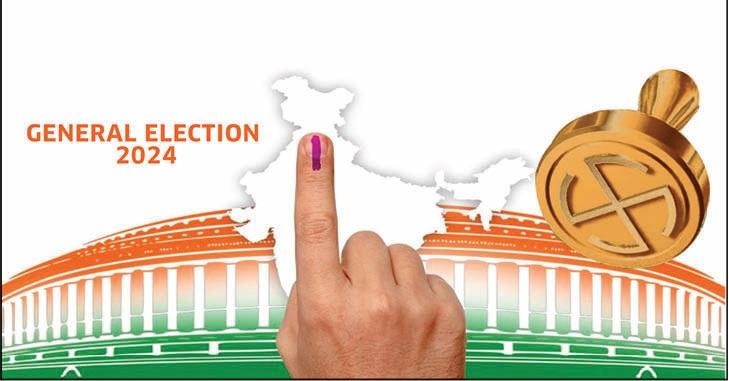
As we approach the six-month mark before India's forthcoming general election, attention gravitates toward this pre-election period, often marked by notable fluctuations in the stock market. The article examines the likelihood of an impact in the months leading to the election.
✨ Key Takeaways
India’s pivotal electoral event, occurring approximately every five years, is slated for April and May next year. As we approach the six-month mark before India’s forthcoming general election, attention gravitates toward this pre-election period, often marked by notable fluctuations in the stock market. However, this election cycle unfolds amidst geopolitical tensions and uncertainties surrounding interest rate trajectories and the global economy. The article examines the likelihood of an impact in the months leading to the election
The build-up to the general election intensifies investor focus on potential financial shifts. Notably, the voter base has significantly expanded since 2019, estimating nearly one billion eligible voters, including 10-12 per cent involved in the stock market to varying degrees. The six months leading to this pivotal political event typically encompass a volatile phase for market participants, characterised by uncertainty and speculative behaviour.
Elections exert considerable sway over the country’s trajectory, significantly impacting investor sentiment and the overall performance of the market. While delving into past market performance during elections offers insights, it is vital to acknowledge that historical trends may not guarantee future outcomes. Nevertheless, comprehending these historical patterns can furnish valuable context for evaluating current conditions.
The following chart deciphers the election and equity market returns.

In the following paragraph we will delve deep into every phase of the election that will make the above graph clear.
What History Teaches
Looking back at past general elections, a pattern emerges where the stock market experiences increased fluctuations and volatility in the months leading up to the polls. For this we carried out a study of the last 11 general elections held in India. What we found is that the average volatility increases as we approach the general election. On an average six months leading to the election, we observed that the daily volatility of the stock market, taking the Sensex as a representative of the stock market, increases to 1.38 per cent from normal 1.29 per cent.
The reason for such a rise in volatility is the uncertainty over the result outcome. Nonetheless, other interesting aspects also emerge. Our study of the last 40 years’ covering 11 election shows that on a median basis, the market has gained 12 per cent in six months approaching elections. There was an instance of negative return of 6 per cent that was witnessed during the six months prior to the 1998 general election. However, it was an exceptional year in terms of global macroeconomic event. It was a time when the Asian financial crisis occurred.
The Asian financial crisis of 1997 was a period of financial instability that gripped much of East and Southeast Asia during the late 1990s. The crisis began in Thailand in July 1997 before spreading to several other countries with a ripple effect, raising fears of a worldwide economic meltdown due to financial contagion. This resulted in a negative return of the Sensex. Besides, there also was political instability that led to such a dismal performance. Some of you might wonder what the median return of any six months of the Sensex is.
In our study of the Sensex since 1979, it shows that the median return of the Sensex for any six months is 6.78 per cent. For this we calculated the rolling six months return of the Sensex and took a median of that. Hence, the higher return by Sensex prior to six months to the general election is not by chance. Out of 11 instances, in nine instances the Sensex has generated better returns than the average six-month returns when approaching the election. The higher return is achieved even on the back of some major global events. The Gulf War is one instance that led to a sharp rise in oil prices, thus creating a negative impact on economic growth in many countries, especially countries like India which is a major importer of crude oil.
The Gulf War also had a significant impact on the stock market. The war led to a sharp decline in stock prices as investors became concerned about the impact of the war on the global economy. The general election held in India in June 1991 saw the Sensex generating healthy return of 18 per cent in the six months prior to election. Examining the recent past, the year 2013 witnessed global headwinds and domestic challenges such as concerns over the Federal Reserve tapering, a weaker rupee, high inflation and slowing growth.

Despite these obstacles, the Sensex recovered from a decline in August and September and closed the six months to election with six per cent gain. The year 2018 was marked by the recovery of the Indian economy after the demonetisation shock, only to face a setback with the ILFS credit default crisis. The liquidity crunch in the NBFC sector affected major corporations, resulting in non-banking stocks experiencing losses in the last quarter of 2018. In the next six months to election, the Sensex gave a return of 9.8 per cent.
Election Results and Returns
It’s not solely pre-election that influences market performance. Even during the election month or when the results are announced, the equity markets tend to perform favourably. On an average, the Sensex during the election month has yielded a return of four per cent, surpassing the median monthly return of 1.13 per cent since 1979. Hence, election months often exhibit returns higher than the historical average. A case in point is May 2009, which recorded the most exceptional performance with the Sensex soaring by 28 per cent in a single month.
This surge was attributed not only to the UPA’s return but also to the economy rebounding from the 2008 Great Financial Crisis (GFC). Contrarily, in 2004, the Sensex plummeted by 16 per cent following the election results due to an unexpected change in government leadership. The ruling party’s unexpected loss and the Congress forming the government with Left party support unsettled the markets. Post the announcement, the frontline index hit the lower circuit as market sentiment was spooked by unexpected election outcome.

A historical analysis of market reactions to election results underscores investors’ aversion to uncertainty and unexpected political shifts. Instances of an unclear mandate or unexpected leadership changes consistently result in negative market returns. For instance, during the 1996 and 1999 elections, the market witnessed negative returns due to the absence of a clear majority for any party. Nonetheless on an average, the return during the election result months remained positive.
Post Election Returns
The better performance of the equity market is not limited to before the election but even beyond the election year as witnessed in the outperformance of the equity market. Examining the data from the table, we can observe various trends between election months and the Sensex performance after a period of 12 months. On a median basis, they have generated 29 per cent against the rolling one-year median return of 11.2 per cent generated by the Sensex since 1979. Hence, there is a clear distinction between the returns after one year of election and any other one year.
For instance, during the December 1984 election, the Sensex experienced a remarkable cumulative return of 93.85 per cent in the subsequent 12 months. The index started at 259.98 and ended at 503.85, indicating significant growth during this period. Similarly, the June 1991 election resulted in a substantial cumulative return of 143 per cent over the next 12 months. The Sensex started at 712 and soared to 1,726.31, between June 1991 and May 1992. However, not all election periods translated into positive returns for the Sensex. The March 1998 election resulted in a dip of 4 per cent in the subsequent 12 months.
This was primarily due to the Asian financial crisis and trouble in Russia. Despite this slight decrease, the index remained relatively stable. Even after the October 1999 election, the Sensex saw a huge drop of 17 per cent in the next 12 months. This was on account of the big bust of the dotcom bubble. The dotcom bubble, which was a period of rapid growth in the stock prices of internet-based companies in the late 1990s, had a significant impact on the Indian equity market. The BSE Sensex fell by over 50 per cent between 2000 and 2002.

The bust also led to a sharp increase in foreign selling of Indian stocks. More recently, the May 2019 election saw a cumulative return of –18 per cent over the next 12 months. One of the prime reasons for such a subdued performance was the fall in the global market due to the corona virus pandemic, which resulted into a fall in the global equity market, including India. This clearly shows that if everything remains normal, post-election equity markets are expected to give superior returns.
Interest Rate Trajectory
The performance of the stock market during and after the elections can be linked to various factors but one significant contributor is the trajectory of interest rates. There is an inverse relation between bond yields and stock market returns. A rising yield makes the cost of capital higher, thus resulting in lower returns by the stock market and vice versa. An analysis of Lok Sabha general elections from the past two decades reveals a consistent trend: yields generally remain subdued in the leadup to the elections, barring the anomaly of the 2014 elections, coinciding with a less favourable macroeconomic scenario.
Over the six months before general elections, 10-year yields declined in three out of four instances, reflecting a relatively stable rate trajectory. As we currently stand six months away from the upcoming elections, there are indications of a downward trajectory, spurred by a combination of cooling inflation and rising real yields. Notably, 2014 stands out as the only instance where the yield during the general elections was higher than a year prior.
However, the prevailing macroeconomic environment significantly influences policy rate decisions, and the trend of decreasing inflation coupled with indications from OIS curves hinting at potential rate cuts suggests the likelihood of consistent yield behaviour this time. Reflecting on the aftermath of the 2009 Global Financial Crisis, we witnessed substantial cuts in both repo rates and government securities. This historical precedent further bolsters the expectation of potential adjustments in interest rates following the upcoming elections.
Expectations for Forthcoming General Election
The present market sentiments strongly indicate an anticipated return of the current BJP government in the upcoming general elections, regardless of the results of state elections. In such a scenario, if market conditions remain consistent before the elections, a BJP victory might not trigger a significant positive impact on the market. However, if the electorate does not vote for continuity, we think that the sentiment on the ground could turn bearish, at least in the short run, with potentially negative implications for growth.
What stocks do after elections is a function of what gets priced in the next six months. If the market prices in an election outcome that heralds change, it means share prices may have already suffered in the run-up to elections. Companies, on the other hand, are prone to delaying investment decisions if they sense a shift in policy with a concomitant impact on growth. As such, our base case is that both the capex and stocks are likely to be robust in the run-up to the election, and hence the likelihood is for both to suffer if the election results belie market expectations.
State election outcomes might not significantly influence the national election outcome, given that voters typically prioritise different issues in state versus national (general) elections. We saw that the BJP faced defeats in critical state elections in Chhattisgarh, Madhya Pradesh and Rajasthan in December 2018, yet convincingly secured victory in the subsequent 2019 general elections. This illustrates the distinct voting patterns and issues that govern state and national election dynamics.
Managing the Portfolio
Considering the historical returns, maintaining the status quo in portfolios appears advisable. However, investors inclined toward risk aversion might consider hedging their exposure using Nifty options. For those less comfortable with this strategy, a direct approach involves assessing the likely volatility around the election result, anticipating market reactions and adjusting portfolios accordingly. Alternatively, a more comprehensive strategy involves preparing portfolios to accommodate various potential scenarios.
While this approach doesn’t ensure superior performance for any specific outcome, it aims to safeguard portfolios from extreme results. Here, the market’s trajectory, either signalling robust growth or hinting at a downturn, guides the allocation of positions in sectors and stocks. If the market anticipates subpar growth, portfolios tend to adopt a defensive stance. Amidst these scenarios, portfolios gradually transition from a cyclical nature to a more defensive posture.
Conclusion
India is the world’s largest democracy and we are no strangers to the excitement and anticipation that come with the general elections. We are only six months away from the 2024 elections, which are expected to happen in April and May. The six months leading up to the general election in India serve as a crucible for the stock market, characterised by increased volatility, speculative behaviour and shifts in investor sentiment. While historical trends offer insights, the unpredictable nature of politics warrants a cautious yet strategic approach for investors aiming to navigate this period successfully.
The strength of past governments appears to have mattered little to market performance beyond the immediate term. Eventually, share prices respond to growth and inflation, which again appear to be a function of many other things including policy choices and global factors. That said, a change in government or lack of strength in its election mandate could have significant near-term share price implications, especially if the market has priced in continuity and strength.