How IPO Allotment Is Calculated: A Simple Guide for Retail Investors
 Join Us
 Follow Us
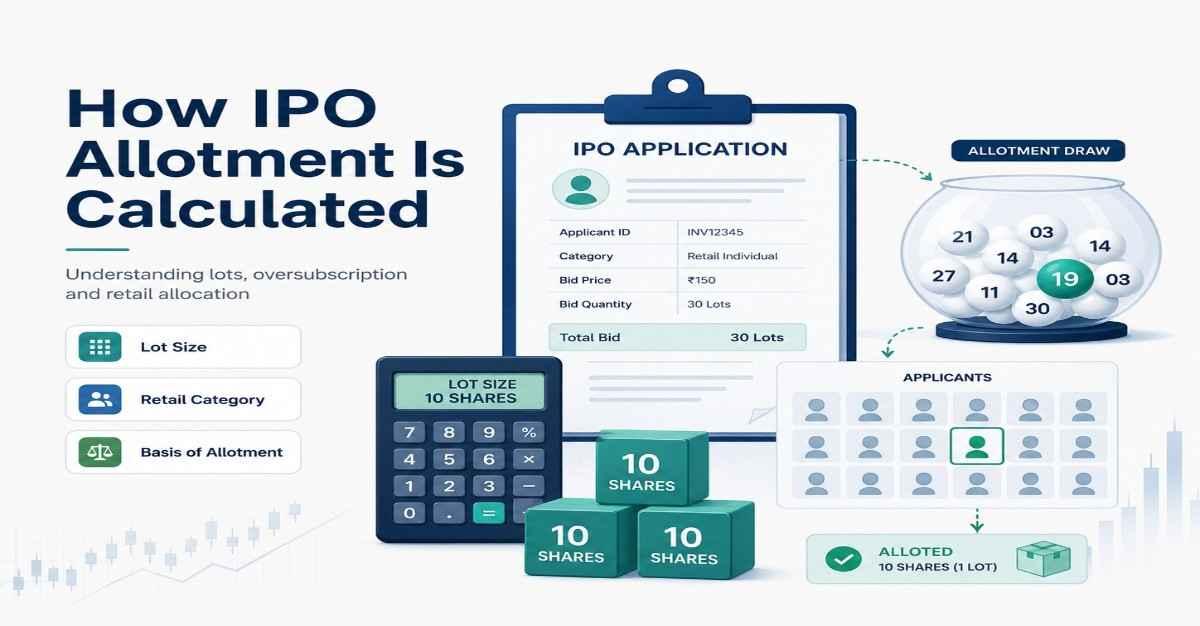
Understand the IPO allotment process, retail allocation rules and why oversubscription can reduce your chances.
✨ Key Takeaways
An Initial Public Offering allows investors to apply for shares before a company begins trading on the stock exchange. Submitting an application, however, does not guarantee allotment. The result depends on the shares reserved for each investor category, the number of valid applications and the level of oversubscription.
Understanding how IPO allotment is calculated helps retail investors interpret subscription figures and estimate their chances more realistically. It also explains why applying for several lots may not improve the probability of receiving shares in a heavily subscribed issue.
What Is IPO Allotment?
IPO allotment is the process through which the offered shares are distributed among eligible applicants after the issue closes. The Registrar to the Issue verifies bids, removes invalid or duplicate applications and prepares the basis of allotment with the lead managers and designated stock exchange.
SEBI’s investor material states that only one application per PAN is allowed in an issue and duplicate applications may be rejected. It also explains that the basis of allotment is finalised by the merchant Banker and registrar and approved by stock exchange officials.
Applications are divided into categories such as retail individual investors, non institutional investors, qualified institutional buyers, employees and shareholders, where applicable. Each category is allotted shares from its reserved portion.
How Retail IPO Allotment Works
The minimum application quantity is called one lot. The lot size and price band are disclosed before the issue opens. If the retail portion receives fewer valid bids than the shares available, eligible investors may receive the quantity applied for.
When the retail category is oversubscribed, each successful retail applicant should receive at least the minimum bid lot, subject to the availability of shares. If the number of valid applications exceeds the number of minimum lots available, successful applicants are selected through a draw of lots. Any balance shares may then be distributed according to the approved basis.
Therefore, an IPO subscribed 10 times does not necessarily give each applicant one tenth of the shares requested. In a strongly oversubscribed retail issue, the number of valid applications is often more important than the total shares applied for.
A Simple IPO Allotment Example
Assume that 12,00,000 shares are available for retail investors and the minimum lot size is 20 shares.
The number of minimum lots available is:
12,00,000 divided by 20 = 60,000 lots
Now assume that the registrar receives 1,80,000 valid retail applications. Only 60,000 applicants can receive one lot. The approximate probability of allotment is:
60,000 divided by 1,80,000 = 33.33%
Roughly one out of every three valid applicants may receive one lot. The actual selection follows the approved draw, so this is only a probability estimate.
Applying for 5 lots instead of 1 may not materially improve the chance of receiving at least one lot when applications greatly exceed available lots. A larger bid becomes more relevant when sufficient shares remain after minimum lots are distributed or when the retail category is not heavily oversubscribed.
Why Applications Get Rejected
Common reasons for rejection include an incorrect PAN, mismatch between the applicant’s name and demat records, invalid demat details, insufficient funds, multiple bids using the same PAN, failure to approve the UPI mandate or a bid below the final issue price.
Retail investors can choose the cut off option, which means they agree to subscribe at the final price discovered through book building. SEBI explains that bids are collected within the announced price band and the final issue price is determined after assessing demand at different prices.
An invalid application is excluded from the allotment process regardless of how many times the issue is subscribed.
How ASBA Works
Under Application Supported by Blocked Amount, the application money remains blocked in the investor’s bank account while allotment is processed. If shares are allotted, only the required amount is debited. If there is no allotment, the blocked amount is released. In a partial allotment, the balance is unblocked.
Investors can check the result on the registrar’s website using details such as PAN, application number or demat information. The basis of allotment document also shows how shares were distributed across categories.
Does Applying Early Improve the Chances?
A valid retail application submitted on the first day does not receive preference over one submitted later. All valid applications are considered under the same basis of allotment.
Applying early can still reduce operational risk. It provides time to correct a banking error, approve the UPI mandate or verify application details before the issue closes.
Key Takeaway
How IPO allotment is calculated depends on the number of shares available, lot size, valid applications and subscription in the relevant category. In a heavily oversubscribed retail issue, the process generally aims to allot one minimum lot to as many successful applicants as possible through a draw.
Investors should focus on submitting one accurate application rather than assuming that a larger bid guarantees allotment. Subscription figures indicate demand, but the final outcome is known only after the approved basis of allotment is prepared.