Why Option Buyers Lose Money Even When Their Market View Is Correct
 Join Us
 Follow Us
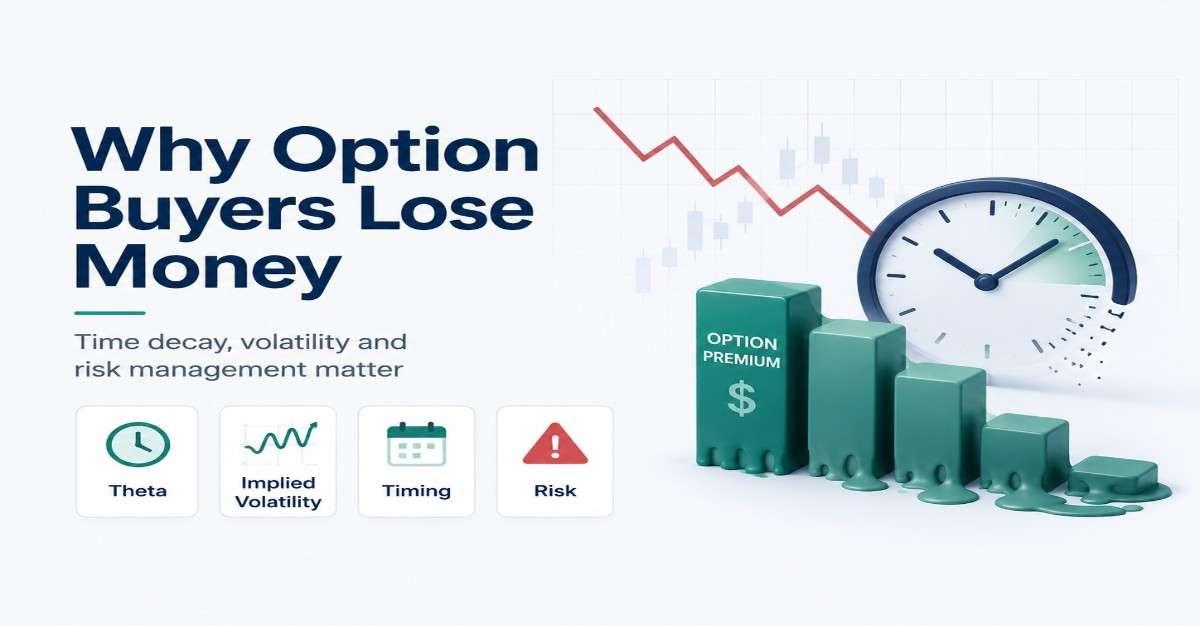
Understand how time decay, volatility, strike selection and overtrading affect option buying returns.
✨ Key Takeaways
Buying an option appears attractive because the maximum loss is limited to the premium paid, while the potential payoff can be much larger. In practice, however, an option buyer must be correct about direction, timing, magnitude and volatility.
This explains why option buyers lose money even when their broad market view is correct. The underlying may move as expected, but the move may be too small, too late or already reflected in an expensive premium.
An Option Is a Wasting Asset
An option has an expiry date. Its premium generally contains intrinsic value and time value. As expiry approaches, the time available for a favourable move declines, causing time value to erode.
This erosion is measured by theta. For an option buyer, theta is usually negative. If the underlying price and volatility remain unchanged, the premium tends to lose value with time.
Decay often accelerates near expiry, particularly for at the money options. A short dated option therefore needs the expected move to occur quickly enough to offset this loss of value.
Direction Alone Is Not Enough
Assume an index is at 20,000 and a trader buys a 20,200 call. If the index rises to 20,100, the directional view is correct, but the option remains out of the money.
Even if the index reaches 20,220 near expiry, the trade may still lose if the premium was high. A call’s breakeven at expiry is the strike plus the premium. A put’s breakeven is the strike minus the premium.
The buyer must judge not only whether the market will rise or fall, but how far it may move and how quickly.
Paying Too Much for Volatility
Implied volatility is a major part of option pricing. Before earnings, a central Bank decision or another important event, premiums may rise because the market expects a large move.
Once the uncertainty passes, implied volatility may fall sharply. This is often called an implied volatility crush.
A trader can predict the direction correctly and still lose if the volatility decline outweighs the benefit from the price move. Buying when volatility is elevated requires a sufficiently large move to justify the premium.
Buying Cheap Out of the Money Options
Far out of the money options appear affordable, encouraging traders to buy more contracts. However, they have a lower probability of finishing with intrinsic value.
A low premium does not necessarily mean the option is undervalued. It may simply reflect the low chance of the underlying reaching the strike before expiry.
Repeatedly buying distant strikes can produce frequent small losses interrupted by occasional gains. Unless those gains cover the accumulated premiums and costs, the strategy loses money.
Short Expiries Leave Little Room for Error
Weekly and other short dated options can move rapidly, but they also experience intense decay. A trade may need to work almost immediately.
Temporary consolidation, a delayed breakout or one adverse move can reduce the premium sharply. Longer dated options provide more time but cost more. The expiry should match the expected time needed for the market view to develop, not simply the cheapest premium.
Poor Position Sizing and Overtrading
Because the premium looks small compared with the underlying exposure, traders may take positions larger than their capital can support.
NISM notes that derivatives require a relatively small amount compared with the underlying value, which can multiply profits and losses. It warns that an incorrect speculative decision can cause severe financial damage.
Frequent trading also adds brokerage, exchange charges, Taxes, bid ask spreads and slippage. Losses may trigger revenge trading, averaging or rapid switching between calls and puts without a clear process.
Ignoring Liquidity
An option may show a last traded price but have limited liquidity. A wide bid ask spread creates an immediate disadvantage.
Buying at ₹12 when the best available exit is ₹10 starts the trade with a ₹2 gap. The impact is substantial in percentage terms. Liquidity can weaken further in distant strikes or near expiry.
Volume, open interest and the bid ask spread should be checked before entry.
The Statistical Reality Is Difficult
SEBI found that 93% of individual traders incurred losses in the equity futures and options segment between FY22 and FY24, with aggregate losses exceeding ₹1.8 lakh crore. The study covers the broader equity F&O segment rather than only option buyers, but it shows how difficult sustained profitability can be.
Options are used for hedging as well as speculation. Without an understanding of pricing, volatility and risk, a limited loss per trade can become repeated capital erosion.
How Buyers Can Improve Their Process
A disciplined process begins with defining the expected direction, target, time horizon and maximum acceptable loss before entering. The strike and expiry should match that view.
Traders should compare implied volatility with its recent range, limit capital at risk and include transaction costs. Exit rules are essential because waiting indefinitely for recovery allows time decay to consume value.
Key Takeaway
Why option buyers lose money is not explained by one factor. Time decay, insufficient movement, expensive volatility, distant strikes, short expiries, poor sizing and overtrading often work together.
The maximum loss on one purchased option is limited to the premium, but repeatedly losing premiums can still cause serious damage. Options require a view on direction, magnitude, timing and volatility, supported by strict risk control.