How to Read a Red Herring Prospectus Before Investing in an IPO
 Join Us
 Follow Us
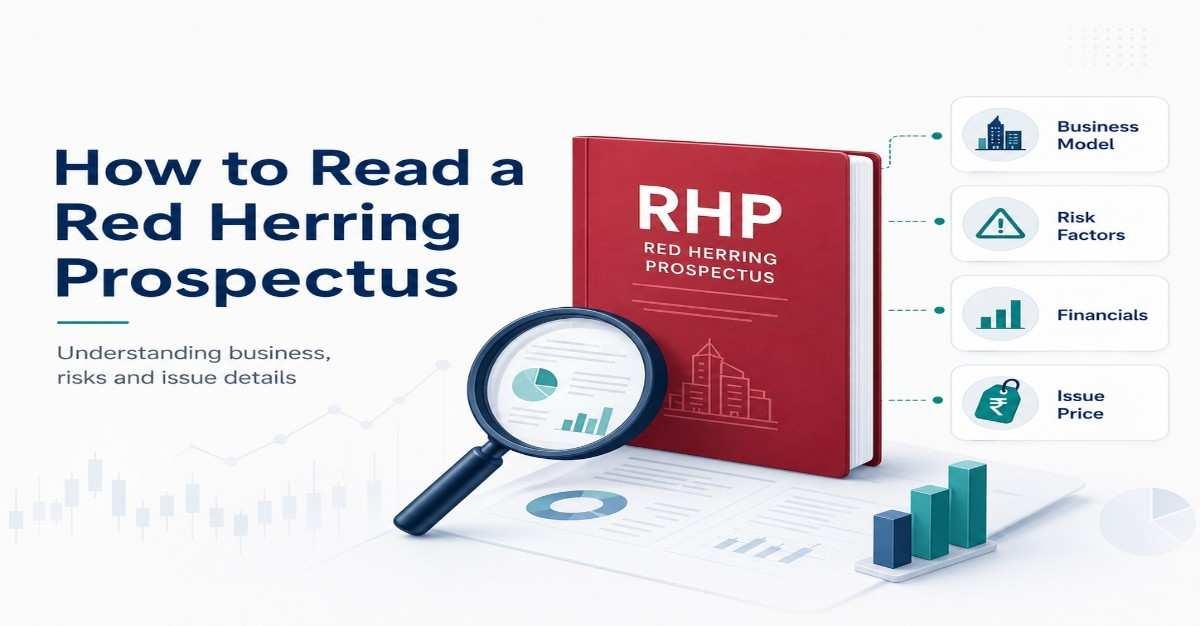
A practical guide to evaluating an IPO’s business, financials, risks, valuation and use of funds.
✨ Key Takeaways
A Red Herring Prospectus is one of the most important documents available before an Initial Public Offering. It contains information about the company, its business, financial performance, promoters, risks and proposed use of funds. Yet many applicants rely mainly on the price band, subscription figures or grey market discussions.
Learning how to read a Red Herring Prospectus helps investors assess an IPO through disclosed facts rather than market excitement. The document is lengthy, but it becomes manageable when read in the right order.
What Is a Red Herring Prospectus?
A Red Herring Prospectus, commonly called an RHP, is the offer document issued before an IPO opens. In a book built issue, the company and its Book Running Lead Managers announce a price band, while the final issue price is determined after bids are collected. SEBI’s investor material explains that the RHP is issued before the IPO begins and contains the relevant issue information.
The Draft Red Herring Prospectus, or DRHP, is filed earlier with SEBI for observations. After required updates, the company files the RHP with the Registrar of Companies. The final prospectus is filed after price discovery.
SEBI does not approve the investment merit of an IPO. It reviews the offer document to support adequate disclosure, but investors must assess the business and risks themselves.
Begin With the Offer Structure
Check the total issue size, price band, lot size and proposed exchanges. More importantly, identify how much of the IPO is a fresh issue and how much is an Offer for Sale.
In a fresh issue, the company receives the proceeds and may use them for expansion, debt repayment or working capital. In an Offer for Sale, existing shareholders sell shares and the company does not receive those proceeds.
A large Offer for Sale is not automatically negative. However, investors should understand who is selling, how much their holding will decline and whether the company is raising enough fresh capital for its plans.
Read the Objects of the Issue
The objects section explains how fresh issue proceeds are expected to be used. Look for specific allocations towards capacity expansion, machinery, acquisitions, working capital or debt repayment.
Compare the proposed spending with the company’s current scale. A project supported by approvals, cost estimates and an implementation schedule is easier to assess than a broad allocation for general corporate purposes.
Debt repayment may reduce interest costs but may not create new revenue. Expansion can support growth, although delays or low capacity utilisation may weaken expected returns.
Understand the Business Model
The business section should explain how the company earns revenue. Study its products, customers, geographic reach, distribution network and manufacturing capacity. Identify whether revenue is recurring, project based, seasonal or linked to commodity prices.
Check whether the company depends heavily on a few customers, suppliers, products or regions. Competitive strengths in an RHP represent management’s view, so test them against data. A claimed market leader should ideally show evidence through scale, margins or customer relationships.
Study the Risk Factors
SEBI’s investor guide highlights risk factors, financials, objects of the issue, litigation, basis of issue price and promoter background as important areas.
Focus on risks that could materially affect revenue, margins, cash flow or reputation. Examples include customer concentration, regulatory dependence, pending litigation, promoter disputes, weak internal controls, raw material volatility or Reliance on one facility.
Pay attention to risks repeated across different sections. Repetition may indicate that the issue is central to the business rather than a routine disclosure.
Analyse the Financial Statements
Review at least 3 years of revenue, operating profit, net profit, cash flow, debt and return ratios. Do not judge the company only by its latest year.
Check whether profit growth is supported by operating cash flow. Compare receivables and inventory with sales. Rapid growth accompanied by stretched working capital can place pressure on cash generation.
Review exceptional items, contingent liabilities and related party transactions. A sudden improvement before the IPO deserves closer examination, particularly when margins rise without a clear operating reason.
Examine the Basis of Issue Price
The basis of issue price section explains the valuation and financial ratios used by the company and lead managers. Compare the valuation with listed peers using measures such as price to earnings, price to book value and enterprise value to EBITDA.
Peer comparisons need care. A company may differ from the chosen peers in growth, margins, debt or business exposure. A premium valuation may be justified, but it should be supported by stronger economics rather than presentation alone.
Check Promoters, Litigation and Governance
Review promoter experience, shareholding changes, related businesses and regulatory history. Study litigation involving the company, promoters, directors and subsidiaries. Also examine contingent liabilities, defaults and related party dealings.
Governance concerns can outweigh attractive growth forecasts. Dependence on promoter controlled entities, frequent related party transactions or unresolved disputes should be understood before applying.
Final Checklist
Knowing how to read a Red Herring Prospectus does not mean giving every page equal attention. Prioritise the offer structure, objects of the issue, business model, risk factors, financial statements, valuation, promoters and litigation.
The RHP cannot predict listing gains. Its purpose is to help investors understand what the company is offering, why it is raising money, what could go wrong and whether the issue price appears consistent with its disclosed financial performance.