Importance Of Portfolio Diversification
 Join Us
 Follow Us
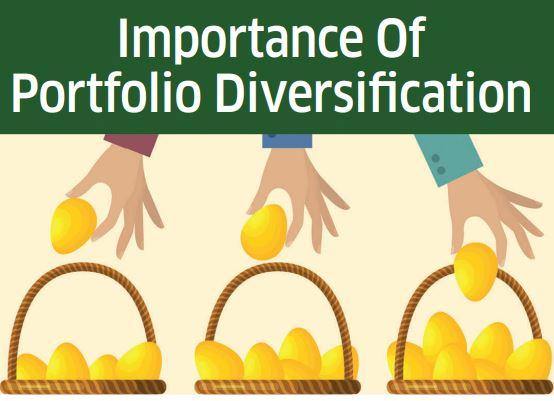
Diversification in its simplest meaning implies investing in stocks or asset classes that do not move in tandem.
✨ Key Takeaways
Diversification in its simplest meaning implies investing in stocks or asset classes that do not move in tandem. Armaan Madhani breaks down the process of diversification which can help investors mitigate portfolio risk by having exposure to a variety of different stocks, and not put all their eggs in one basket
Investors come in different shapes and sizes. They have different investment horizons and risk appetites that determine their investment decisions. They are broadly categorised into conservative, moderate and aggressive. Some investors keep adjusting their risk appetite depending on the prevailing market condition. When the market falls precipitously, the way it did in the first quarter of FY23, these investors become aggressive.
Nonetheless, when the market is trading at a lofty valuation, they become conservative. These types of investors are ‘opportunists’. There is nothing wrong with such investors. However, identifying the top and bottom of the market is extremely difficult and even the most seasoned investors cannot vouch for it on a consistent basis. Hence, one of the best strategies is to invest in a diversified portfolio. Diversification is the key to reducing investment risk.
Defining Diversification
Diversification in its simplest meaning implies investing in stocks or asset classes that do not move in tandem. Through the process of diversification you mitigate the portfolio risk by having exposure to a variety of different assets or stocks, which means not putting all your eggs in one basket, as the old cliché goes. The main purpose of diversification is to lessen the overall volatility of your investments. Where one may go bad, others go well, which means helping to even out the performance over the long term. In the current market situation, it’s a good time to diversify your portfolio.
This will help to smoothen the portfolio ride for an investor, which means investors may be less likely to indulge in panictriggered selling and deviate from long-term investment strategies. Investors can diversify their investments in various ways such as investing in different asset classes including equity, debt and commodities such as gold. Within this broader asset class they can invest in sub-asset classes such as Large-Cap, Mid-Cap and Small-Cap when investing in equity. The crux of diversification in a portfolio is that the price of their constituents should not move together.
There are several ways to check how diversified a portfolio is but the popular metric is diversification ratio to know the degree of diversification of a fund. This ratio is the portfolio’s weighted average asset volatility to its actual volatility. The result of this calculation gives us the diversification ratio. Since different asset classes or sectors are not perfectly correlated to each other, this ratio in general is greater than 1. In other words, a well-diversified portfolio is greater than the sum of its investments as the overall risk of such a portfolio is less than the weighted-average risk of its component holdings.
What is Correlation?
In the world of finance, a statistical measure is how two securities or indices move concerning each other. Correlations are used in advanced portfolio management. It is a measure that determines the degree to which two variable’s movements are associated. Correlation is computed into what is known as the correlation coefficient, which ranges between –1 and +1. A perfect positive correlation (a correlation coefficient of +1) implies that as one index moves, either up or down, the other index will move in lockstep, in the same direction. Alternatively, perfect negative correlation means that if one index moves in either direction, the index that is perfectly negatively correlated will move in the opposite direction. If the correlation is 0, the indices’ movements are said to not correlate; they are completely random. The table below exhibits the annual return correlation among the various S and P BSE sectoral indices.

Reasons for Diversification
It is crucial to have a well-diversified equity portfolio. It will help you to achieve your financial goals, some of which may be your ‘needs’ and some would be ‘wants’. However, building your own portfolio is indeed a task. As iconic investor Warren Buffet once said, “We don’t have to be smarter than the rest, but we have to be more disciplined than the rest.” It is a maxim that is apt to the world of investments, which requires a more disciplined approach. Building the right equity portfolio calls for a disciplined approach and proper planning.
Constructing a ‘right portfolio’ may sound simple but selecting a strategy to build a right or constructive portfolio that suits you is quite complex. Hence, it is crucial on your part to identify and implement a portfolio strategy that best suits your circumstances and needs. While it is important to know the objective of your investment before deciding on your portfolio strategy, knowing your risk appetite is also equally important. This is because your risk appetite will determine your asset allocation. There are basically two different ways of creating an equity portfolio based on your situation.
If you are someone who wishes to achieve his or her financial goals such as child’s education, marriage, retirement, buying a house or a car, or going on a vacation, etc. then here the portfolio strategy should be more conservative to moderate.
However, if all these things are taken care of and you are now looking to create wealth, then a more aggressive portfolio is desired. Therefore, based on which category you belong to, choose a strategy accordingly. The portfolio strategy that we are touting is about creating a core and satellite portfolio.
Core and Satellite Portfolio Strategy
The basic principle behind the core and satellite portfolio is that the portfolio gets split into two major parts. One part of the portfolio follows the core strategy which is relatively stable and low on volatility and the other segment follows the satellite strategy, which seeks higher returns or alpha and is potentially high on volatility. So, what are the basics of the core and satellite investment strategy? The core investment strategy takes a conservative approach of investing and its main objective is to build a relatively stable portfolio. It usually goes for investment with lower risk-return profile. Also, this strategy is passive in nature which means occasional or no re-jigging of the portfolio at all with respect to the market dynamics.
To a large extent, high quality large-cap and mid-cap stocks which have strong fundamentals and a durable competitive advantage form part of the core portfolio. However, the percentage allocation to each stock depends upon your risk appetite. This segment of the portfolio is usually directed towards achievement of your financial goals, especially those that can be identified as ‘needs’. The satellite investment strategy is sort of aggressive in nature and its main objective is to generate higher returns. The role of a satellite portfolio is to provide investors with an opportunity to position their portfolio so that it can exploit the opportunities presented by market dynamics to get higher returns.
Therefore, this strategy requires active management. Stocks that are the part of this strategy are usually ones that are gaining favour in the market due to industry tailwinds, improving business cycle and other external factors. As opposed to the core portfolio’s strategic stock allocation, the satellite portfolio adopts tactical asset allocation. This kind of portfolio is meant purely for wealth creation. It is wise not to allocate any other financial goals with this portfolio. As it adopts tactical asset allocation, there is no constant and consistent stock allocation. The stock-wise allocation of your satellite portfolio would change with change in valuations. Regular rebalancing is critical to maintain the desired weightage in the portfolio constituents.
Sectoral Diversification
You might be aware of the fact that stocks from different sectors respond to market conditions in various ways. Sectoral diversification can be a paramount tool that can be used at any time to enable shock absorption to maintain the overall return of the portfolio. Changing the pattern of correlations between sectors is vital for investment purposes. To better understand this strategy, we constructed two portfolios, one concentrated and the other diversified. The concentrated portfolio consists of 12 top stocks with equal weighting belonging to highly correlated sectors of power, oil and gas and capital goods.
The diversified portfolio consists of 24 top stocks with equal weighting belonging to sectors with less correlation among them such as information technology (IT), pharmaceuticals, FMCG, automotive, financials and chemicals. Upon backtesting each of the portfolios for historical returns over 2018 to 2021, we found that the diversified portfolio on average furnished returns of ~23 per cent as compared to only ~13 per cent returns delivered by the concentrated portfolio. This example is just the tip of the ice-berg.
There are multiple studies demonstrating why diversification works—to put it simply, by spreading investments across various sectors or industries with low correlation to each other, an investor can easily reduce price volatility. This is because different industries and sectors don’t behave in tandem at the same time or at the same rate. If you execute sectoral diversification in your portfolio, you are less likely to experience major drops because while some sectors encounter tough times, the others may be thriving.

Conclusion
Diversification is not a recent wisdom but has been followed from centuries. You can find its mention in both Indian and western literature. In the ‘Merchant of Venice’, William Shakespeare tells us why we should diversify: “I thank my fortune for it. My ventures are not in one bottom trusted, nor to one place. Nor is my whole estate upon the fortune of this present year. Therefore, my merchandise makes me not sad.” This is spoken by the merchant who diversifies so that all of his risk is not tied up in just one ship, referred to in the quote as ‘one bottom’. Surprisingly, much before this, it has been well articulated even in ‘Arthashastra’, a treatise on statecraft, economic policy and military strategy.
The method the author suggested in the book to reduce the loss caused by the theft of high-valued items is that such items should not be shipped together. Rather, they should be distributed across several shipments and with other regular items. Diversification is not about investing in every good stock. It is about spreading your risk and maximising returns. However, you should not forget your risk profile in your quest to maximise returns. Diversification is important. However, it needs to be followed intelligently. Investors should also keep in mind that too much diversification causes lack of control, just like it does in most things in life. It is ideal to keep things simple.