India’s Draft Steel Policy Targets 3X Capacity by 2047
 Join Us
 Follow Us
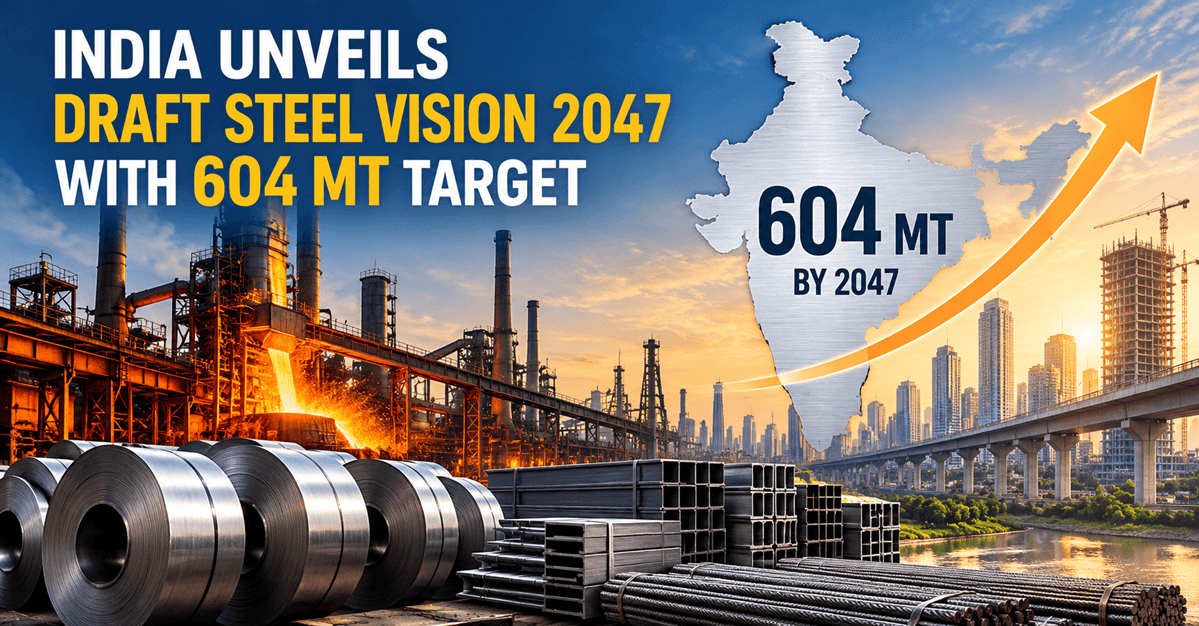
India’s draft Steel Policy Vision 2047 targets 604 million tonnes of crude steel capacity, higher consumption, exports and lower carbon intensity over the next two decades.
✨ Key Takeaways
On October 11, 2026, India released the draft National Steel Policy Vision 2047 for public consultation, targeting a sharp expansion in crude steel capacity to 604 million tonnes by 2047 from around 220 million tonnes currently. The draft also targets finished steel consumption of 505 million tonnes and per-capita consumption of 302 kg by 2047.
Steel Capacity Could Nearly Triple
The proposed policy comes as India seeks to strengthen its position as a major global steel producer while meeting rising demand from infrastructure, manufacturing, Construction and transportation.
India's crude steel production has increased from around 89 million tonnes in 2014-15 to about 170 million tonnes in 2025-26. Installed crude steel capacity currently stands at around 220 million tonnes per annum. The new policy aims to take this capacity to 604 million tonnes by 2047, with crude steel production projected at 531 million tonnes.
Looking for Quality Mid-Cap Growth Opportunities?
Explore DSIJ’s Mid Bridge - a research-driven service focused on fundamentally strong mid-cap companies with robust business models and long-term growth potential.
Download Service BrochureThe government expects finished steel consumption to reach 505 million tonnes by 2047, compared with 164 million tonnes in 2025-26. Per-capita consumption is projected to rise from around 116 kg currently to 302 kg, reflecting the expected expansion of India's economy and infrastructure base.
Raw Material Security Becomes A Key Focus
The expansion will require a significant increase in access to raw materials. The draft policy estimates India's iron ore requirement at around 772 million tonnes by 2047.
Coking coal demand is also projected to rise sharply to around 236 million tonnes. To reduce supply risks, the government plans to diversify sourcing through overseas assets, joint ventures and wider international engagement.
The policy also focuses on improving domestic mining, Logistics and transportation infrastructure to ensure that raw materials can reach steel plants more efficiently.
Government Targets Lower Carbon Intensity
Capacity expansion is only one part of the plan. The government also wants the steel industry to reduce its environmental footprint as production increases.
The draft targets a reduction in average carbon-emission intensity from around 2.54 tonnes of carbon dioxide per tonne of crude steel currently to about 1.54 tonnes by 2047. That represents a reduction of roughly 39 per cent. The target is aligned with India's broader objective of achieving net-zero emissions by 2070.
The policy places greater emphasis on cleaner technologies, energy efficiency, scrap utilisation, digitalisation and higher-value steel products as the industry expands.
Exports Also Part Of The Long-Term Plan
The government is targeting around 45 million tonnes of steel exports by 2047, including direct exports as well as steel embedded in manufactured products. The policy therefore goes beyond meeting domestic demand and aims to strengthen India's position in global steel value chains.
The draft also places emphasis on specialty and value-added steel, technology development and greater domestic manufacturing of critical equipment used in steel production.
What It Means For Steel Companies
The proposed roadmap could create a long-term growth opportunity for India's steel industry, particularly for companies investing in new capacity, specialty steel, cleaner production technologies and raw-material security.
However, the 604 million tonne target is part of a draft policy currently open for public consultation, rather than a final government commitment. Stakeholders can submit suggestions on the draft until October 30, 2026.
If implemented successfully, the policy could reshape India's steel industry over the next two decades, with capacity expansion, higher domestic consumption, export growth and decarbonisation developing alongside each other.
Disclaimer: This article is for informational purposes only and not investment advice.