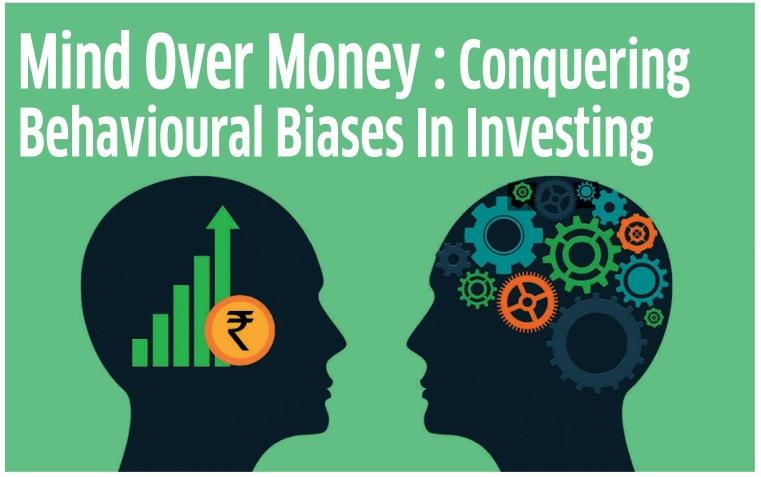
Mind Over Money : Conquering Behavioural Biases In Investing
 Join Us
 Follow Us
Imagine, after conducting thorough research, you are confident that a particular stock will rise.
✨ Key Takeaways
Behavioural biases play a significant role in shaping investment decisions and market behaviour, often leading to irrational outcomes. Biases like overconfidence, loss aversion, and anchoring push individuals to make decisions based on emotions or mental shortcuts instead of clear, logical analysis. The first step in minimising these biases is recognising them. The article points out the various biases that come into play during the investment processes and also provides tips on how you can, as an investor, avoid them
Imagine, after conducting thorough research, you are confident that a particular stock will rise. Based on this analysis, you buy the stock. However, instead of increasing, the stock begins to decline. Rather than re-evaluating your decision, you focus only on news or data that supports your belief that the stock will recover. At the same time, you overlook clear warning signs, such as declining volumes or bearish trends. This leads you to hold on to the stock longer than necessary, allowing your losses to grow from a manageable 10 per cent to a significant 30 per cent.
This scenario is a classic example of confirmation bias. If you were aware about this bias you could have avoided the significant loss. You would have re-evaluated the stock’s performance, being objective as the situation changed. Rather than holding on to your initial belief, you would have recognised the negative signals and exited your position on time, potentially preventing your losses from escalating. To avoid falling for biases and making irrational decisions, it is important to familiarise yourself with the other biases that can influence decision-making.
Research has shown that when people face complex decisions, they often rely on basic judgments and preferences to simplify the situation, rather than acting entirely rationally. While these approaches may seem quick and intuitively appealing, they can lead to suboptimal outcomes. In the field of finance, behavioural biases generally take two forms: cognitive biases (also known as cognitive errors) and emotional biases (which stem from feelings or emotions). Both types of bias, regardless of their origin, can cause decisions to deviate from what is predicted by the traditional finance theory. Within the category of cognitive biases, we further classify them into two sub-categories: belief perseverance biases and processing errors.
Cognitive Biases
Belief Perseverance Biases
Belief perseverance occurs when new information clashes with our existing beliefs, causing discomfort, known as cognitive dissonance. To alleviate this discomfort, people may ignore the new information or distort it to fit their pre-existing beliefs, focusing only on what aligns with their current thinking.
Confirmation bias
It is the habit of focusing only on information that supports what you already believe while ignoring anything that contradicts it. This happens because people naturally try to justify their existing views. It's important to actively consider opposing information and make decisions based on a balanced perspective to avoid this.
Overcoming Confirmation Bias - Before making an investment decision, verify it from multiple angles. For example, if you pick stocks based on price trends (like 52-week highs), also check other factors like the company's financial health, industry performance, or expert analysis. This helps ensure decisions are based on facts, not just personal biases.
Conservatism Bias
This bias happens when people hold on to their old beliefs and fail to adjust adequately based on new, conflicting information. They give more weight to what they already know and less to the new data, leading to weak changes in their views.
Example: After merging in 2018, Vodafone Idea was expected to challenge Jio and Airtel. However, mounting debt, AGR dues and subscriber losses hurt its growth. Despite warnings, some investors held on, relying on its past reputation rather than new data.
Overcoming Conservatism Bias - To overcome this, always ask: "How does this new info change my view?" Instead of ignoring or downplaying new facts, analyse them properly and adjust your thinking accordingly. This follows Bayes' Rule, which is just a fancy way of saying: combine old and new info logically to make better decisions.
Representativeness Bias
Representativeness bias occurs when we judge new information based on what we have experienced before, even if it is actually different. This can lead to incorrect conclusions. One type of this bias is base-rate neglect, where people ignore broader trends or data about a larger group and focus too much on specific details that might not be as reliable. Another type is sample-size neglect, where people assume that small amounts of data accurately represent a larger population, even though they may not. In investing, this can mean overvaluing one stock or a small set of data without considering the bigger trends or context.
Example: When Paytm launched its IPO in 2021, many investors jumped in, expecting it to replicate the success of past technology IPOs like Zomato. However, Paytm suffered high losses, an uncertain business model and tough competition. Ignoring these factors, many invested based on past IPO trends, leading to heavy losses post-listing. Rather, investors would have done better if they had analysed Paytm as an individual entity in terms of what its business model was and whether it would be sustainable over the long term despite the mounting competition.
Overcoming Representativeness Bias - You could ask yourself: Is this new IPO really like the successful one I am comparing it to? By researching how similar IPOs usually perform and checking the company’s fundamentals, you would make a more informed decision instead of relying on just one past example.
Illusion of Control Bias
The illusion of control bias occurs when people believe they can influence events they can’t actually control. For example, someone might feel more confident in winning the lottery if they pick their own numbers, even though it’s purely based on chance.
Example: Imagine you pick a stock based on a gut feeling or some quick research, thinking you can make a profit. You believe that by choosing this stock, you will outsmart the market. However, the stock market is unpredictable, and even the best research or instincts can’t guarantee success. Many factors, like unexpected news or market shifts, can affect the stock, making it hard to control or predict the outcome.
Overcoming Illusion of Control Bias - To avoid the illusion of control bias, understand that investing is about probabilities, not control. Even large firms can’t predict outcomes because many factors affect investments. Before investing, consider the risks and what could go wrong. It helps to get an opposing view, like speaking with someone who doesn’t agree with your choice, to make a more balanced decision.
Hindsight Bias
Hindsight bias occurs when people believe that past events were predictable or should have been expected, even though they weren’t at the time. It’s easy to think you knew what would happen after it already happened.
Example: In 2020, a trader watched Zomato’s fluctuating stock after its IPO and thought, “It’s too risky, I will wait.” But when Zomato’s stock surged in 2021-22, the trader might say, “I should have invested when I saw it coming,” forgetting the uncertainties and risks at the time. This is hindsight bias, where past decisions seem clearer after knowing the outcome.
Overcoming Hindsight Bias - To avoid hindsight bias, it’s important to ask yourself, “Am I being honest about the reasons I made this decision, or am I just looking back and thinking it was obvious?” One way to fight this bias is by keeping a written record of your decisions and why you made them when they happened. This way, when you look back, you can refer to the actual reasons behind your choices, rather than relying on your memory, which might be influenced by the outcome.
Processing Errors Processing errors happen when we process information in a faulty or irrational way. It’s not about remembering how things went wrong but about how we understand or use the information itself, leading to flawed decisions.
Anchoring and Adjustment Bias
Anchoring and adjustment bias occurs when people base their decisions on an initial piece of information (the ‘anchor’) and then make small adjustments from it, even if the initial information isn’t perfect. This often leads to biased conclusions because the adjustments are insufficient.
Example: Suppose a retail trader watches a random inexperienced YouTuber’s stock recommendation and gets the impression that the target price of a particular stock is ₹1,200. Despite the stock’s fundamentals pointing to a lower value, the trader continues to believe it will reach ₹1,200, as he has become anchored to the YouTuber’s prediction.
Overcoming Anchoring and Adjustment Bias - Traders should ask, “Am I holding this stock because of solid reasoning, or because I am fixated on a YouTuber’s prediction or my own mental target price?” Stock prices change with future conditions, not just past data. Rely on current analysis, not outdated predictions. Always question if your decisions are based on facts or just a previous number you have locked in your mind. Staying flexible with your approach can help you make better, more informed choices.
Mental Accounting Bias
Mental accounting bias occurs when individuals mentally separate their money into different ‘accounts’ for specific purposes, even though all money is the same. This can affect decision-making because it leads people to treat funds differently based on arbitrary categories, instead of considering their overall financial situation.
Example: Suppose you have received a year-end bonus of `20,000 or earned some unexpected income. Instead of treating it as part of your overall wealth, you considered it ‘extra’ money and decide to take a risky bet by buying Nifty call options. Unfortunately, the trade doesn’t go as planned, and you lose the entire amount. This is a classic example of mental accounting bias, where the bonus was mentally separated from your main finances, leading to a risky decision.
Overcoming Mental Accounting Bias - This bias can cause you to take unnecessary risks because you mentally separate your money into different ‘buckets’ instead of looking at your total wealth as a whole. To avoid this, gather all your investments, savings and assets on one spreadsheet without dividing them into categories. Seeing everything together will give you a clear picture of your actual financial position. This helps you plan a better investment strategy by considering all your assets and reducing unintentional risks.
Framing Bias
Framing bias happens when decisions change based on how information is presented. Narrow framing is when someone focuses on small details and misses the bigger picture, leading to poor choices.
Example: Imagine you come across a stock being promoted because it gives an 8 per cent dividend yield. It sounds great— who doesn’t like extra income? But here’s what many traders ignore: the stock’s price might be dropping significantly. So, while you earn that 8 per cent dividend, the stock’s falling value could wipe out your overall returns, leaving you at a loss. The focus on the high dividend blinds you to the big picture of how much money you might actually lose.
Overcoming Framing Bias - Investors should try not to focus on past gains or losses. Instead, they should focus on the future and make decisions based on what’s best moving forward, without letting emotions or previous outcomes cloud their judgment. The key is to stay neutral and open-minded when making decisions.
Availability Bias
This bias creeps in when we judge something based on how easily we can remember similar information. For example, if we quickly recall a past success, we might think the same outcome will happen again, even if it’s not likely. It can also happen when we rely too much on personal experiences or familiar categories when making decisions, and ignore other possibilities. Essentially, we often make decisions based on what’s easiest to remember, rather than looking at all the facts or considering different perspectives.
Example: With the recent market fall, a trader hears a lot of bad news about the overall market and assumes that all stocks are risky. Because this negative news is fresh in their minds, they might avoid investing in the market entirely, even though some stocks or sectors could still offer good opportunities. This is availability bias, where recent events influence their decision to stay out of the market.
Overcoming Availability Bias - In the case of the recent market fall, investors should have a clear strategy and research their options thoroughly. Instead of making decisions based on recent bad news, they should ask themselves, “Why am I avoiding the market? Is it because of the negative headlines I have seen?” Sometimes, a market drop can actually present the best buying opportunity. Focusing on long-term trends and data helps prevent decisions based solely on what’s currently getting media attention.
Emotional Biases
Emotional biases are cognitive biases that arise from our feelings, emotions or moods rather than from objective facts or logical reasoning. These biases can affect decision-making, often leading people to make irrational or biased choices. Emotional biases are harder to fix than cognitive ones because they come from gut feelings or intuition, not careful thought.
Loss-Aversion Bias
This happens when people feel the pain of losing money more strongly than the happiness of gaining money. In other words, losing ₹1,000 feels worse than how good it feels to gain ₹1,000. Because of this, people often make decisions that are more about avoiding loss than about trying to make a gain.
Example: Suppose an investor has invested in Yes Bank at ₹400 per share. Over time, due to financial troubles, the stock price drops to ₹50. Instead of cutting the losses and selling the shares, the investor holds on, hoping the stock will recover to ₹400 or higher in the future, even though there’s no clear indication that it will. Currently, after six years, the stock is still trading at ₹18.
Overcoming Loss-Aversion Bias - To overcome lossaversion bias, a disciplined investment approach is the key. While we can't avoid the emotional pain of loss, analysing investments and considering the chances of both gains and losses helps make more rational decisions, rather than holding on to losing investments out of fear.
Overconfidence Bias
Overconfidence bias is when people overestimate their abilities, especially in investing. They might make predictions with too much certainty or a narrow view, ignoring market fluctuations. This bias is driven more by emotions like hope or gut feeling than by solid analysis.
Example: Overestimating stock picks happens when a trader is overly confident that a stock will rise, ignoring the risks. When it doesn’t perform as expected, they refuse to admit they were wrong and keep hoping the stock will recover, thinking they will be proven right in the end.
Overcoming Overconfidence Bias - Investors should review their past trades, including both winners and losers, to identify mistakes and patterns. By being objective and learning from both good and bad decisions, they can avoid repeating errors and make better choices in the future.
Self-Control Bias
Self-control bias occurs when people choose short-term satisfaction over long-term goals. They struggle to make sacrifices now for bigger rewards later, often because they prefer immediate gratification over waiting for larger benefits in the future.
Example: Let’s consider an investor who purchases Trent Limited’s stock at ₹1,000 per share. Over the next few months, the stock price rises to ₹1,500. Instead of holding on to the stock to potentially benefit from further growth, the investor decides to sell and secure a quick ₹500 profit. Subsequently, the stock price continues to climb, reaching ₹8,000. By selling early, the investor misses out on an additional ₹6,500 gain due to the desire for immediate profit.
Overcoming Self-Control Bias - To avoid short-term temptations, investors should have a clear, written plan and regularly review it. They should also keep a balanced mix of investments, focusing on long-term goals rather than quick gains.
Status Quo Bias
Status quo bias occurs when people prefer to keep things the same, even if making a change would be better. They stick with their current situation out of habit or comfort, rather than making a conscious decision to improve or change things.
Example: An investor has a portfolio with 60 per cent stocks and 40 per cent bonds. Over time, stocks perform well, but instead of rebalancing, the investor avoids making changes, sticking with the current mix even though it now carries more risk. This happens because the investor is comfortable with the existing setup and doesn’t want to deal with the hassle of adjusting it. However, by not rebalancing, the investor is exposing himself to higher risk, as the portfolio is now more heavily invested in stocks.
Overcoming Status Quo Bias - To overcome status quo bias, it’s important to understand the benefits of change. Investors should learn about the advantages of spreading their investments across different assets to reduce risk and increase returns. For example, if someone is heavily invested in one stock, showing them how much they could lose if that stock crashes might convince them to diversify and protect their wealth.
Endowment Bias
Endowment bias occurs when people value something more just because they own it. For example, you might be willing to sell an item for a certain price, but if you are trying to buy the same item, you may not want to pay as much. This bias happens because owning something makes us feel it’s worth more, even though the price should be the same whether we are buying or selling.
Example: An investor buys XYZ Ltd. at ₹500 per share. The stock drops to ₹300, but the investor refuses to sell, thinking it will recover just because they own it, even though there’s no strong reason for it to bounce back.
Overcoming Endowment Bias - Wealth managers should help clients view inherited or owned investments more objectively. They can ask, “If you had cash instead of these investments, how would you invest it now?” This shift focuses from the past to the present, helping investors make better decisions based on current opportunities, not past attachments.
Regret-Aversion Bias
Regret-aversion bias occurs when people avoid making decisions because they fear they will regret the outcome. This bias makes people more afraid of the consequences of taking any action, like making a bad investment, than of doing nothing at all. The regret they feel from making a wrong decision feels stronger than the regret of missing out on an opportunity by not acting. So, they often choose to do nothing instead of taking a risk.
Example: An investor sees a stock’s strong performance and potential for growth but hesitates to invest because they worry the stock might fall. They fear the regret of losing money if the investment doesn’t succeed, so they decide to avoid investing altogether. In the end, they stay on the side-lines, missing out on potential gains if the stock continues to rise.
Overcoming Regret-Aversion Bias - Investors need to understand the benefits of spreading their investments across different assets. This reduces the risk of making bad choices based on fear. It’s important to accept that losses are a normal part of investing and focus on long-term growth. By having a well-balanced portfolio, investors can avoid being too cautious or taking on too much risk just because of past regrets.
Conclusion
Behavioural biases play a significant role in shaping investment decisions and market behaviour, often leading to irrational outcomes. Biases like overconfidence, loss aversion, and anchoring push individuals to make decisions based on emotions or mental shortcuts instead of clear, logical analysis. The first step in minimising these biases is recognising them. Once investors understand how these biases affect their decisions, they can take steps to reduce their impact—such as creating clear investment strategies, focusing on long-term goals, and diversifying portfolios.
Staying emotionally disciplined and seeking professional advice can also help reduce the effects of biases. While it’s impossible to fully eliminate biases, increasing self-awareness and adopting a structured approach to investing can help limit their negative impact. By addressing these biases, investors are more likely to make rational decisions, leading to better financial outcomes. As markets become more complex, understanding and managing these biases is crucial for making sound investment choices and achieving long-term success.