M&M Share Price Hits Two-Month High: Why Is the Stock Rallying on Dhanteras?
 Join Us
 Follow Us

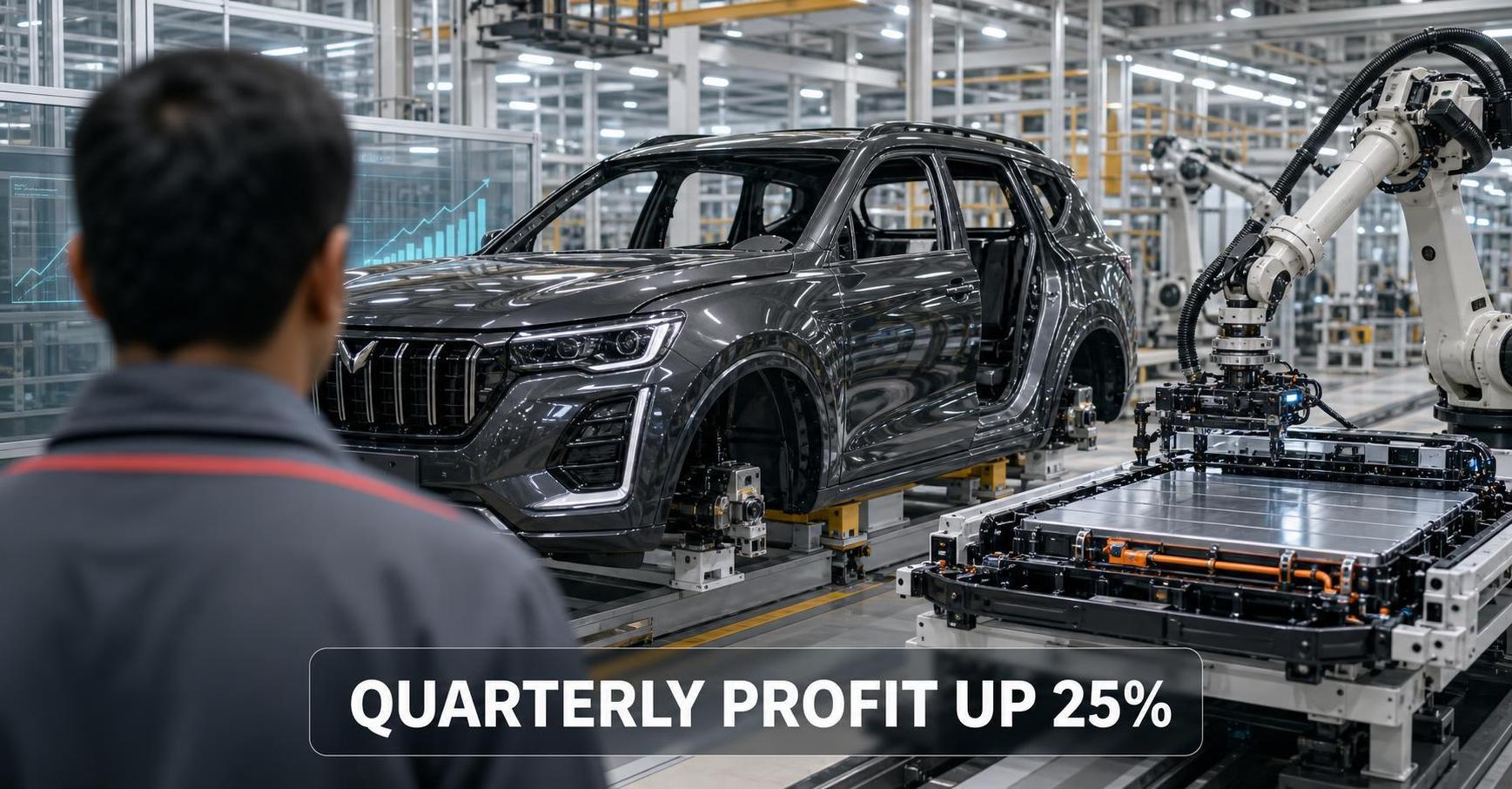
Mahindra & Mahindra’s Q2 FY27 consolidated revenue and profit rose 25 per cent, driven by strong SUV and EV demand, while farm profitability weakened amid commodity inflation and softer international operations.
✨ Key Takeaways
Mahindra & Mahindra’s automotive business has become the group’s principal growth engine as it expands SUV and electric-vehicle capacity, while its farm business remains exposed to commodity costs and overseas agricultural cycles. The company reported a 25 per cent rise in consolidated revenue to Rs 57,553 crore in the second quarter of FY27, while profit after Tax (PAT) increased 25 per cent to Rs 4,588 crore.
For the first half of FY27, consolidated revenue grew 26 per cent to Rs 1,15,741 crore and PAT rose 29 per cent to Rs 10,042 crore. The group reported an annualised return on equity of 21 per cent for the half year. Standalone revenue rose 26 per cent to Rs 44,282 crore in the quarter, although standalone PAT growth was lower at 13 per cent, reflecting cost pressures in the core manufacturing businesses.
Auto was the largest contributor to the increase in consolidated profit. The segment’s revenue climbed 39 per cent to Rs 37,756 crore and profit before interest and tax (PBIT) rose 31 per cent to Rs 3,319 crore. SUV volumes increased 26 per cent to 1.83 lakh units, helping M&M retain the leading SUV revenue market share of 24.3 per cent. Light commercial vehicle volumes below 3.5 tonnes rose 19 per cent, with market share improving to 52.3 per cent.
Electric vehicles added to the momentum. M&M billed 23,345 electric SUVs during the quarter and captured a 23.2 per cent volume market share in the category. It plans to increase SUV and EV operating capacity to 82,000 units a month by the end of FY27, from 64,500 units at the end of FY26. However, Auto PBIT margin for SUVs and light commercial vehicles fell to 9.8 per cent from 11.0 per cent a year earlier, as commodity inflation continued to weigh on profitability.
The farm business presented a contrasting picture. Volumes rose 6 per cent to 1.16 lakh units and market share improved by 150 basis points to 41.5 per cent, but consolidated revenue declined 6 per cent to Rs 9,572 crore. Farm PBIT fell 14 per cent, while the segment’s PBIT margin declined to 14.4 per cent from 15.7 per cent. Mahindra Finance and Tech Mahindra offered support, with their PAT rising 61 per cent and 33 per cent, respectively.
As of 9:55 am on November 6, 2026, M&M shares were trading at Rs 3,265.35, up 5.2 per cent from the previous close. The stock remained 14.4 per cent lower over one year, compared with a 2.2 per cent decline in the BSE 500 over the same period. Its market capitalisation stood at about Rs 3.86 lakh crore, while domestic institutional ownership rose 1.62 percentage points to 34.25 per cent.
What This Means for Investors
The quarter reinforces M&M’s dependence on Auto for earnings acceleration. Higher SUV volumes, improving revenue market share and rising EV penetration support the company’s strategy of scaling premium utility vehicles and electric mobility. The planned capacity expansion is important because current production limits could otherwise constrain volume growth. Stronger profit at Mahindra Finance and Tech Mahindra also broadens the group’s earnings base beyond vehicles and tractors.
The result is mixed on profitability. Auto PBIT margin contracted despite robust volume growth, showing that commodity inflation, hedging and pricing remain central variables for near-term earnings. Farm retained market-share leadership, but weaker international operations and lower margins underline the sensitivity of the segment to rural conditions and input costs. At 19.91 times trailing 12-month earnings, the valuation reflects expectations of sustained execution in SUVs, EVs and group businesses. The pace of capacity commissioning and margin recovery will remain the key tests.
Disclaimer: The article is for informational purposes only and not investment advice.