Paytm Shares Surge 7% After UPI Rule Change: Big Money Opportunity Ahead?
 Join Us
 Follow Us
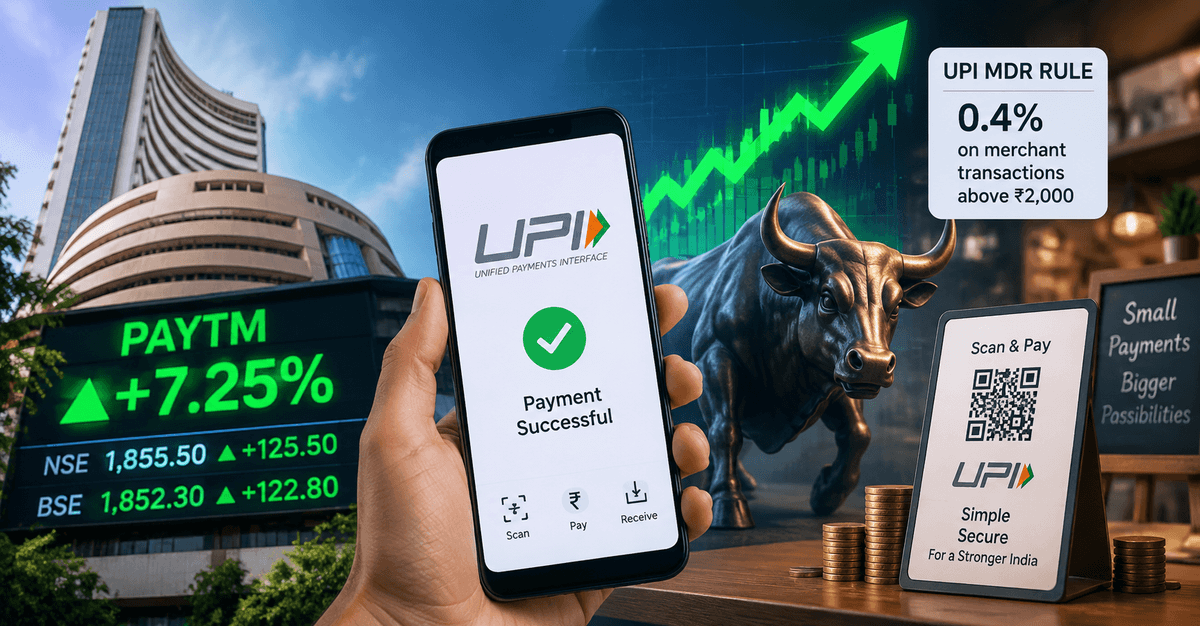
Paytm shares surged after NPCI introduced a new UPI MDR framework for merchant transactions above Rs 2,000. The move has renewed focus on whether UPI monetisation can create a new revenue opportunity for digital payment platforms.
✨ Key Takeaways
Shares of One 97 Communications, the parent company of Paytm, gained sharply on September 16 after investors reacted positively to the updated UPI fee framework. The stock jumped 7.25 per cent to touch an Intraday and 52 week high of Rs 1,855.50 on the NSE, compared with its previous close of Rs 1,730. Trading activity also increased significantly, with combined NSE and BSE volumes crossing 7 million shares during the session.
However, after the initial rally, the stock witnessed some profit booking and gave up a part of its gains. The movement reflected investor expectations that a clearer revenue model for UPI transactions could benefit digital payment companies.
Looking for Quality Mid-Cap Growth Opportunities?
Explore DSIJ’s Mid Bridge - a research-driven service focused on fundamentally strong mid-cap companies with robust business models and long-term growth potential.
Download Service BrochureNPCI Introduces MDR On UPI Merchant Payments Above Rs 2,000
The National Payments Corporation of India (NPCI) has introduced a 0.4 per cent Merchant Discount Rate (MDR) on UPI merchant transactions above Rs 2,000. The new framework will be effective from October 15, 2026. The charge will apply only to person to merchant (P2M) transactions above Rs 2,000. Payments between individuals and smaller merchant transactions will continue under the existing free UPI structure.
The Ministry of Finance has clarified that customers making payments through UPI will not be required to pay any charges. The MDR will be applicable within the merchant payment ecosystem, where merchants pay the fee to payment service providers involved in processing transactions.
Why The New Rule Matters For Paytm
The development is important for Paytm because merchant payments remain a key part of its digital payments ecosystem.
Until now, UPI transactions generated limited direct revenue for payment platforms because merchants were not charged MDR on UPI payments. Despite processing billions of transactions, payment companies had limited opportunities to monetise this large payment network.
The introduction of MDR on selected higher value merchant transactions creates a possible new revenue stream for payment aggregators and other participants in the UPI ecosystem. Paytm said the new framework will generate additional revenue from merchant transactions that were previously free. The company also highlighted that customers will continue to use UPI without any charges.
What Is MDR And Who Will Pay The Fee?
Merchant Discount Rate, or MDR, is a fee charged within the digital payment ecosystem for processing merchant transactions. Under the new structure, merchants will pay the MDR on eligible UPI transactions above Rs 2,000. Customers making payments through UPI will not directly bear this cost. The government has also clarified that users will continue to have free and unlimited access to UPI payments without monthly restrictions or transaction limits.
However, the impact on merchants will need to be watched once the new framework becomes operational. Some businesses may absorb the additional cost, while others may review their pricing strategies.
Also Read - Free UPI At Risk? Government’s New Rs 2,000 Rule Explained
Digital Payments Sector Moves Towards Monetisation
The UPI ecosystem has grown rapidly over the last few years, becoming one of the largest digital payment networks globally. However, the zero MDR structure has remained a challenge for payment companies that have invested heavily in technology, infrastructure and transaction processing capabilities. The introduction of MDR on selected transactions marks a shift towards creating a more sustainable revenue model for the digital payment ecosystem.
For companies such as Paytm, Banks and other payment service providers, the key factor will be how much additional revenue this framework generates and how merchants respond after implementation.
Disclaimer: This article is for informational purposes only and should not be construed as investment advice.