Rs 4,000 Crore Opportunity: Solar Company’s Expansion Plan Enters Next Phase
 Join Us
 Follow Us
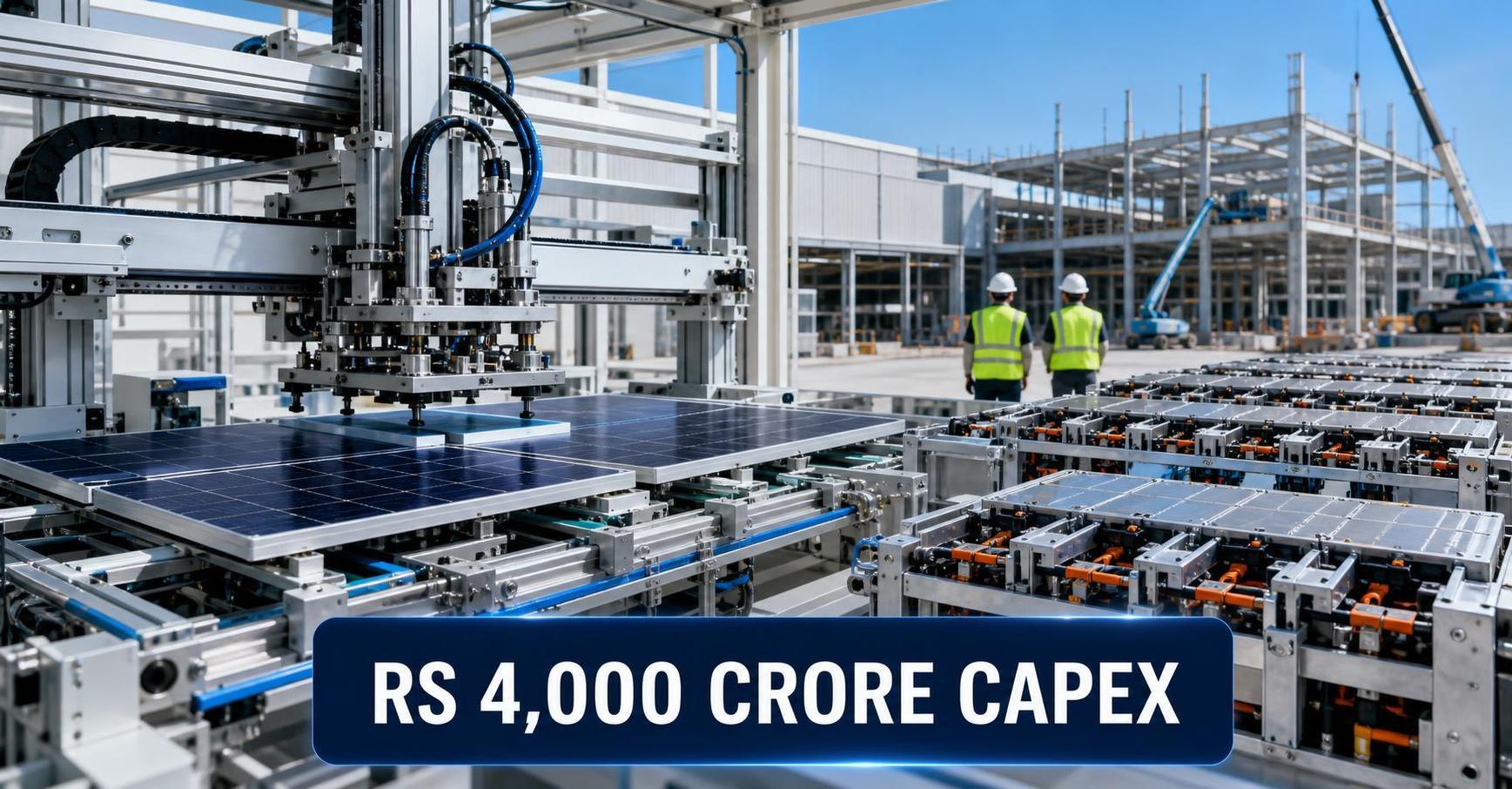
Solex Energy has outlined a Rs 4,000 crore expansion programme through FY30 after FY26 revenue rose 143.9 per cent to Rs 1,621.1 crore, supported by order visibility above Rs 3,400 crore.
✨ Key Takeaways
Solex Energy Limited has set a revenue-potential target of more than Rs 4,500 crore by FY28 as it seeks to move beyond Solar-module manufacturing into solar cells and battery energy storage systems.
The company, at its 12th Annual General Meeting held through video conferencing, said it plans to invest around Rs 4,000 crore between FY27 and FY30. The programme will fund solar-cell manufacturing and battery-pack and container-assembly capacity, marking its largest proposed expansion programme so far.
The strategy follows a sharp rise in FY26 financial performance. Consolidated revenue rose 143.9 per cent year on year to Rs 1,621.1 crore, while EBITDA increased to Rs 186.7 crore and profit after Tax reached Rs 98.3 crore. The company reported order visibility of more than Rs 3,400 crore, equivalent to over twice its FY26 revenue, providing a sizeable pipeline as it increases manufacturing scale.
However, the rapid growth did not translate into an expansion in reported margins. EBITDA margin was about 11.5 per cent in FY26, compared with 12 per cent in the preceding year, while net profit margin declined to around 6.1 per cent from 6.4 per cent. This makes successful backward integration into solar cells important to Solex’s plan to improve control over input costs and supply reliability.
Looking for High-Growth Stocks Below ₹100?
Explore DSIJ’s Penny Pick - a research-driven service focused on uncovering fundamentally strong low-priced stocks with long-term growth potential.
Download Service BrochureSolex currently has 4 GW of solar-module manufacturing capacity at Tadkeshwar in Gujarat. Its next manufacturing phase includes 2.2 GW of solar-cell capacity by FY28, which is to be scaled up to 5.2 GW by early FY29. It is also developing 10 GWh of battery-pack and container-assembly capacity, beginning with a 5 GWh phase targeted for FY29.
The planned expenditure is around 2.5 times Solex’s FY26 revenue, underlining both the scale of its ambition and the execution demands attached to the programme. The company has said it will maintain discipline in capital deployment, technology investments and project execution.
Management sees the expansion as a response to rising electricity demand from electric mobility, industrial electrification, artificial intelligence, data centres and other energy-intensive applications. Solar generation increasingly requires storage integration to manage intermittency and improve the reliability of power supply, creating a longer-term opportunity for battery systems alongside modules and cells.
Chairman and Managing Director Dr Chetan Shah said the company was building ‘an integrated, technology-driven and globally competitive energy platform from India’, with an emphasis on resilience through industry cycles.
The company is also pursuing overseas opportunities through Solex Europe and Solex USA, targeting customer partnerships in markets seeking diversified renewable-energy supply chains. Its annual report had identified Europe, the United States, and the Middle East and Africa as relevant export markets, although management has indicated that exports are expected to remain a relatively small contributor in the near term.
The capacity programme also carries funding, infrastructure and execution risks. In recent management commentary, Solex said the proposed cell-manufacturing project required closure of financing arrangements and formal electricity approvals. Cell manufacturing is more technically complex than module assembly, and the commissioning and ramp-up of the proposed TOPCon cell line will be a key milestone for the company’s margin and integration plans.
As of 3:53 pm on September 22, 2026, Solex Energy shares were trading at Rs 679.00, down 2.19 per cent from the previous close of Rs 694.20. The stock was about 23.3 per cent below its 52-week high of Rs 884.90 and around 3.1 per cent above its 52-week low of Rs 658.60.
Disclaimer: The article is for informational purposes only and not investment advice.