Shakti Pumps invests Rs 10 crore in subsidiary for 2.20 GW solar cell and module plant
 Join Us
 Follow Us
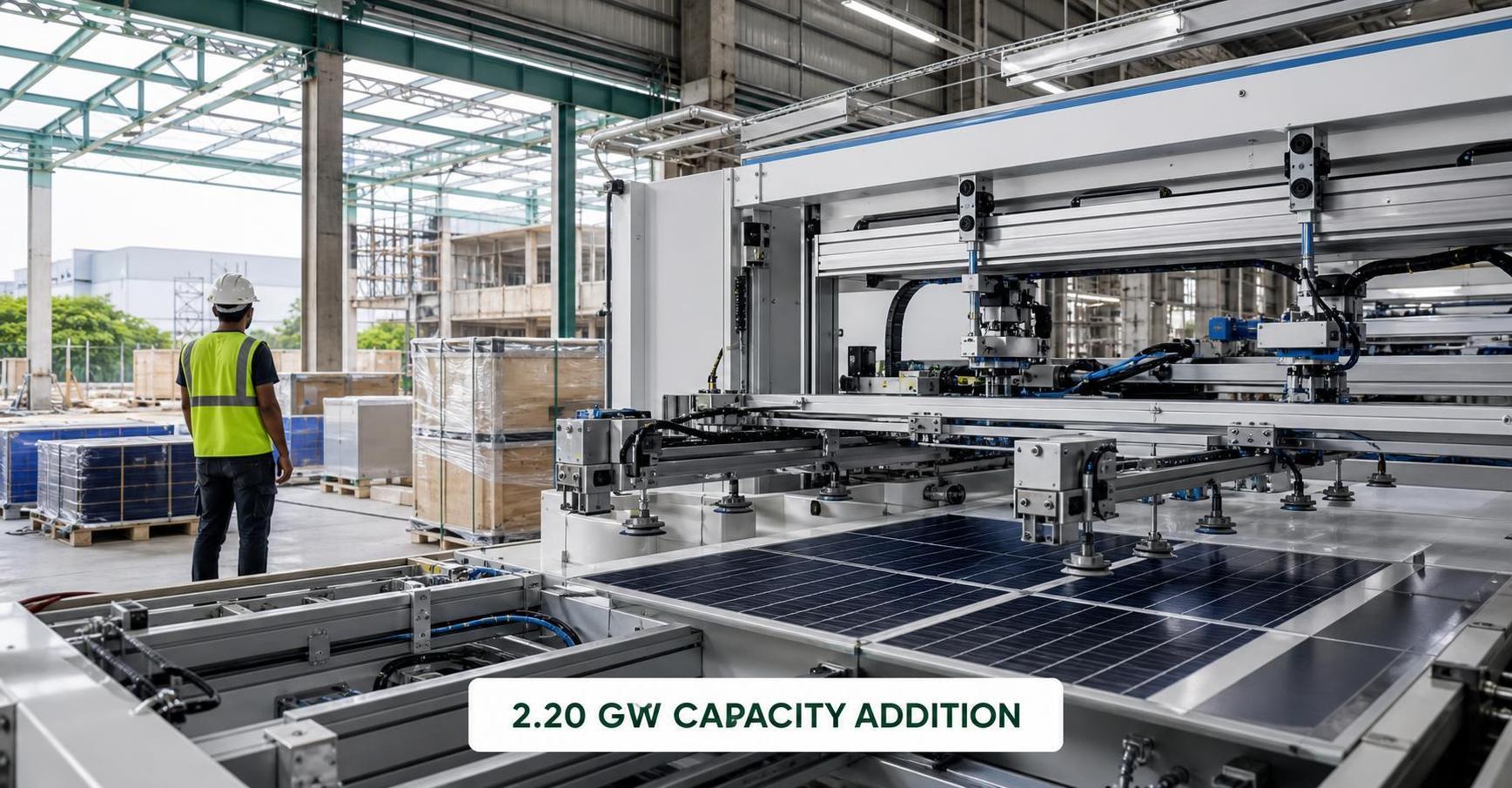
Shakti Pumps has invested Rs 10 crore in wholly owned Shakti Energy Solutions to develop a 2.20 GW solar DCR cell and PV module facility at Pithampur.
✨ Key Takeaways
Shakti Pumps (India) Ltd has invested Rs 10 crore in its wholly owned subsidiary, Shakti Energy Solutions Ltd, to establish a greenfield, high-efficiency Solar domestic content requirement, or DCR, cell and solar photovoltaic module manufacturing plant at Pithampur in Madhya Pradesh.
The proposed facility is planned with a production capacity of 2.20 GW. The investment was made in cash through subscription to equity shares of Shakti Energy Solutions, with shares to be issued from time to time under the agreement. The company said the transaction was completed on the same day.
The investment is a small initial equity infusion relative to the wider manufacturing programme outlined by Shakti Pumps, but it advances a strategically important backward-integration plan. The company had earlier indicated a broader Rs 1,200 crore investment programme for a 2.20 GW DCR cell and module facility. Establishing domestic cell capability could reduce its Reliance on external suppliers for a component that management has previously identified as a major cost element in solar pumping systems.
Looking for Quality Mid-Cap Growth Opportunities?
Explore DSIJ’s Mid Bridge - a research-driven service focused on fundamentally strong mid-cap companies with robust business models and long-term growth potential.
Download Service BrochureDCR-compliant solar cells accounted for around 40 per cent to 50 per cent of the cost of a solar pump set, according to the company’s FY2026 annual report. This dependency has become more relevant as domestic-content requirements tighten for government-linked renewable-energy programmes. Shakti Pumps has said ALMM List-II DCR compliance would become mandatory from June 2026 for PM-KUSUM, PM Surya Ghar and other major government-linked solar schemes.
For Shakti Pumps, which derives a substantial part of its business from state-led solar-pump programmes, captive cell and module manufacturing could help improve supply security, tender execution and control over input costs. Management had previously estimated that full backward integration could potentially add around 3 percentage points to EBITDA margin, although that remains contingent on commissioning, utilisation and cost-effective operations.
Shakti Energy Solutions, incorporated on September 6, 2010, currently manufactures solar structures and operates in solar rooftop and other businesses. It is expanding into DCR solar cell and PV module manufacturing. The subsidiary recorded turnover of Rs 239.11 crore in FY2026, up from Rs 216.53 crore in FY2025 and Rs 139.59 crore in FY2024, indicating that it has already become a meaningful operating arm within the group.
The parent company’s latest quarterly performance highlights both the need and the potential benefit of the proposed integration. Net sales rose 37.94 per cent year-on-year to Rs 858.67 crore in the June 2026 quarter, but PBIDT excluding other income fell 42.29 per cent to Rs 82.86 crore. The corresponding margin declined to 9.65 per cent from 23.06 per cent a year earlier, amid higher raw-material costs, lower realisations on some orders and elevated Logistics expenses.
Shakti Pumps had an outstanding Order Book of about Rs 1,000 crore as of July 22, 2026, largely linked to government solar-pump projects. Its ability to build domestic module and cell capacity will therefore be watched alongside execution of this pipeline, working-capital management and the timing of new orders under PM-KUSUM 2.0.
The company said no government or regulatory approvals are required for the equity investment. It also stated that the transaction does not fall under related-party transaction requirements despite Shakti Energy Solutions being a wholly owned subsidiary, and that arm’s-length considerations were not applicable.
As of 3:54 PM on October 12, 2026, Shakti Pumps shares were trading at Rs 418.30. The stock was in its 52-week low range at Rs 419.35 and had declined 49.32 per cent over one year, compared with a 6.29 per cent fall in the BSE 500 over the same period.
Disclaimer: The article is for informational purposes only and not investment advice.