Tata Motors Partners with Amazon to Deploy 3,000 Electric Trucks in India’s Largest E-Truck Rollout by an E-Commerce Company
 Join Us
 Follow Us

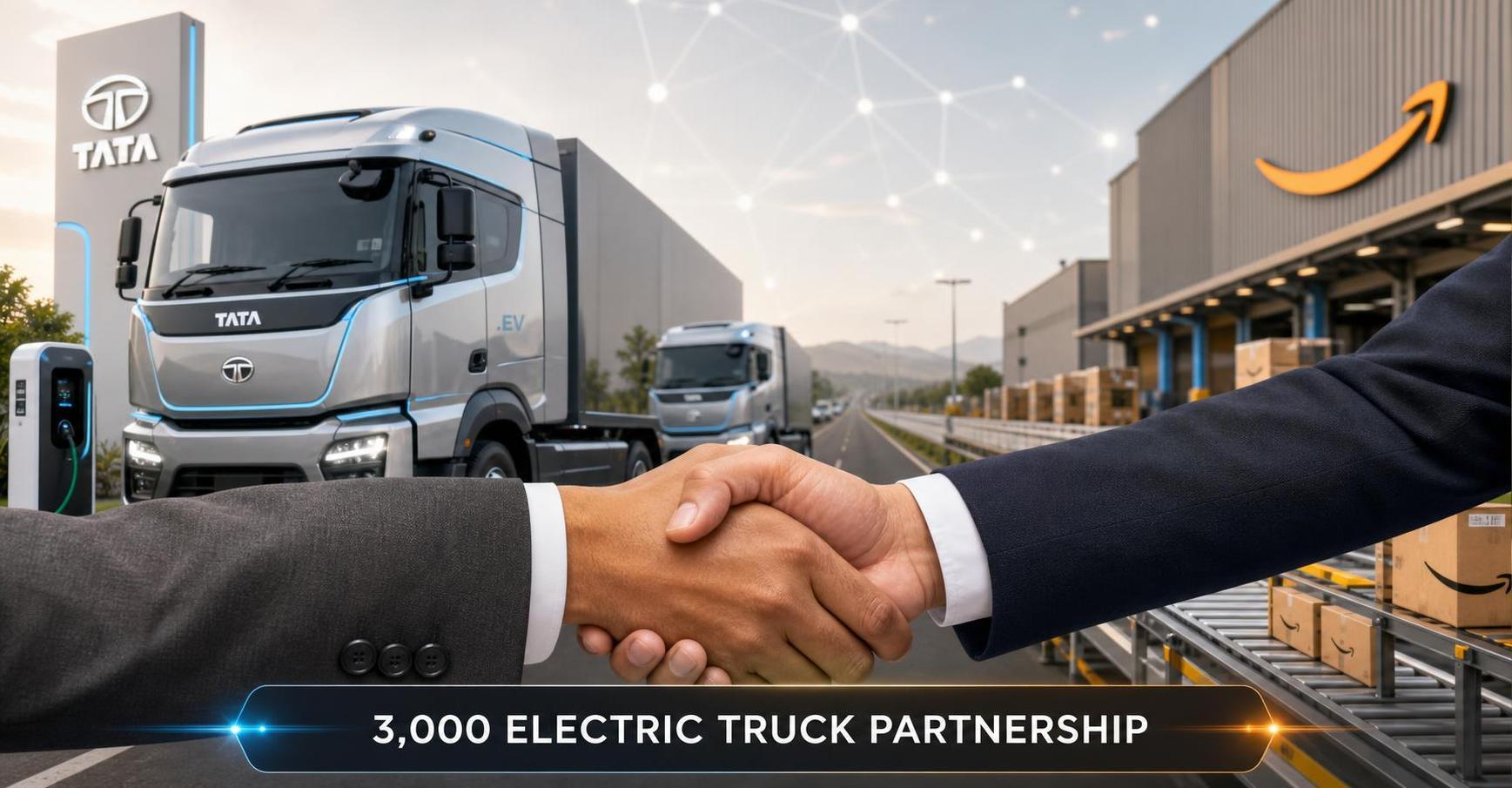
Tata Motors will supply 3,000 electric trucks for Amazon’s India logistics network, beginning with Delhi deployments during the festive season and expanding towards major freight corridors.
✨ Key Takeaways
Tata Motors has been expanding its electric commercial-vehicle portfolio as freight operators focus on operating costs, vehicle uptime and lower emissions. The company recorded 26 per cent YoY growth in commercial-vehicle wholesales in the June 2026 quarter and has now partnered with Amazon to deploy 3,000 electric trucks across the e-commerce company’s transportation network in India.
The first batch of Tata electric trucks was flagged off in Delhi on October 27, 2026. Tata Motors will supply the vehicles, while Amazon’s carrier partners will own and operate them. The initial deployment will support middle-mile Logistics, including the movement of customer shipments between facilities, across cities and on freight routes.
Amazon said the programme is the largest electric-truck deployment by an e-commerce company in India. The rollout begins during the festive season, when shipment volumes typically rise across e-commerce and retail supply chains. Tata Motors will initially provide light- and medium-duty Tata Ultra E.7 electric trucks, which feature an integrated electric axle, regenerative braking, fast-charging capability and high-voltage safety systems.
The companies plan to extend the programme to key national highways, with an ambition to electrify the 2,800-km Delhi-Bengaluru-Chennai corridor on NH48. The route spans seven states and links six large e-commerce regions. Charging hubs being developed with Yahhvi will support the expansion, building on 10 charging yards already developed by the provider for Amazon in India.
The Delhi rollout also coincides with the city’s 2026 electric-vehicle policy. The first 1,000 privately owned medium-duty electric trucks registered within three months of the policy’s launch will receive 10-year permission to enter Delhi at all hours, bypassing usual restrictions. For Tata Motors, the programme provides a significant operating deployment for its electric-truck platform. Execution will depend on charging availability, vehicle uptime and carrier economics as routes expand beyond city operations.
As of 1:00 pm on October 27, 2026, Tata Motors shares were trading at Rs 402.55, up 4.97 per cent from the previous close of Rs 383.50. The stock remained about 20.3 per cent below its 52-week high of Rs 504.90. Tata Motors had a market capitalisation of Rs 1,41,235 crore, while foreign institutional ownership rose by 0.44 percentage points and domestic institutional ownership increased by 0.16 percentage points in the latest reported period.
What This Means for Investors
The agreement gives Tata Motors a reference deployment in a segment where scale is central to electric-truck economics. A 3,000-vehicle programme, if converted on schedule, could support production volumes, service revenues and operating learning. It fits the company’s effort to expand battery-electric commercial vehicles alongside higher-payload trucks and follows more than 3,400 electric-vehicle orders across segments. Carrier ownership limits Tata Motors’ direct fleet capital requirement while placing emphasis on vehicle reliability, charging availability and after-sales support.
For investors, the development is strategically supportive rather than an immediate earnings event because pricing and delivery phasing have not been disclosed. The main uncertainty is the execution of charging hubs and carrier economics at scale. That matters while electric-truck profitability remains below that of internal-combustion-engine vehicles at current volumes, according to management. September-quarter profitability also showed sensitivity to commodity costs and mix, reinforcing the need for scale and cost control.
Disclaimer: The article is for informational purposes only and not investment advice.