The Brands You Think Are Rivals Are Often Owned by the Same Company
 Join Us
 Follow Us
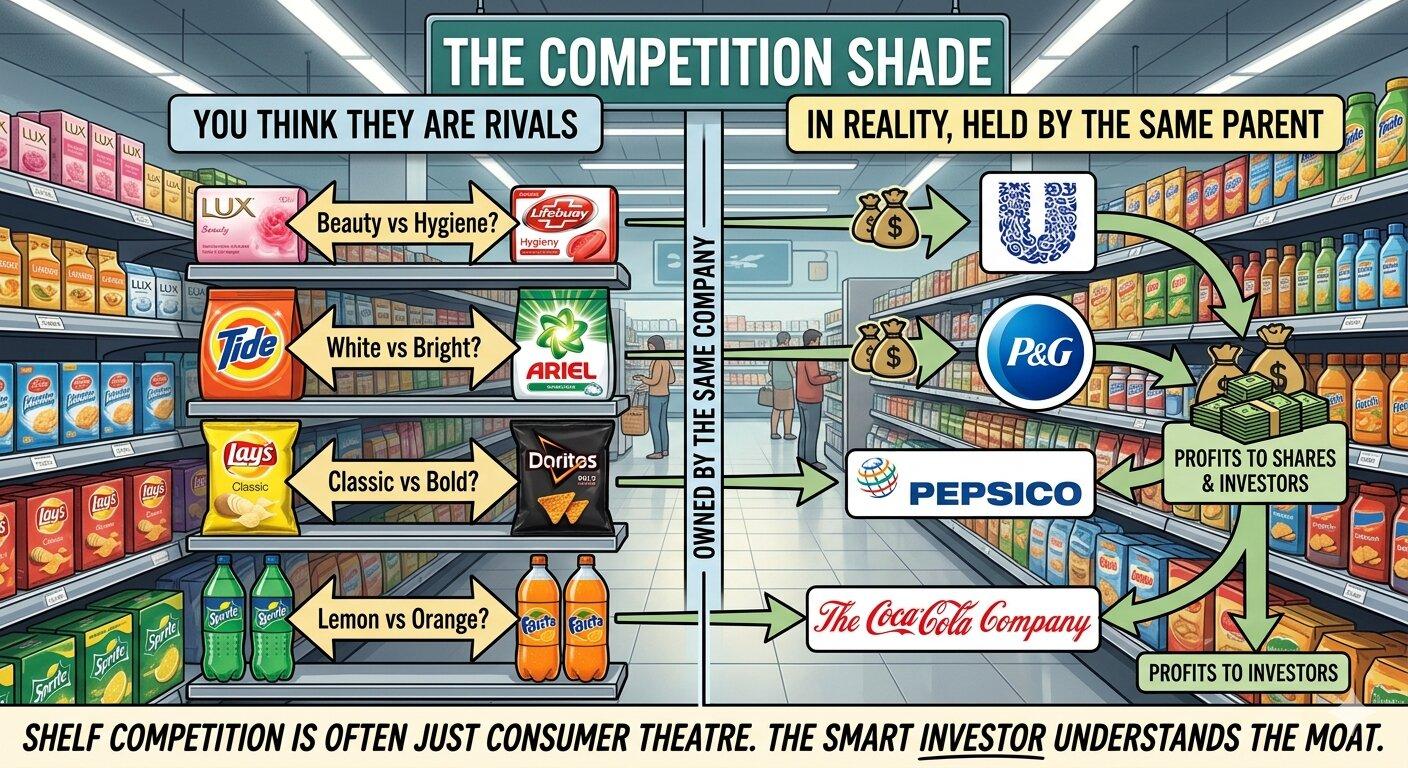
Why the competition on the shelf is carefully manufactured and what it means for investors who understand the game
✨ Key Takeaways
Walk into any supermarket and the shelves feel like a battlefield. Lux versus Lifebuoy. Lay's versus Doritos. Sprite versus Fanta. Tide versus Ariel. You pick a side, drop it in your basket and feel like you have made a choice. You have. Just not the one you think.
In most of these cases, regardless of which brand wins your attention, the money flows to the same company. The competition is real at the consumer's eye level. At the shareholder level, it is theatre carefully designed, deliberately maintained and increasingly sophisticated theatre.
This is not a new strategy. But in 2025 and 2026, it is being executed with more precision than ever before, driven by the rise of quick commerce platforms where digital shelf visibility is as important as physical shelf space, and where having more brands means more chances of being seen, clicked and bought.
Lux vs Lifebuoy: Same Soap Aisle, Completely Different Emotional Pitch
Hindustan Unilever is the most visible practitioner of this strategy in India. Walk into the soap aisle and Lux and Lifebuoy stare back at you from adjacent shelves, each making its case.
In FY25, HUL actively repositioned Lifebuoy from a germ protection soap to a broader skin protection and health brand, pushing it aggressively at large public events. The brand's identity is rooted in protection, hygiene and family health the functional, responsible choice.
At the same time, Lux was relaunched with a stronger beauty and flawless glow positioning, with the premium Lux International range expanded. The brand's emotional territory is glamour, aspiration and skin indulgence the beauty choice.
Same product category. Same manufacturing infrastructure in many cases. Same parent company. Completely different emotional pitches designed to capture consumers at different points of their shopping psychology. If you buy Lifebuoy because you are thinking about your family's health, HUL wins. If you buy Lux because you want to feel good about your skin, HUL wins. If your partner buys one and you buy the other, HUL wins twice.
The brands are not fighting each other. They are dividing the market between themselves with surgical precision.
Lay's vs Doritos: One Company Owns Your Entire Craving Spectrum
PepsiCo runs an even more sophisticated version of this playbook in snacks. Lay's and Doritos sit in the same crisps category and target the same broad demographic snack hungry consumers but the positioning gap between them is deliberately widened every year.
In 2026, Lay's underwent one of its biggest global refreshes in India, reinforcing its position as the familiar, everyday chip. The messaging is comfortable, accessible and universal the chip you reach for without overthinking. Meanwhile, Doritos is being pushed as bold and experimental, with new variants like Cool Ranch and Jalapeño Salsa Mexicana introduced in 2025 to build its identity as the choice for consumers who want an edge.
PepsiCo has even extended the ladder upward with premium offerings like Red Rock Deli, capturing consumers willing to pay more for a perceived artisanal or gourmet experience.
The architecture is deliberate. Whether you want safe, spicy or premium, PepsiCo has a product positioned precisely at that point of your craving. You feel like you are choosing between distinct brands with distinct characters. What you are actually doing is navigating a product portfolio that one company has designed to capture every variation of snack preference you might have.
Sprite vs Fanta: Coca-Cola Wins Every Thirst
The beverage aisle runs the same script. Sprite and Fanta appear to compete for the same rupee both cold, both carbonated, both in similar price brackets. But Coca-Cola has built a clear divide between them that corresponds to genuine differences in consumer preference.
Sprite, now a billion dollar brand in India, owns the clear lemon refreshment territory. It is the crisp, clean, citrus choice. Fanta holds over 50 per cent share in the orange flavoured soft drink segment a completely different taste profile with a distinct consumer base that skews younger and more playful. Even if your preference shifts between citrus and orange depending on your mood, Coca-Cola captures both. And with India's soft drink market expanding, the company is actively investing in pushing multiple brands toward the billion dollar revenue milestone simultaneously.
Why This Works — And Why It Is Intensifying
The strategic logic behind maintaining multiple competing brands rather than consolidating into one master brand comes down to two things: shelf coverage and psychological permission.
On shelf coverage, a company with one brand occupies one slot in a consumer's consideration set. A company with three brands that each occupy distinct emotional or functional territory occupies three slots. In a world where brand choices are made in seconds, more presence equals more capture. This is why HUL, PepsiCo and Coca-Cola consistently outperform single-brand competitors even in categories where any individual brand might be evenly matched.
On psychological permission, consumers who feel loyalty to one brand and are offered a seemingly different alternative from a company they do not know they are already buying from are more willing to try it. The perceived novelty matters. If Lay's lovers felt Doritos was made by the same company, some of the excitement of "trying something different" might diminish. The separation of brand identities creates optionality for the consumer while concentrating revenue for the parent.
What is intensifying this strategy in 2025 and 2026 is quick commerce. On platforms like Blinkit and Swiggy Instamart, search results and product thumbnails determine purchases in ways that physical shelf positioning never did. A company with four brands in a category appears in four different search result slots. A company with one brand appears once. HUL is actively building platform-specific portfolios and expanding online availability precisely because the digital shelf rewards breadth in a way that amplifies the multi-brand advantage further.
The Volkswagen Group's approach in the Indian auto market follows the same logic at a different price point. Volkswagen and Škoda visually compete for similar buyers in Indian showrooms. But both sit under the same group, which recently recorded Skoda's highest ever quarterly sales of over 20,000 units and is preparing a Rs 10,000 crore India 3.0 investment plan. What appears as showroom rivalry is coordinated expansion at the group level each brand capturing a slightly different buyer segment while the overall group grows market share.
What This Means for Investors
The multi-brand strategy is not just a marketing curiosity. It has direct implications for how these companies should be evaluated and why their dominance tends to persist longer than expected.
At a surface level, competition looks intense. But at a structural level, many of these companies are not competing in the way they appear to be. They are segmenting the market internally and capturing demand across price points, preferences and use cases.
This is not limited to FMCG.
In smartphones, what looks like competition between brands is often internal positioning. Xiaomi operates across multiple layers with Mi, Redmi and Poco, each targeting a different price band and consumer segment. BBK Group does the same globally with Oppo, Vivo, OnePlus and Realme. A consumer comparing Vivo versus OnePlus may believe they are choosing between different companies, but in reality, they are moving within the same ecosystem designed to capture different spending capacities and preferences.
The automobile industry follows a similar pattern. Hyundai and Kia operate as separate brands in India but share platforms, technology and strategy. Toyota and Lexus target different segments of the same buyer pyramid. Even within the Volkswagen Group, brands like Volkswagen, Škoda, Audi and Porsche operate across price points, but ultimately feed into the same parent-level growth.
The same playbook extends into apparel, electronics and even digital platforms. Companies are no longer trying to win with a single dominant product. They are building portfolios that ensure that wherever the consumer goes, they remain within the same system.
For investors, this changes how competition should be viewed.
A company with a single strong brand is exposed to disruption at one level. A company with multiple brands across segments is much harder to displace because competition has to succeed across several layers simultaneously. Even if one brand loses relevance, others continue to hold ground, keeping the overall business stable.
This is also why such companies are able to maintain market share over long periods despite visible competition. What appears as fragmentation at the consumer level is often consolidation at the corporate level.
It also explains why these companies continue to command premium valuations over time. The strength is not just in any one brand, but in the ability to control multiple consumer decisions within the same category. That creates a deeper and more durable moat than what is visible on the surface.
The key insight, therefore, is not just to identify strong brands, but to understand how many positions a company controls within a category. Because in many cases, the company that looks like it is competing on multiple fronts is actually the one controlling the entire field.
Disclaimer: This article is for informational purposes only and not investment advice.