Zydus revenue rises 29 per cent in Q2, but margin compression pulls down profit
 Join Us
 Follow Us

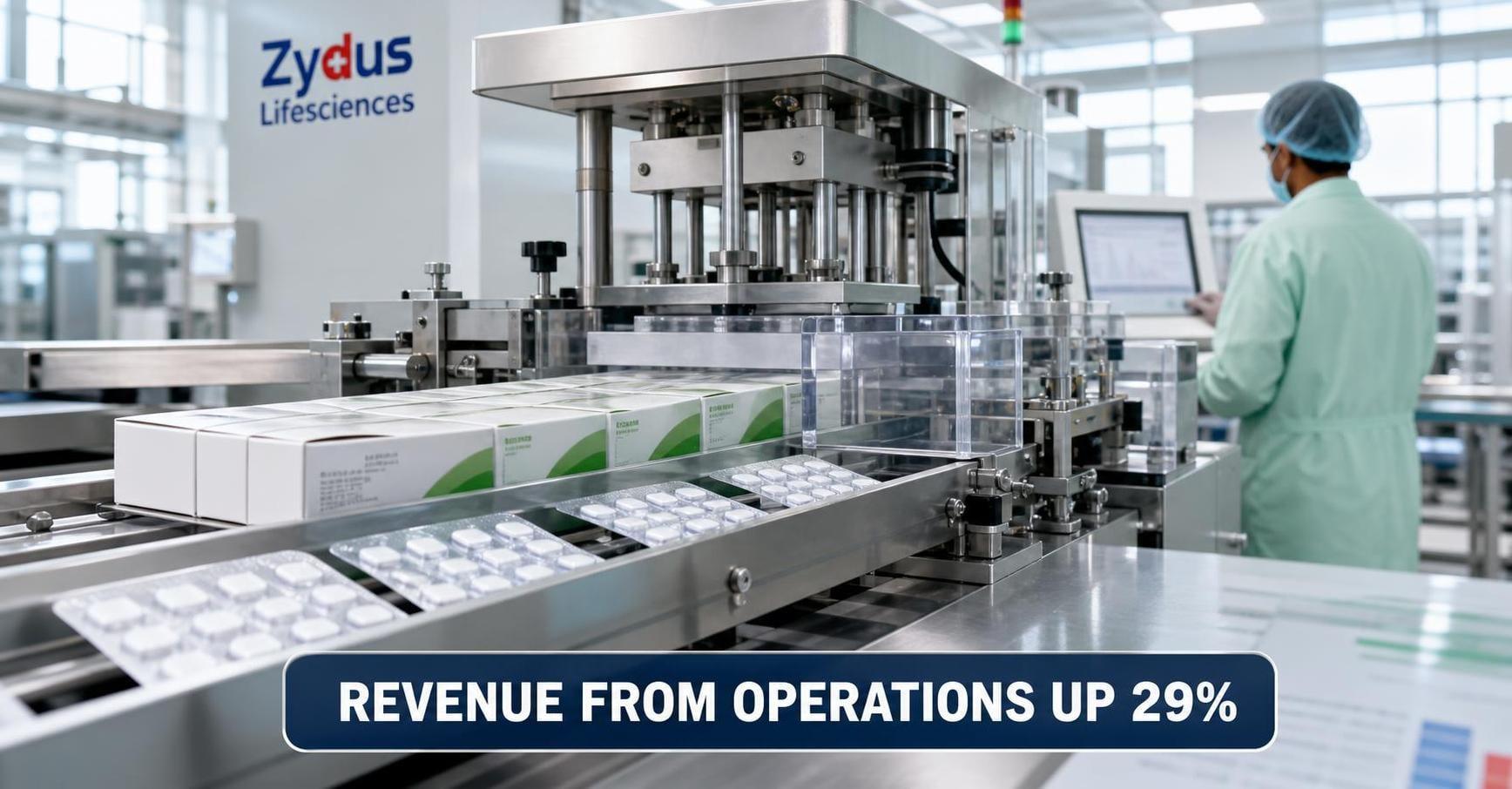
Zydus Lifesciences posted strong Q2 FY27 revenue growth led by India, North America and Consumer Wellness, but EBITDA margin fell sharply and net profit declined 27 per cent.
✨ Key Takeaways
Zydus Lifesciences is expanding its branded, specialty and consumer health businesses while continuing to invest heavily in research-led products and US market launches. Its second-quarter performance showed that this strategy is lifting revenue, although profitability has yet to keep pace with the faster top-line growth.
Consolidated revenue from operations rose 29.2 per cent YoY to Rs 7,909.6 crore in the quarter ended September 30, 2026. However, earnings before interest, Tax, depreciation and amortisation (EBITDA) declined 6 per cent to Rs 1,894.5 crore, while net profit fell 26.6 per cent to Rs 925.5 crore. EBITDA margin narrowed by 8.9 percentage points to 24 per cent from 32.9 per cent a year earlier. Revenue was also 1.3 per cent lower QoQ, while net profit declined 3.6 per cent.
The first-half picture was similar. Revenue from operations grew 25.4 per cent YoY to Rs 15,926.6 crore, but EBITDA declined 6.8 per cent and net profit dropped 30.9 per cent. The margin contraction indicates that revenue growth from new businesses, launches and acquisitions is not yet translating into proportionate operating profit growth.
The pharmaceuticals business remained the main contributor, accounting for 83 per cent of consolidated business revenue. North America formulations revenue rose 20.8 per cent YoY to Rs 3,314.5 crore, supported by base-business volumes and a scale-up in specialty products. Zydus launched five products and secured 12 abbreviated new drug application approvals during the quarter. It also launched the first generic version of Riociguat tablets in October 2026.
India formulations revenue increased 18.3 per cent to Rs 1,884.4 crore, with branded formulations growing 19 per cent. Consumer Wellness revenue climbed 76.1 per cent to Rs 1,122.3 crore, while MedTech revenue rose 46.6 per cent to Rs 224.6 crore. Research and development spending stood at Rs 657.3 crore, or 8.3 per cent of quarterly revenue, while organic capital expenditure was Rs 465.5 crore.
The company also reported progress in its differentiated pipeline. The US Food and Drug Administration accepted for review the biologics licence application for Pembrolizumab biosimilar FYB206, developed with Formycon AG. Zydus also presented updated Phase III data for Saroglitazar Magnesium in primary biliary cholangitis. However, inspections at its SEZ II, Ahmedabad, and Moraiya formulations facilities ended with one and five observations, respectively, which the company said it was addressing.
At 12:50 pm on November 4, 2026, Zydus Lifesciences shares were trading at Rs 1,185.20, down 4.34 per cent from the previous close of Rs 1,239.00. The stock was about 4.7 per cent below its 52-week high of Rs 1,244.00. Over the past year, the shares have gained 23.91 per cent, compared with a 5.73 per cent decline in the BSE 500, indicating substantial outperformance over that period.
What This Means for Investors
Revenue momentum is broad-based, with domestic chronic therapies, international formulations and the US platform doing the heavy lifting. The rise in branded US sales to 16 per cent and the Saroglitazar, biosimilar and rare-disease milestones support Zydus's effort to reduce Reliance on conventional generics. Yet the immediate financial message is mixed. H1 EBITDA fell 6.8 per cent despite 25.4 per cent revenue growth, and the 8.2 per cent research and development intensity reflects an investment-heavy phase.
Low leverage, with net debt to EBITDA at 0.62 times, gives the group room to fund development and organic capital expenditure. Still, earnings visibility depends on recovering operating leverage while converting pipeline advances into approvals and commercial launches. The five USFDA observations at Moraiya also keep manufacturing compliance in focus. At 27.39 times trailing 12-month earnings, the valuation places weight on margin normalisation and successful specialty execution, rather than revenue growth alone.
Disclaimer: The article is for informational purposes only and not investment advice.