Hitachi Energy India Has Doubled in a Year. Here Is What the Market Is Pricing In
 અમારી સાથે જોડાઓ
 અમને અનુસરો
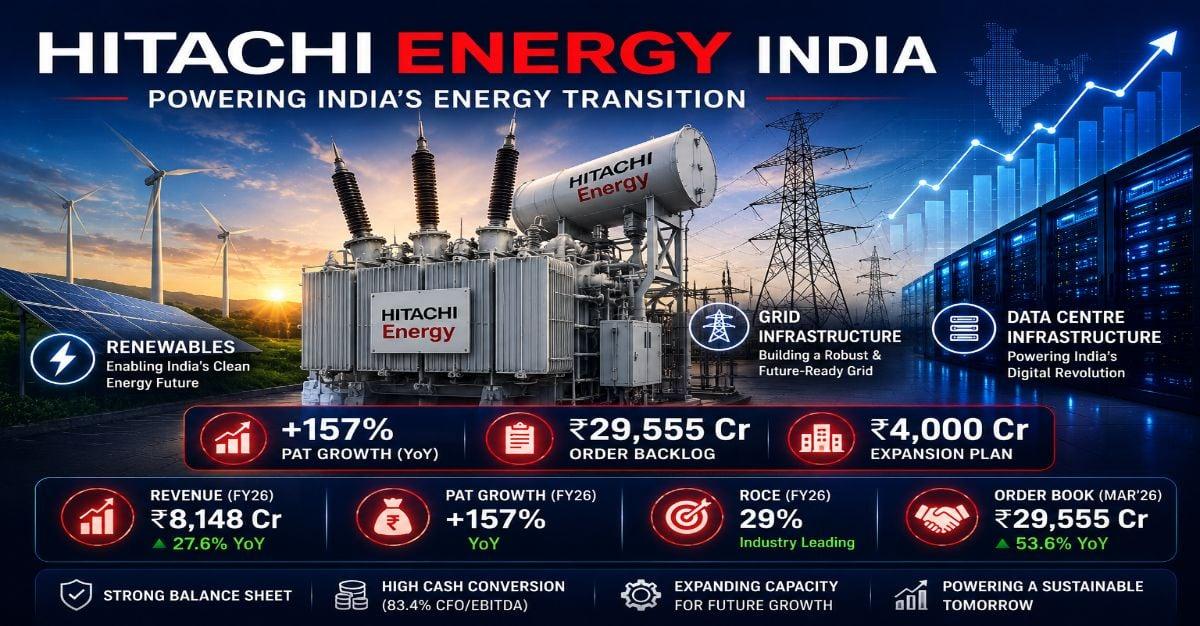
157% PAT growth a Rs 29,555 crore order backlog. A Rs 4,000 crore expansion commitment. This is not a momentum trade it is the market repricing what Hitachi Energy India actually is
✨ મુખ્ય મુદ્દાઓ
On June 1, 2026, Hitachi Energy India hit a 52-week high of Rs 38,800. The stock has since pulled back to Rs 34,350 still representing a multibagger return of 101.59 per cent over the past twelve months and 85.87 per cent year to date. The correction from the peak is real but should be read in context: it followed an exceptional run, not a deterioration in business fundamentals. Understanding why the stock ran and what the correction reflects requires reading the FY26 results carefully rather than reacting to the price move.
What Hitachi Energy India Actually Is
Hitachi Energy India manufactures and supplies power Transformers, high-voltage switchgear, HVDC systems, power quality products and grid automation solutions. It is not a consumer business. Its customers are transmission utilities, renewable energy developers, data centre operators, metro rail projects and industrial manufacturers. Every Solar park and wind farm built in India requires transformers and switchgear to connect to the grid. Every data centre requires high-reliability power infrastructure. Hitachi Energy India sits at the manufacturing layer of all of it.
The business was historically viewed as a project driven power equipment company where earnings were often constrained by execution cycles, commodity costs and project mix. FY26 changed that perception significantly. FY26 marked an inflection point in profitability and order visibility, leading investors to reassess the company's long-term earnings potential.
The Numbers That Triggered the Re-rating
|
Financial Year |
Revenue (Rs crore) |
EBITDA (Rs crore) |
EBITDA Margin (%) |
PAT (Rs crore) |
|
FY23 |
4,469 |
— |
— |
94 |
|
FY24 |
5,237 |
350.2 |
6.69 |
164 |
|
FY25 |
6,385 |
592 |
9.27 |
384 |
|
FY26 |
8,148 |
1,253 |
15.38 |
988 |
Revenue grew 27.6 per cent in FY26. EBITDA grew 111.5 per cent. PAT grew 157.3 per cent. The margin expansion from 9.3 per cent to 15.4 per cent EBITDA in a single year is the number that changed everything. This is not incremental improvement — it is an inflection point.
The mechanism is operating leverage. Once a project-heavy industrial business scales past its fixed cost absorption threshold, incremental revenue converts to profit at a dramatically higher rate. Hitachi Energy India crossed that threshold in FY26. Revenue grew 28 per cent while PAT grew 157 per cent the gap between those two numbers is the story. Three-year EPS growth of 118 per cent on 22.2 per cent three-year revenue growth is operating leverage compounding over multiple years.
Q4 FY26 alone demonstrated that the trend is accelerating, not plateauing: revenue of Rs 2,754 crore up 46.2 per cent year-on-year, EBITDA margin of 16.4 per cent and PAT of Rs 330 crore up 79.7 per cent. The full year closed at 15.4 per cent EBITDA margin, but the exit rate is already 16.4 per cent.
The Order Backlog: Why Investors Are Paying a Premium
The order backlog of Rs 29,555 crore as of March 2026 up 53.6 per cent year-on-year is the single most important number in the Hitachi Energy India investment thesis. Against FY26 revenue of Rs 8,148 crore, the backlog represents revenue visibility equivalent to roughly 3.6 times annual revenue. For an industrial company, that level of visibility is exceptionally rare and commands a premium valuation.
FY26 order inflows of Rs 18,457 crore grew 1.6% year-on-year on a high base. While some investors focused on the modest growth rate, management highlighted that demand across renewables, transmission and data centres remains strong, with execution capacity rather than demand emerging as the primary constraint. The modest growth in new inflows reflects capacity constraints and the high base from the previous year rather than demand softening. The backlog growing 53.6 per cent while revenue grew 28 per cent confirms the demand is outpacing the company's ability to execute rather than the reverse.
Within the order composition, HVDC contributed approximately 15 per cent of FY26 revenue at Rs 1,100 to 1,200 crore. HVDC projects are generally considered higher-value and technologically complex projects that typically support better margins than conventional transmission equipment. As HVDC projects in the backlog convert to revenue in FY27 and FY28, margins are expected to improve further from the current exit rate of 16.4 per cent.
Why India's Energy Infrastructure Is a Multi-Year Demand Driver
The structural demand case for Hitachi Energy India rests on three simultaneous themes, each of which is independently large enough to sustain the business at scale.
India's renewable energy buildout requires Rs 7.93 lakh crore in transmission investment to integrate 900 GW of non-fossil capacity by 2035. Every solar park and wind farm requires grid connection equipment. India's renewable generation buildout is creating a substantial need for transmission infrastructure expansion to ensure efficient evacuation of power from generation centres to consumption hubs.
Data centre investment in India reached Rs 6.5 lakh crore in FY26 commitments with a further Rs 8.3 lakh crore announced. India's installed data centre capacity is below 2 GW and is projected to reach 13 to 18 GW. Management indicated that power infrastructure, transformers, switchgear and power quality solutions together could represent approximately 15 per cent of overall data-centre capital expenditure. A 6 to 8x expansion in data centre capacity from current levels translates directly into transformer and power quality equipment demand.
HVDC transmission — moving power over long distances with minimal losses — is the third driver. Management guided three to four HVDC projects in the near-term pipeline. Each represents significant equipment supply and the new Vadodara facility is being built specifically to manufacture HVDC converter transformers at scale.
The Rs 4,000 Crore Capex Commitment
The most powerful signal management can send is capital allocation. In October 2024, Hitachi Energy India announced Rs 2,000 crore in manufacturing expansion. In the Q4 FY26 board meeting, an additional Rs 2,000 crore was approved — taking total committed capex to Rs 4,000 crore. A greenfield large power transformer facility at Karjan, Vadodara breaks ground June 12 with production targeted for Q4 calendar 2028.
The new facility will add 30 to 40 GVA of transformer capacity — roughly matching the entire existing factory base. The Rs 4,000 crore expansion reflects management's confidence in the long-term demand outlook across transmission, renewables, data centres and electrification. The capex is being funded from operating cash flows: CFO to EBITDA conversion of 83.4 per cent reflects high earnings quality. Debt to equity is 0.02x. Interest coverage is 109x. This expansion is executed from financial strength, not necessity.
The company's existing manufacturing capacity is approaching utilisation limits in several product categories. The Karjan facility is not being built to create demand it is being built because demand already exists. This distinction matters. Capacity additions driven by visible order pipelines tend to carry lower execution risk than speculative expansions built in anticipation of future demand.
The Valuation and the Honest Risk AssesSMEnt
At Rs 34,350 the stock trades at 149x P/E against an industry P/E of 34.1x — a premium of more than 4x to sector peers. The premium reflects the market's expectation that earnings growth, margin expansion and capacity additions will continue over the next several years. The 3-year median P/E of 198.6x provides historical context: the stock has consistently traded at a sector premium because growth has consistently outpaced sector averages.
For an industrial business in early-cycle margin expansion, P/E can overstate the valuation concern. ROCE of 29 per cent and ROE of 21.9 per cent confirm genuine capital efficiency at the current earnings base. The more relevant question is whether FY27 and FY28 earnings delivery can reduce the forward multiple to something more digestible. Jefferies' projection of 58 per cent EPS CAGR over FY26 to FY28 if delivered would compress the forward multiple significantly even at the current price.
The correction from Rs 38,800 to Rs 34,350 appears to reflect a combination of profit booking after a sharp rally and investor caution around valuation levels following a significant re-rating. Neither reflects a change in the underlying business trajectory. The order backlog is at an all-time high. Margins are expanding. Capacity is being doubled. The demand drivers are multi-year and structural.
What the Re-rating Is Actually About
The market is no longer valuing Hitachi Energy India as a transformer manufacturer. It is valuing it as the backbone infrastructure provider for India's energy transition — renewable integration, HVDC expansion, data centre power infrastructure and industrial electrification simultaneously.
The 101 per cent one-year return reflected the market recognising a business that had crossed its operating leverage inflection point, built a four-year revenue backlog and committed Rs 4,000 crore to doubling capacity for the next demand cycle. The correction is the market pausing to verify that execution matches the ambition.
The backlog of Rs 29,555 crore against FY26 revenue of Rs 8,148 crore means the next 3.6 years of revenue is already contracted. Whether the next three years match the last three depends on execution — and on whether India's grid infrastructure investment continues at the pace the Order Book is already pricing in.
Disclaimer: This article is for informational purposes only and not investment advice.