IPL Franchises Are Worth More Than the Companies That Own Them
 आमच्यासोबत जोडा
 आम्हाला फॉलो करा
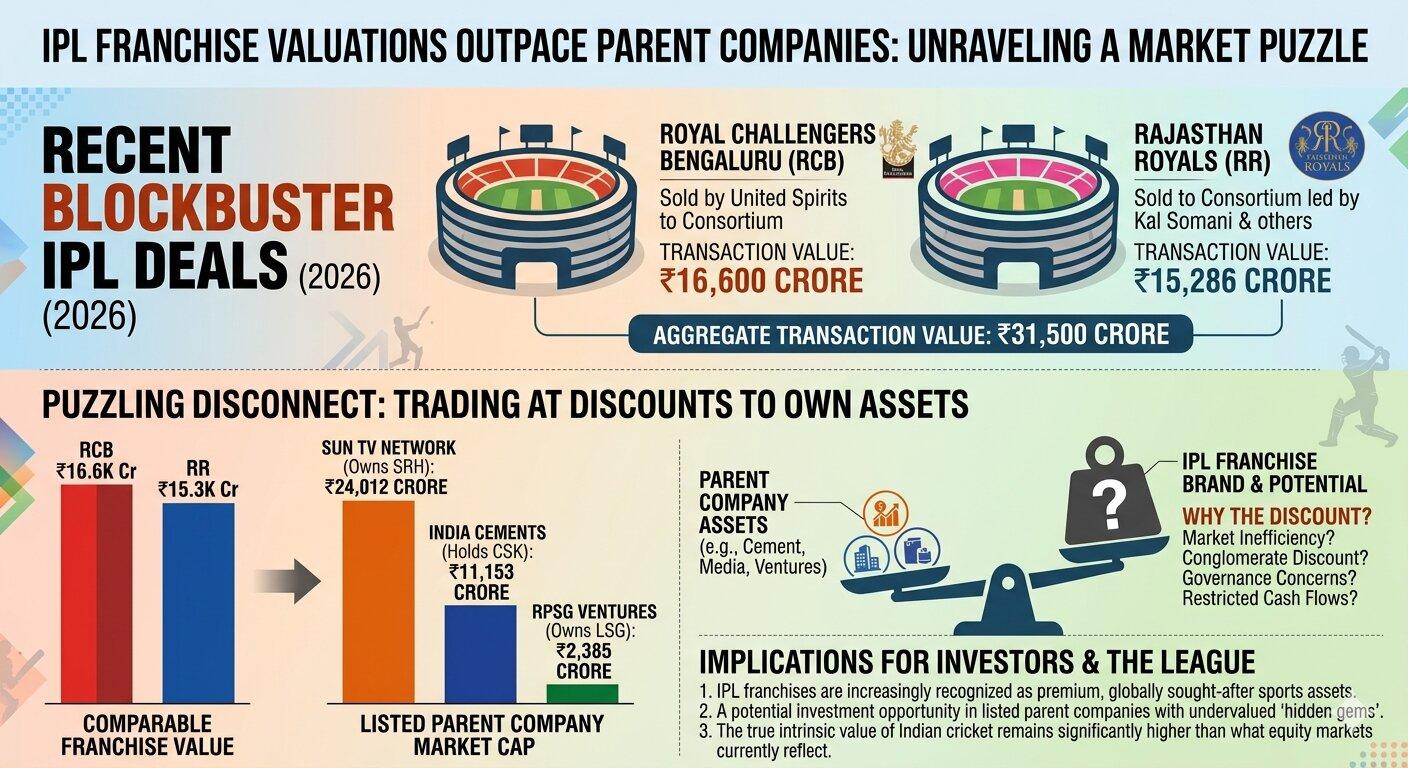
Two blockbuster deals have reset IPL valuations dramatically, but the parent companies trading at discounts to their own assets reveals a deeper market inefficiency worth understanding
✨ एआय पॉवर्ड सारांश
Two IPL franchise deals in quick succession have just redrawn the valuation map of Indian cricket's most valuable commercial property. United Spirits sold Royal Challengers Bengaluru to a consortium comprising the Aditya Birla Group, The Times of India Group, Bolt Ventures and Blackstone for Rs 16,600 crore. Later, the Rajasthan Royals changed hands at Rs 15,286 crore to a consortium led by US based entrepreneur Kal Somani, along with the Walmart family and the Hamp family. Two deals, two franchises, Rs 31,500 crore in aggregate transaction value. That is not a coincidence of timing. That is a market telling you clearly what IPL franchises are worth in 2026.
The numbers are striking on their own. But they become genuinely puzzling when you line them up against the market capitalisation of the listed companies that own some of the other franchises. Sun TV Network, which owns Sunrisers Hyderabad, has a market cap of Rs 24,012 crore. India Cements, which holds Chennai Super Kings, is valued at Rs 11,153 crore. RPSG Ventures, which owns Lucknow Super Giants, trades at a market cap of just Rs 2,385 crore. If RCB just sold for Rs 16,600 crore and Rajasthan Royals changed hands at Rs 15,286 crore, how is it possible that the entire listed entity that owns a comparable franchise is worth a fraction of that transaction value?
This is not a simple question. The answer involves how markets value conglomerates, how unlisted assets get priced inside listed companies, and why the discount between asset value and market cap persists even when the gap is obviously large.
The Conglomerate Discount: Why the Sum of Parts Never Adds Up
When a company owns multiple businesses under one listed entity, markets almost never value it at the full sum of its parts. This is one of the most consistent and well-documented phenomena in equity markets globally and it is called the conglomerate discount.
The reason is straightforward. When you buy a share of RPSG Ventures, you are not buying a pure play on the Lucknow Super Giants franchise. You are buying exposure to RPSG's entire business portfolio, which includes its CESC power business, its retail operations, its Quest Mall assets, its BPO business and several other interests alongside the IPL franchise. The IPL franchise may be its most exciting asset today, but the market is pricing the entire company, not just one part of it.
Investors apply a discount to conglomerates because capital allocation decisions sit with the promoter and management, not with the shareholder. If the company decides to use cash from its power business to fund an unrelated acquisition, the shareholder has no say. That lack of control over capital deployment gets priced in as a discount to the underlying asset values. The more diverse and unrelated the businesses, the larger the discount typically is.
The Unlisted Asset Problem
The second issue is specific to IPL franchises. Until the RCB and Rajasthan Royals transactions, there was no clean public market transaction to anchor the valuation of an IPL franchise at current media rights and revenue levels. Houlihan Lokey had estimated RCB at around USD 269 million in 2025. The actual transaction at Rs 16,600 crore translates to roughly USD 1.9 billion, more than seven times that estimate. Markets had simply not updated their assumptions to reflect what a willing strategic buyer is now prepared to pay.
When an asset is unlisted and there is no recent transaction to reference, equity markets tend to be conservative in how they price it inside a parent company. The IPL franchise sits on the books of these companies either as an intangible asset or at historical cost, neither of which reflects its current economic value. Analysts covering Sun TV, India Cements or RPSG Ventures are primarily focused on the core operating businesses. The franchise tends to get a token value or gets ignored entirely in sum-of-parts models because it was always considered hard to monetise. The RCB and Rajasthan Royals deals have just changed that calculus entirely.
Running the Numbers
Consider what this implies for each of these listed entities now that there is a market-clearing price for comparable franchises.
RPSG Ventures has a total market cap of Rs 2,385 crore. If the Lucknow Super Giants franchise, which has a strong fan base, a large home market and competitive on-field performance, is worth even Rs 12,000 to 14,000 crore on a transaction basis, then the franchise alone is worth five to six times the entire listed company. The power and retail businesses come free. That is an extreme version of a value gap and it explains why RPSG Ventures has seen sharp buying interest following these deal announcements.
India Cements at Rs 11,153 crore holds Chennai Super Kings, arguably the most valuable franchise in the league given its unmatched brand equity, consistent performance, loyal fanbase and commercial partnerships. CSK has won five IPL titles. Its fanbase extends well beyond Tamil Nadu. If RCB sold for Rs 16,600 crore, it would be reasonable to argue that CSK in a transaction context would command a significant premium to that. The entire India Cements listed entity is worth less than what CSK alone might fetch. To be clear, India Cements has its own cement business challenges, debt and operational concerns, but the franchise value sitting inside it is substantial.
Sun TV Network at Rs 24,012 crore owns Sunrisers Hyderabad, a franchise that has reached multiple IPL finals and has a dedicated following. The Sun TV business itself a dominant regional media company is valuable on its own. The SRH franchise adds another layer that the market cap may not fully reflect at current levels.
Why the Gap Persists and What Could Close It
If the asset is worth more than the company, why does the market not simply arbitrage the gap away?
Several reasons. First, the franchise cannot be easily monetised by a shareholder. You cannot individually sell your proportional share of the LSG franchise. The monetisation event, like the RCB sale, requires a decision by the promoter and board, which could take years or may never happen. Markets discount assets that are locked inside a structure with uncertain liquidity timelines.
Second, operating businesses drag on valuations. India Cements has debt and cement sector challenges. RPSG Ventures has complex business interests that require separate analysis. Investors willing to pay a premium for a pure IPL franchise do not necessarily want to take on a cement company or a power utility alongside it.
Third, corporate governance and promoter intent matter. Even if the asset value is clearly higher than the market cap, investors will not fully close the gap unless they believe the promoter will actually unlock that value for shareholders. If there is no credible plan to monetise or spin off the franchise, the discount persists.
What could close the gap? A formal announcement of a franchise stake sale, a demerger of the IPL entity into a separate listed company, or even a partial stake sale that crystallises a valuation on the books. Any of these events would force the market to reprice the parent company rapidly toward its underlying asset value.
The Bigger Picture
The IPL has quietly become one of the most valuable sports league ecosystems in the world. Total franchise valuations across ten teams are now estimated at over USD 18 billion. The media rights cycle that begins in 2028 is expected to be significantly larger than the current one. Global private equity, sovereign wealth funds and strategic investors are all circling the asset class.
For listed investors, the two recent deals have opened a window of opportunity. The market has not yet fully repriced the parent companies of IPL-owning entities to reflect what comparable franchises are now fetching in private transactions. That gap between private market value and public market value is the opportunity. It will close eventually, either through corporate action or through the market simply catching up to the new valuation reality.
In the meantime, the situation illustrates one of the oldest and most persistent inefficiencies in equity markets. Sometimes the most valuable thing a company owns is the thing that does not show up clearly on a balance sheet or in a quarterly earnings report.
Disclaimer: This article is for informational purposes only and not investment advice.