Dixon Technologies: From Rs 18,472 to Rs 9,605 in Six Months: Here Is What Actually Went Wrong
 எங்களுடன் சேருங்கள்
 எங்களைப் பின்தொடரவும்
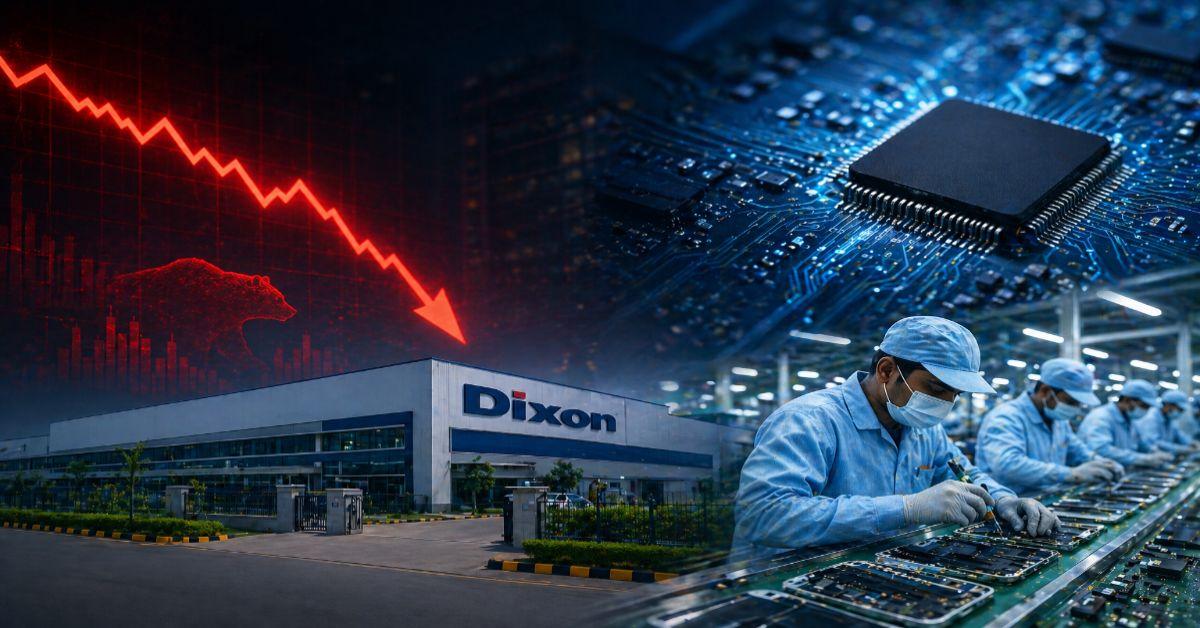
The business is not broken. But three things hit simultaneously and the market was not priced for even one of them.
✨ AI இயங்கும் சுருக்கம்
Dixon Technologies peaked at Rs 18,472 in September 2025. By March 2026 it had touched Rs 9,605 a 48 per cent decline in six months from a stock that had delivered 285 per cent returns over three years. It has since recovered partially to approximately Rs 11,175, but still sits 39.5 per cent below its 52-week high. A business with 40 per cent ROCE, 32.8 per cent ROE and three-year profit growth of 59.7 per cent does not fall that far without real reasons. There are three of them.
First, Understand What Dixon Actually Is
Before the reasons for the fall, the business model needs to be clear because it is the foundation of everything else.
Dixon is India's largest Electronics Manufacturing Services company. It does not own brands. It manufactures on behalf of brands — assembling smartphones for Samsung, Motorola and others, making LED TVs, washing machines, refrigerators, routers and laptops under contract for companies that sell under their own names. Dixon gets paid a manufacturing fee. The brand takes the margin, the distribution and the consumer relationship. Dixon keeps the volume and the operational efficiency.
This model has one defining characteristic: thin margins. Operating margins run at approximately 3.5 to 4 per cent at the consolidated level. Mobile phone margins specifically are in the 2.8 to 3.2 per cent range. That is not a flaw it is the nature of contract manufacturing globally. The business generates exceptional returns on capital precisely because it runs on negative working capital and asset-light operations. The working capital cycle is minus 5 days, meaning Dixon collects from customers before paying suppliers. Debt-to-equity is 0.34 with interest coverage of 13.7x. The balance sheet is clean.
The market understood this for three years and paid a premium anyway because revenue was growing at 53.7 per cent annually and profits at 59.7 per cent. A 3 per cent margin business growing at 60 per cent is a different proposition from a 3 per cent margin business growing at 2 per cent. Which brings us to what changed.
Reason One: The Memory Chip Super-Cycle
The immediate trigger for the stock's fall was something Dixon did not cause and cannot control a global memory price super-cycle driven by AI and data centre demand.
The world's largest memory manufacturers — supplying DRAM and NAND flash for smartphones, laptops and consumer electronics have been reallocating production capacity toward high-bandwidth memory chips required for AI servers and GPU clusters. The result is a supply squeeze for conventional consumer device memory. DRAM contract prices have risen sharply over the past two quarters with further increases expected into mid-2026.
For Dixon's mobile business, this created a direct problem. Memory is one of the largest cost components in a smartphone's bill of materials. When memory prices rise sharply, smartphone brands face pressure on their own margins. Their response — documented in Dixon's Q3 FY26 earnings call was to pull back shipment volumes, reduce channel inventory targets and delay orders. The Indian smartphone market fell 7 per cent year-on-year in Q3 FY26 as a result.
Dixon's Q3 FY26 revenue came in at Rs 10,678 crore up just 2.1 per cent year-on-year from Rs 10,461 crore. PAT was at Rs 321 crore versus Rs 216 crore a year earlier a growth of 48 per cent. For a stock that had been priced for 50-60 per cent growth, this was a significant miss. Smartphone volume for Q3 was 6.9 million units management guided Q4 at 7 to 7.5 million but acknowledged that FY27 numbers are "still being worked out" because of memory price uncertainty.
The market reads management saying "situation is slightly fluid" as an earnings risk. Multiple expansion reverses when earnings visibility disappears.
Reason Two: The Vivo JV Is Stuck
Dixon's single largest near-term growth catalyst has been delayed for over a year — the PN3 government approval required to formalise the Vivo manufacturing joint venture.
Vivo is one of the largest-selling smartphone brands in India. Dixon had been manufacturing for Vivo as a contract manufacturer and had structured a formal joint venture that would deepen the relationship, bring dedicated capacity and add approximately 20 million units of annual volume in FY27 alone. That is meaningful scale for a business doing approximately 27 million units in the first nine months of FY26.
The PN3 approval — a government clearance required for JVs involving Chinese technology partners has been pending. On the Q3 earnings call, management maintained confidence that approval is close and that they are "deeply involved in the process." But the approval has been expected for multiple quarters and has not arrived. Each quarter without it is a quarter where 20 million units of guided volume sits in uncertainty.
Management was also clear about the mechanics: even after approval arrives, it takes 45 to 60 days to consummate the transaction. So any Q1 FY27 contribution from the Vivo JV depends entirely on when the approval lands. Investors modelling FY27 revenue had the Vivo volume baked in. As those assumptions get pushed quarter by quarter, estimates come down and the stock follows.
Reason Three: PLI Uncertainty and the Capex Gap
Dixon's margins have been partially supported by the Production Linked Incentive scheme approximately 0.5 to 0.6 percentage points of the mobile segment's 3.5 per cent margins come from PLI income. The original mobile PLI scheme's incremental benefits are phasing out.
Management confirmed on the earnings call that discussions on a PLI 2.0 extension are ongoing and that there is "positive response" from the government. But they were equally clear that nothing is certain. If PLI is not extended, mobile margins drop from approximately 3.5 per cent to approximately 3.0 per cent a meaningful compression for a thin-margin business.
The answer to this margin pressure is backward integration — Dixon moving from assembly into manufacturing actual components. Camera modules, display modules, optical transceivers, SSDs, mechanical enclosures. The capex programme is Rs 1,100 to 1,200 crore in the current fiscal with a significant expansion in display modules through the HKC joint venture first phase capacity of 24 million units per annum for smartphones, ramping to 55 million in phase two. Camera module capacity at Q Tech is expanding from 40 million to 190 million units annually.
These are the right investments. The problem is timing. Management was explicit: commercial production for most of these projects starts Q2 FY27 at the earliest. Margin contribution from components builds through FY27-28. So Dixon is in a gap period — PLI income declining, capex absorbing cash, component margins not yet arrived.
The market is not being asked to pay for a high-growth story right now. It is being asked to pay for a transition period where near-term earnings are under pressure and the payoff is 18 to 24 months away. At a stock P/E of 48.2x, with a three-year median P/E of 117.9x still embedded in historical averages, the valuation leaves no room for that kind of patience.
Why the Stock Fell as Much as It Did
The three factors — memory super-cycle, Vivo JV delay, PLI-to-components gap would each alone be manageable for a stock priced at reasonable multiples. Dixon was not priced at reasonable multiples. At its September 2025 peak near Rs 18,472, the market was paying for near-perfection in execution across every growth driver simultaneously.
When the memory headwind slowed the smartphone market, the Vivo volume did not arrive to compensate. When the Vivo volume did not arrive, the capex for components was already underway without the earnings to justify it in the near term. Three things going wrong at once on a stock priced for zero things going wrong is how you get a 48 per cent peak-to-trough decline.
The Piotroski score of 7 out of 9 confirms the underlying business health has not deteriorated. ROCE of 40 per cent and the negative working capital cycle are structural advantages that have not changed. The Rs 1 lakh crore revenue target management has set for three to four years out is built on a manufacturing diversification story — mobile, IT hardware, telecom equipment, appliances, lighting, components that is visibly in execution.
But between where the business is today and where that target requires it to be, there is a transition period with thin margins, heavy capex and uncertain timing. The stock is telling you exactly that.
Disclaimer: This article is for informational purposes only and not investment advice.