Kwality Pharmaceuticals Has Returned 238% in One Year. The Bigger Story Is What Coming Next
 எங்களுடன் சேருங்கள்
 எங்களைப் பின்தொடரவும்
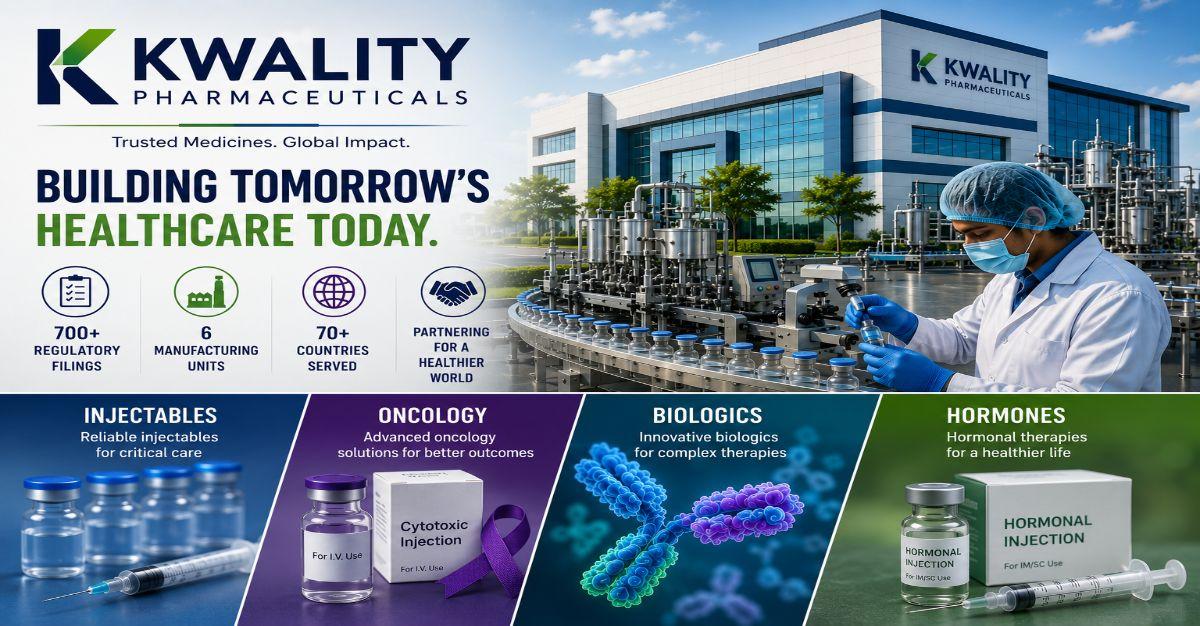
Six manufacturing units, 700-plus regulatory filings, biosimilar clinical trials underway and a revenue model built on one principle: each new registration can potentially contribute USD 1.5 to 2 million in annual revenue. The potential compounding from that model is what has driven the stock and what investors need to understand before drawing conclusions about the current price.
✨ முக்கிய குறிப்புகள்
Kwality Pharmaceuticals hit a 52-week high of Rs 3,725.45 on August 17, 2026. The 52-week low was Rs 828.80 on November 11, 2025. The one-year return is 238.9 per cent making the stock a multibagger and one of the strongest performers in its segment over the period. Over three years the return is 769.88 per cent. Over ten years it is 14,737.77 per cent. For a pharmaceutical company headquartered in Amritsar with a growing presence in injectables, oncology, biologics and hormones, those numbers demand a closer look.
What Kwality Actually Is
Kwality Pharmaceuticals manufactures and exports pharmaceutical products across six manufacturing units covering general injectables and oral solids, beta-lactam, oncology, cephalosporins, biologics and a sixth hormone unit currently under Construction with completion expected by November 2026. Four of the five operational units are EU-GMP approved, including compliance with the revised EU GMP Annex 1 requirements for sterile manufacturing. These approvals strengthen Kwality's ability to access regulated international markets, particularly in Europe and other markets that recognise stringent GMP standards.
The business model is built on out-licensing and supply — approximately 90 per cent of revenue comes from licensing products and supplying to partners across 70-plus countries, with approximately 10 per cent from CDMO work. This model allows Kwality to expand geographically without building a front-end sales force in each market, instead leveraging partners who already have distribution relationships and regulatory presence.
The revenue engine is straightforward. Management stated on the Q1 FY27 earnings call that each successful registration can potentially contribute approximately USD 1.5 to $2 million in annual revenue, depending on the market and product. Management indicated that two to three registrations per quarter are currently translating into incremental revenue and expects this pace to increase to six to seven per quarter from Q2 FY27. With a target portfolio of 200 to 250 products across 70 to 80 countries, the potential compounding of registrations is central to the investment thesis.
The Financial Trajectory
|
Year |
Revenue (Rs crore) |
Operating Profit (Rs crore) |
OPM |
PAT (Rs crore) |
|
FY23 |
251 |
61 |
24% |
19 |
|
FY24 |
307 |
66 |
22% |
24 |
|
FY25 |
370 |
80 |
22% |
40 |
|
FY26 |
503 |
118 |
24% |
67 |
|
Q1 FY27 |
162 |
41 |
25% |
26 |
Revenue has grown from Rs 251 crore in FY23 to Rs 503 crore in FY26 — 100 per cent growth in three years. More importantly, PAT has grown from Rs 19 crore to Rs 67 crore across the same period — a 253 per cent increase on a 100 per cent revenue increase. That operating leverage with PAT growing substantially faster than revenue indicates the benefit of higher capacity utilisation and operating leverage as the business scales. Over the past three years, sales have grown at a CAGR of 26.1 per cent while profit has grown by 28.8 per cent.
Q1 FY27 continued the trajectory. Revenue of Rs 162 crore grew 45.7 per cent year-on-year from Rs 111 crore in Q1 FY26. OPM expanded to 25 per cent from 22 per cent. PAT of approximately Rs 25.6 crore was approximately 115 per cent higher than Rs 12 crore in Q1 FY26. Management has raised its FY27 revenue guidance to more than Rs 700 crore from the earlier Rs 650 crore target, while retaining its EBITDA margin guidance at 27 per cent to 28 per cent and guiding for a PAT margin of more than 15.5 per cent.
The Four Growth Engines
Existing business — General and Oncology: The general facility contributed approximately 63 per cent of Q1 FY27 revenue. New registrations were received from MENA and LATAM in Q1 — specifically from Mexico, Algeria, Morocco and Tunisia. Oncology contributed approximately 20 per cent of revenue, or roughly Rs 30 to 35 crore in the quarter. Management is maintaining the Rs 100 crore FY27 oncology guidance with Q3 and Q4 expected to show acceleration from additional registrations. Saudi Arabia and the wider GCC region represent the next significant geographical opportunity — 12 to 13 submissions were made in FY26 and management expects revenues to begin by Q3 FY27.
BE programme — 40 bioequivalence studies: Kwality is conducting bioequivalence studies on 40 molecules covering oral solids and three complex injectables — lIPOsomal Amphotericin B (Kwality as second generic), Octreotide LAR (first generic in approximately 70 per cent of markets) and Leuprolide 45mg (first generic in 75 to 80 per cent of markets). Management said six to seven molecules had completed BE studies during Q3 and Q4 FY26. Management expects five to six of these to be commercially launched by Q4 FY27. All 40 BE submissions are targeted for completion before Q1 FY28. Management expects the BE programme to contribute Rs 80 to 100 crore of revenue in FY28, with the potential to reach Rs 400 to 500 crore by FY29 as registrations from these dossiers are secured across international markets.
Biologics — Erythropoietin and Pembrolizumab: Unit 5, the biologics facility, currently contributes approximately 1 per cent to 2 per cent of revenue from early-stage work. Two programmes are in development. Erythropoietin: pre-clinical has been successfully completed and CDSCO has granted permission to conduct clinical trials. Clinical trials are expected to begin by November or December 2026, with clinical closure targeted for October or November 2028. Management expects commercial sales in India to begin by the end of calendar 2027, subject to successful completion of the clinical and regulatory process, and is targeting international registrations across 10 to 12 countries by November to December 2027. FY28 revenue target from Erythropoietin is Rs 80 to 100 crore from the India market. Pembrolizumab biosimilar: CDSCO approval has been received to conduct stability batches and pre-clinical. Pre-clinical is expected to begin by December 2026 and be completed by March 2027. Clinical trials will follow over one to one-and-a-half years. Management is targeting commercialisation by the end of calendar 2028, broadly aligned with the expected patent-expiry opportunity, and expects to participate in the early wave of launches.
Hormone plant — Unit 6: Manufacturing licence expected by November 2026. Management indicated that for certain ROW markets and tender-based businesses, the manufacturing licence may be sufficient to begin commercial supplies without waiting for a separate full GMP certification. Management has guided Rs 70 to 80 crore revenue from hormones in FY28 from these markets, rising to Rs 150 to 200 crore by FY29 as bioequivalence studies complete and registrations are obtained.
The Capex Behind the Growth
Two specific investments shown in the investor presentation deserve attention because they are not included in the FY29 guidance and therefore represent upside optionality rather than baseline assumptions.
The hormone facility — Unit 6 — has a planned capex of Rs 65 crore, of which approximately 50 per cent has already been incurred. Civil construction is 90 per cent complete, equipment procurement is 80 per cent complete and equipment installation is 60 per cent complete. Commercial production is targeted for Q3 FY27. The potential annual revenue from the facility is stated at Rs 150 crore in the investor presentation.
The biologics facility — Unit 5 — carries a planned multi-year capex of approximately Rs 195 crore-plus. Importantly, the 500-litre bioreactor expansion has already been physically installed — what remains pending is CDSCO approval for the expanded capacity, which management has not prioritised since the facility is currently being used only for clinical-scale batches.
The investor presentation states explicitly: management has clarified that the FY29 revenue guidance excludes contributions from both the hormone facility and biologics platform, creating meaningful upside beyond the current guidance base. The Rs 1,000 crore FY29 target is therefore a floor built on the existing business and BE programme. If both hormone and Erythropoietin execute on schedule, FY29 revenues could materially exceed the stated guidance.
The currently outlined capex programme supporting this trajectory totals approximately Rs 185 to 195 crore: Rs 65 crore for the hormone plant, Rs 50 crore for oncology expansion, Rs 25 to 30 crore for BE studies, Rs 20 crore for working capital and Rs 10 to 15 crore for biosimilar R&D. An additional Rs 150 crore for biosimilar clinical trials is planned between Q3 FY28 and Q4 FY29.
The FY29-FY30 Revenue Map
Management's FY29 revenue target of approximately Rs 1,000 crore is based primarily on the existing businesses and the BE programme, with biologics and hormones not forming part of the stated base case. Management has indicated that timely hormone registrations could provide an additional revenue lever and potentially offset a shortfall in other businesses.
For FY30, management has guided Rs 1,300 to 1,500 crore, which includes hormone contributions of Rs 200 to 250 crore, Erythropoietin international sales of Rs 200 to 250 crore and oncology at approximately 25 per cent of the total. This would imply a business approaching three times FY26's revenue base, if the guidance is achieved.
The Algeria and LATAM JV Arrangements
Management disclosed a joint venture arrangement with an Algerian counterpart — a fill-finish plant in Algeria where Kwality will provide the API and regulatory dossiers while the local partner makes the plant investment. Kwality will receive equity in return for technology transfer of three to four biosimilar molecules. Management expects revenue from the MENA region through this arrangement to begin as stability batches are initiated in Algeria, alongside progress on the relevant clinical programmes at Kwality. A similar arrangement is under discussion in Mexico and other LATAM markets.
Valuation
ROCE of 24.1 per cent and 3-year average ROCE of 19.5 per cent reflect improving capital efficiency as the business scales. EV/EBITDA of 26.1x also indicates that the market is already assigning a significant premium to the expected improvement in earnings and operating scale.
The current trailing P/E of 42.6x compares with an industry P/E of 34.1x and a three-year median P/E of 23.4x. The stock is therefore trading at a substantial premium to both its historical valuation and sector peers, indicating that the market is already assigning considerable value to the potential contribution from biosimilars, hormones and the BE programme.
Working capital remains an important constraint. Debtor days stood at 208 days in FY26, with management attributing the elevated level to collection delays in the MENA and CIS regions. Management is targeting a reduction to 165 to 170 days by the end of FY27. Even at that level, a Rs 700-plus crore revenue base would still require a substantial amount of capital to be tied up in receivables. CFO-to-EBITDA of 14.2 per cent highlights the current cash-conversion challenge, with extended collection cycles in export markets absorbing a significant portion of operating cash generation. Free cash flow is negative at Rs 28.6 crore. Management has indicated that the current capex programme is being funded primarily through internal accruals, with a Rs 15 to 20 crore credit line available if required.
The Core Thesis and Its Limits
Kwality's case is built on a demonstrable model: file dossiers, secure registrations and potentially convert each successful registration into approximately USD 1.5 to $2 million of annual revenue. The financial trajectory provides evidence that this model has been working to date — revenue growing 100 per cent in three years with PAT growing 253 per cent. Three-year revenue CAGR of 26.1 per cent and profit CAGR of 28.8 per cent are consistent with a business compounding steadily through registration accumulation.
At Rs 3,342.95, the stock already reflects a considerable degree of confidence in the company's execution. The 238 per cent one-year return has been supported by rapid growth in the existing business, improving margins and a growing registration pipeline. The next leg of the investment case, however, depends on converting that pipeline into commercial revenue. BE studies, hormone registrations, biologics development and international expansion provide multiple potential growth levers, but they also carry regulatory, execution and working-capital risks. The key question from here is therefore not whether Kwality has a growth pipeline, but how much of that pipeline can be converted into sustainable earnings at a valuation that already prices in substantial future growth.
Disclaimer: This article is for informational purposes only and not investment advice.