Apollo Micro Systems Has Returned 3,075% in Five Years: The Real Question Is Whether the Next Phase Is as Compelling as the Last
 Join Us
 Follow Us
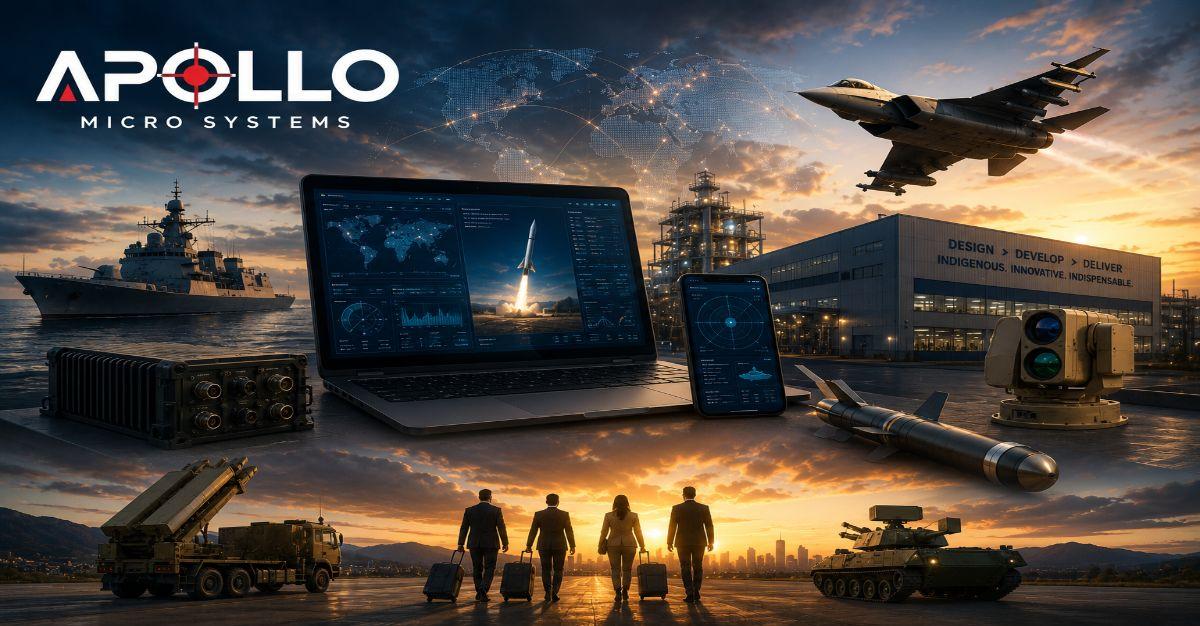
A 61% revenue jump, a 91% PAT surge, a 12x greenfield expansion and entry into autonomous underwater warfare — FY26 was the strongest year in this company's history. Yet the stock sits 14.7% below its 52-week high. The tension between the business momentum and the price action is worth examining carefully.
✨ Key Takeaways
Five years ago, Apollo Micro Systems traded at a level that would make today's Rs 398 look like a multibagger because it is. The five-year return is 3,075.04 per cent. The three-year return is 591.47 per cent. The one-year return is 130.41 per cent, cementing its multibagger status across every meaningful timeframe. The 52-week high of Rs 466.70 was hit on July 3, 2026. The current price of Rs 398.15 represents a 14.7 per cent correction from that peak.
The business that produced those returns posted its strongest year in FY26. Understanding why the stock is off its high despite that and whether the next phase justifies the current multiple requires reading both the opportunity and the risks honestly.
What Apollo Micro Systems Actually Is
Apollo is not a Defence contractor in the traditional sense of assembling imported components. With 41 years of experience, 700-plus onboard technologies and participation in 150-plus indigenous defence programmes, the company has built genuine design, development and manufacturing capability across missile systems, naval electronics, air defence and land platforms. Its customers are DRDO, Defence PSUs, the Ministry of Defence and private defence OEMs.
The strategic shift that matters most for understanding the current valuation is the transition from supplying defence subsystems to becoming a fully integrated weapon systems manufacturer. That movement up the value chain — from component to platform — changes the margin profile, the competitive positioning and the addressability of future contracts simultaneously. It is also what makes the comparison to two years ago misleading. The company that exists today is structurally different from the one that existed when the five-year return clock started.
FY26: Every Metric at a Record
|
Year |
Revenue (Rs crore) |
Operating Profit (Rs crore) |
OPM |
PAT (Rs crore) |
|
FY23 |
298 |
64 |
22% |
19 |
|
FY24 |
372 |
84 |
23% |
31 |
|
FY25 |
562 |
129 |
23% |
56 |
|
FY26 |
904 |
218 |
24% |
107 |
Revenue grew 61 per cent in FY26. EBITDA grew 69 per cent. PAT grew 91 per cent. OPM expanded from 23 per cent to 24 per cent — modest but meaningful because it came alongside a 61 per cent revenue increase, indicating that operating leverage is beginning to work. Three-year revenue CAGR is 44.8 per cent and three-year profit CAGR is 75.6 per cent.
The quarterly trajectory shows momentum building through the year.
|
Quarter |
Revenue (Rs crore) |
OPM |
PAT (Rs crore) |
|
Q1 FY26 |
134 |
31% |
18 |
|
Q2 FY26 |
225 |
26% |
30 |
|
Q3 FY26 |
252 |
20% |
23 |
|
Q4 FY26 |
293 |
23% |
37 |
Q4 FY26 revenue of Rs 293 crore is the highest single quarter in company history. Q1 FY26 delivered an operating margin of 31 per cent—the highest quarterly margin in the period under review—reflecting a favourable product mix. The variation in quarterly margins is characteristic of defence businesses, where revenue recognition depends on project milestones and product mix can change significantly from quarter to quarter.
The Three Strategic Developments That Define the Current Phase
The IDL Explosives Acquisition and the Premier Explosives Stake
The acquisition of IDL Explosives represents backward integration into defence and industrial explosives — the raw material layer of weapon systems. By controlling explosives manufacturing, Apollo reduces dependence on external suppliers for a critical input and gains access to industrial explosives markets that provide commercial diversification alongside the defence Order Book. The proposed acquisition of a 41.33 per cent stake in Premier Explosives extends this logic further, potentially creating a vertically integrated explosives and systems manufacturer.
Management indicated that another strategic acquisition is expected during FY27, subject to completion. The acquisitive strategy—two transactions in quick succession, with a third anticipated—is building capabilities faster than organic R&D alone would allow. However, it also contributes to the negative free cash flow and working capital pressure currently visible on the balance sheet.
The Rs 300 Crore Greenfield Facility
Apollo is investing Rs 300 crore in a greenfield manufacturing facility that management says will significantly expand manufacturing capacity and support its transition into complete weapon systems. The scale of this investment relative to FY26 PAT of Rs 107 crore is significant — this is a company investing aggressively in production capacity ahead of the order cycle it expects to materialise over Vision 2036. The investment aligns with management's long-term Vision 2036, under which it has articulated an aspiration of sustaining 45 per cent to 50 per cent growth over the long term. The new facility will manufacture weapons systems platforms, explosives and associated systems not just subsystems. This is the physical infrastructure for the move up the value chain.
The SAVIOR-ASW and the Smart Bomb PSO
Two programme wins in FY26 are strategically significant beyond their immediate revenue contribution.
The Indian Navy Make-II Prototype Sanction Order for SAVIOR-ASW — an autonomous underwater surveillance system — marks Apollo's entry into autonomous underwater warfare. This is a high-barrier segment where few domestic companies have demonstrated the capability to even receive a prototype sanction order. The IAF Make-II Prototype Sanction Order for a 500 kg Smart Bomb adds air-delivered precision munitions to a portfolio previously concentrated in electronics and guidance systems.
Both are prototype sanctions, not production orders. The revenue contribution from these programmes is contingent on prototype validation, trials and subsequent production orders — a process that typically takes several years in Indian defence procurement. But the strategic signal is meaningful: Apollo is being trusted with next-generation weapon system development, not just electronics subsystems.
Additionally, the company received a perpetual licence to manufacture and assemble calibre above 12.7mm with an annual capacity of 1,000 units per category across two categories. This positions Apollo to participate in India's ammunition indigenisation programme at a time when import substitution in ammunition is a stated policy priority.
R&D spending at 8 per cent of FY26 revenue — approximately Rs 72 crore — is the investment that is building this product pipeline. It is also the investment that is compressing near-term free cash flow.
From Technology Development to Commercial Execution
While Apollo's transformation into a full-fledged weapon systems manufacturer has been years in the making, management believes the business is now entering the commercial execution phase. During the Q4 FY26 earnings call, it highlighted that several large-ticket defence programmes are expected to materialise during FY27, with the order book anticipated to increase meaningfully as these contracts are awarded. Management also noted that many indigenous programmes have matured from development to production, a transition that typically results in larger and more recurring orders for suppliers. If execution remains on track, this shift from R&D-led development to production-led manufacturing could become the next major driver of revenue growth and improve the utilisation of Apollo's expanding manufacturing capacity.
The Risks That Cannot Be Overlooked
Three risks are directly sourced from the data and merit honest examination.
The cash flow picture is the most important concern. Free cash flow is negative Rs 357 crore. Operating cash flow is negative Rs 130 crore despite PAT of Rs 107 crore. CFO to EBITDA is negative 57.8 per cent. This is a business generating strong accounting profits while consuming cash — a pattern characteristic of defence companies with long project cycles and high working capital requirements, as explicitly noted in the key risks section of the coverage note. The working capital intensity will not reduce until order execution shortens in duration or advance payments increase. Until then, the company is funding operations through debt, which has increased to Rs 543 crore with debt to equity at 0.41x and interest coverage at 4.27x — the weakest ratio in the dataset.
Promoter pledge of 30.5 per cent is a governance risk that warrants monitoring. Nearly one-third of promoter shares are pledged — at a promoter holding of 49.98 per cent. Any forced selling triggered by pledge calls would have an outsized impact on price and control. This is not an immediate stress indicator but it is not a comfort factor either.
The valuation demands scrutiny. At 131x trailing P/E against an industry P/E of 67.9x, Apollo trades at nearly twice the sector multiple. The 3-year median P/E of 93.4x is itself elevated. EV/EBITDA of 67.6x and price to sales of 16.4x further confirm that the stock is pricing a multi-year execution of the Vision 2036 ambition, not current earnings.
The Rs 1,432 crore order book provides healthy revenue visibility, although sustained high growth will require continued large order inflows, something management expects over FY27 and beyond.
What the Stock Is Actually Pricing
The 130 per cent one-year return and the 3,075 per cent five-year return were earned by a business that genuinely transformed—from a subsystem supplier generating Rs 298 crore of revenue to an integrated weapon systems manufacturer with FY26 revenue of Rs 904 crore. With a new greenfield facility under development and an expanding portfolio of higher-value weapon systems, the company is now investing for its next phase of growth rather than optimising its existing business.
The question the current price asks is whether the next phase — greenfield commissioning, prototype-to-production conversion on smart bombs and autonomous underwater systems, acquisitions integrating cleanly and continue to grow at similar pace — delivers on time and without execution setbacks. At 131x trailing P/E, there is very little margin for disappointment.
The business is building toward something genuinely significant. Whether the stock at Rs 398 already prices that destination, or still offers a discount to it, depends on how quickly the greenfield comes online, how the prototype sanctions convert and whether the working capital cycle improves as the order book scales.
Disclaimer: This article is for informational purposes only and not investment advice.