Apple Names John Ternus as CEO: The End of One Era and the Beginning of Another
 Join Us
 Follow Us
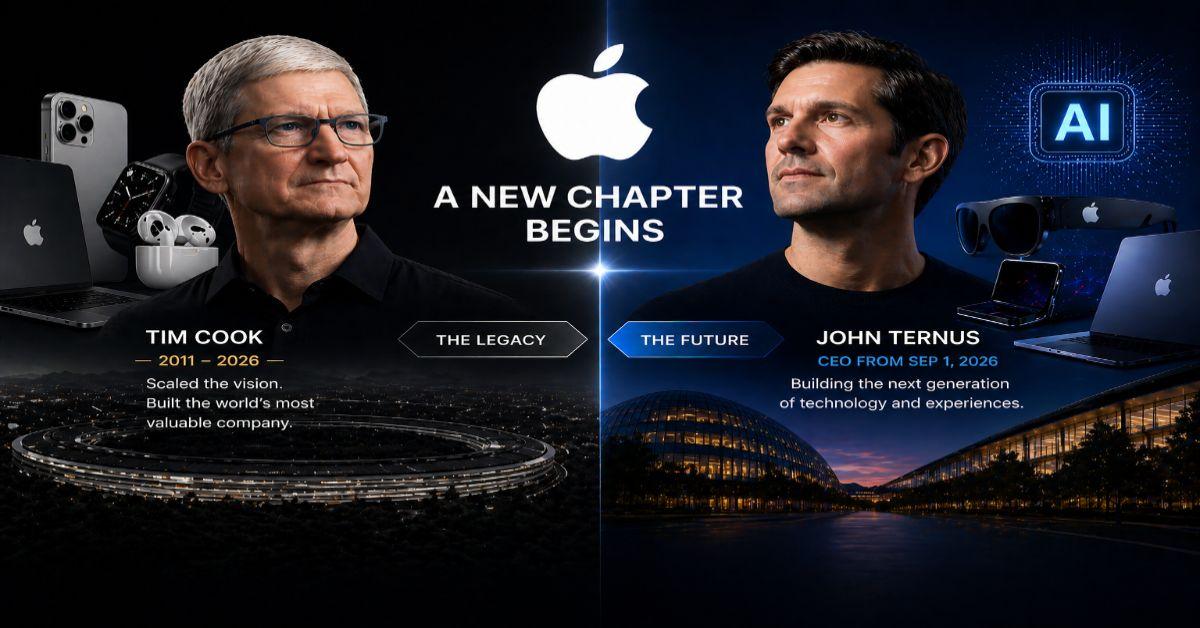
Tim Cook turned Steve Jobs' technology into a USD 4 trillion empire. Now Apple needs someone to build the next technology and that is precisely why the baton is being passed
✨ Key Takeaways
Apple Inc. is currently trading at approximately USD 271, carrying a market capitalisation of USD 3.98 trillion. To put that in context: as of late April 2026, every listed company in India combined is worth approximately USD 5 trillion. Apple alone represents nearly 80 per cent of that. It is the third most valuable company on earth. When a company of this scale changes its chief executive, it is not just a corporate event it is a signal worth reading carefully.
On September 1, 2026, John Ternus will become Apple's third CEO. Tim Cook moves to executive chairman. The board approved the succession plan unanimously.
A Brief History Worth Remembering
Apple in the late 1990s was weeks from Bankruptcy. Steve Jobs returned in 1997, cut 70 per cent of the product line and refocused the company on a handful of things it could do exceptionally well. The iMac, IPOd, iPhone and iPad followed in succession each one redefining a category. By the time Jobs passed in October 2011, Apple had rebuilt itself into one of the most admired technology companies in the world.
But admired and valuable are different things. Throughout the Jobs era, Apple was celebrated for its products far more than its shareholder returns. The technology was exceptional. The business model at that point still largely hardware driven with thin services revenue had not yet been fully monetised at the scale the balance sheet eventually allowed.
The Warren Buffett Moment That Changed Everything
The story that connects these threads is one that is not discussed enough. Steve Jobs, sitting on a growing pile of cash reserves that Apple had accumulated from its hardware success, went to Warren Buffett and asked a direct question: what should Apple do with all this money?
Buffett's answer was characteristically simple. He told Jobs that the most value accretive things Apple could do with its excess cash were two: buy back its own shares aggressively and consistently, and pay Dividends to shareholders. The logic on buybacks was straightforward if you believe your business is worth more than the market is pricing, buying your own stock is the highest return capital allocation decision available. The logic on dividends was equally direct a company generating more cash than it can productively reinvest owes that cash to the people who own it.
Jobs heard both suggestions. He chose neither. Throughout his second era at Apple from 1997 until his death in 2011 the company paid no regular dividend. Cash accumulated on the balance sheet as Apple's products redefined category after category, but shareholders received nothing back directly. Jobs believed the cash gave Apple strategic flexibility. What it also did was signal to markets that Apple was a technology bet, not an investment in the traditional sense and the stock was priced accordingly.
Tim Cook: The Man Who Did What Buffett Suggested
Cook understood the Buffett logic completely and executed both parts of it. In 2012, less than a year into his tenure, Apple reinstated its dividend the first time the company had paid one since 1995. Then came the buybacks, one of the largest share repurchase programmes in corporate history, returning hundreds of billions of dollars to shareholders over more than a decade. The combined effect was mechanical in its elegance: dividends gave income oriented institutional investors a reason to own Apple for the first time, while buybacks reduced shares outstanding and drove earnings per share growth independent of revenue. Buffett's two suggestions, both ignored by Jobs, were implemented in full by Cook and the market rerating that followed was historic.
Warren Buffett, who had famously avoided technology stocks throughout his career on the grounds that he did not understand their competitive moats well enough, watched what Cook was doing and recognised it immediately. Berkshire Hathaway began buying Apple shares in 2016 and accumulated a position worth over USD 170 billion at its peak, Buffett's largest single holding by a significant margin. The man who avoided tech his entire career made Apple his biggest bet, not because of the iPhone, but because of how Cook was treating the people who owned it.
What Cook Actually Built
Cook's operational genius often gets underappreciated because it is less glamorous than product launches. He built Apple's global supply chain into the most efficient in the technology industry outsourcing manufacturing to China through partners like Foxconn and the Tata Group, implementing just-in-time inventory systems that reduced warehousing costs to near zero and negotiating component deals years in advance that locked out competitors.
The flash storage deal he struck in 2005 — before smartphones had even arrived is a textbook example. Cook committed Apple to purchasing tens of millions of flash storage units over a decade, securing priority allocation from suppliers. When iPhone launched and became a cultural phenomenon, competitors scrambled for components that Apple had already locked up. Supply chain foresight as competitive weapon.
Beyond hardware, Cook scaled Apple's services business — iCloud, Apple Pay, Apple Music, the App Store past USD 100 billion in annual revenue. He launched Apple Silicon, transitioning the Mac from Intel processors to custom designed chips that now set the performance and efficiency benchmark for the entire industry. He led Apple to become the world's first USD 1 trillion, USD 2 trillion, USD 3 trillion and eventually USD 4 trillion company, with shares increasing approximately 20-fold during his tenure. Apple's fiscal Q1 2026 alone reported revenue of USD 143.8 billion and net profit of USD 42.1 billion its highest quarterly numbers in at least four years, with a 16 per cent year-on-year revenue jump.
In India specifically, Cook invested meaningfully. His 2016 visit seeded a development centre in Bengaluru and an office in Hyderabad. iPhone manufacturing in India, which began in 2017 through Wistron and later Foxconn and Tata, scaled to approximately 55 million units in 2025 up from 36 million the year before. India is now a meaningful and growing node in Apple's global production architecture.
The Theory Behind the Transition
Here is the analytical frame that makes this leadership change make sense.
Steve Jobs built extraordinary technology but had not fully thought through the investor and scale dimension of what he had created. Tim Cook's genius was recognising that Jobs had built the engine and that the job of the next phase was to drive it as far and as efficiently as it could go. He leveraged the technology Jobs created, scaled it globally, monetised it through services and rewarded shareholders through buybacks. That strategy worked brilliantly for fifteen years and created nearly USD 3.6 trillion in market value.
But that playbook has a natural endpoint. You can only scale and optimise what already exists for so long before the market starts asking what comes next. Apple has been late on artificial intelligence — Siri's limitations have been publicly mocked, and the company has had to partner with Google to power AI features in its own devices. The Vision Pro launch underwhelmed. The next category — smart glasses, foldable iPhones, AI wearables, agentic computing requires a fundamentally different kind of thinking than supply chain excellence and services monetisation.
Tim Cook was the right person for Phase Two of Apple. John Ternus is being positioned as the right person for Phase Three.
Who John Ternus Is
Ternus, 50, joined Apple in 2001 from the product design team during the Steve Jobs era. He spent the next two decades building hardware every iPhone generation, every iPad, Apple Watch, AirPods and Mac. In 2021 he joined the executive team as Senior Vice President of Hardware Engineering, reporting directly to Cook. He oversaw the Apple Silicon transition arguably the most consequential engineering decision Apple has made in twenty years, migrating the Mac from Intel processors to custom chips that now dominate performance benchmarks across the industry.
Under his oversight, Apple introduced the ultra-thin iPhone Air and MacBook Neo, demonstrating that his product instincts extend beyond pure engineering into commercial positioning. He spent his entire professional career inside one company, building its most important physical products. His philosophy is explicitly product first. He has spoken about technology serving users rather than existing for its own sake a continuity with the Jobs ethos that Cook, for all his strengths, was never associated with.
What Happens Now
Ternus is not walking into a rescue mission. Apple has USD 158 billion in current assets, no existential financial pressure and a brand that remains the most valuable in consumer technology. But he is walking into genuine competition — OpenAI, Meta, Microsoft and Google are all moving aggressively on AI hardware and software in ways that could disrupt Apple's premium device ecosystem if Apple does not respond credibly and quickly.
Smart glasses, foldable form factors, AI-native operating systems, agentic assistants that actually work these are the battlegrounds of the next decade. An engineer who spent 25 years building Apple's hardware at the highest level just got the keys to the world's most valuable hardware company at the moment those keys matter most.
Three CEOs. Three distinct mandates. Jobs made people want Apple. Cook made people own Apple. What Ternus makes them do next is the only question that matters now.
Disclaimer: This article is for informational purposes only and not investment advice.