Cracking the Code: A Beginner’s Guide to Reading Balance Sheets
 Join Us
 Follow Us
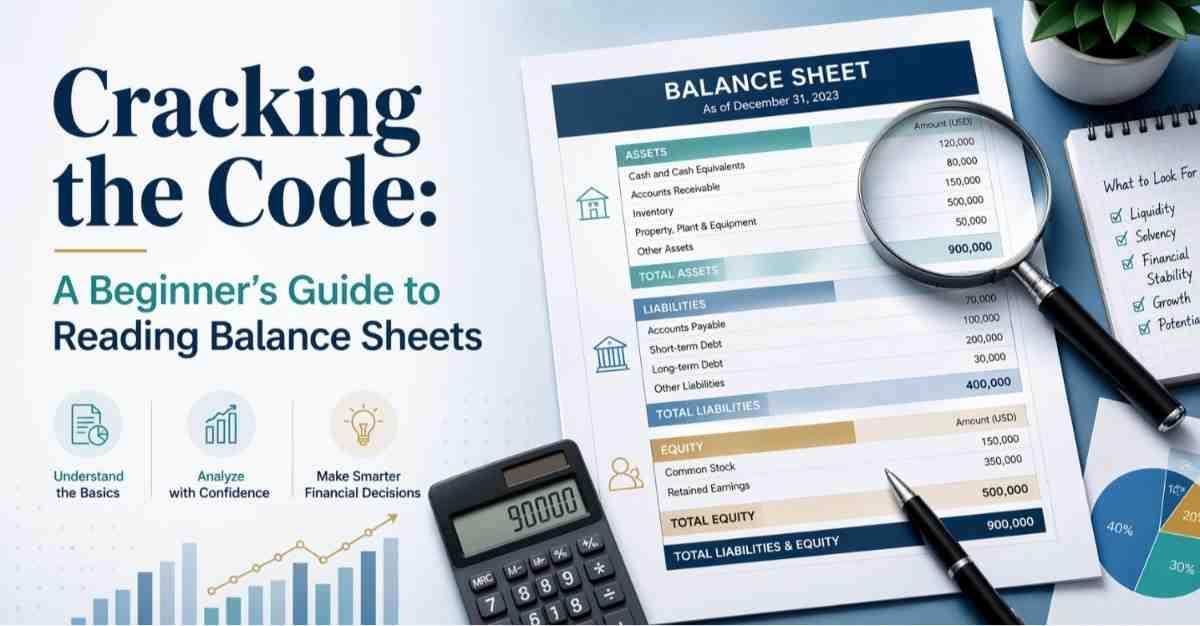
A Clear and Concise Guide to Understanding Where the Money Goes.
✨ Key Takeaways
If you’ve ever looked at a company’s financial report and felt like you were staring at a foreign language, you aren't alone. Between "accumulated depreciation" and "retained earnings," the terminology can be intimidating. However, at its heart, a balance sheet is incredibly simple. It is a financial snapshot taken at a specific point in time, showing exactly what a business owns, what it owes, and what is left over for the owners.
Think of it like a personal "net worth" statement. If you list the value of your car and house, then subtract your student loans and mortgage, the result is your financial standing. A balance sheet does the exact same thing for a multi-billion-dollar corporation.
The Golden Equation
Every balance sheet in the world follows one fundamental rule. It must always "balance." The formula is:
Assets = Liabilities + Shareholders’ Equity
• Assets: Things the company uses to operate (Cash, inventory, equipment).
• Liabilities: Money the company owes to others (Bank loans, unpaid bills).
• Equity: The "net worth" of the company belonging to the owners/shareholders.
1. Assets: What the Company Owns
Assets are usually listed in order of liquidity, how quickly they can be turned into cash. They are divided into two main categories:
Current Assets (Short-term)
These are items the company expects to convert to cash within one year.
• Cash and Equivalents: Money in the bank or very safe investments.
• Accounts Receivable: Money customers owe the company for products already delivered.
• Inventory: Raw materials or finished goods sitting on the shelf waiting to be sold.
Non-Current Assets (Long-term)
These are long-term investments that aren't easily sold.
• Property, Plant, and Equipment (PP&E): The factories, delivery trucks, and office computers.
• Intangible Assets: Things you can’t touch, like brand reputation, patents, or trademarks.
Example: Imagine "Sams’s Lemonade Stand." His assets include $50 in the cash box, $20 worth of lemons and sugar (inventory), and the $100 wooden stand itself. Total Assets = $170.
2. Liabilities: What the Company Owes
Just like assets, liabilities are split by when they need to be paid back.
Current Liabilities
Bills due within the next 12 months.
• Accounts Payable: Money owed to suppliers (e.g., the sugar vendor).
• Short-term Debt: Credit card payments or small bank loans.
Long-term Liabilities
Debts that are due further down the road.
• Long-term Bonds: Money borrowed from investors to be paid back over 10 or 20 years.
• Deferred Tax Liabilities: Taxes that are owed but haven't been paid yet.
Example: Sam borrowed $40 from his mom to buy the wood for his stand. He also owes his neighbour $10 for a bag of ice he used today. Total Liabilities = $50.
3. Shareholders’ Equity: The Owner's Stake
Equity is what remains if a company closed down today, sold all its assets, and paid off all its debts. It primarily consists of:
• Contributed Capital: The money owners or investors originally put into the business.
• Retained Earnings: The profits the company has kept over the years rather than paying them out as Dividends.
Example: Following our formula (Asset- Liability) Sam’s Equity is $120. This represents the "true value" Sam holds in his business.
How to Analyse the Health of a Balance Sheet
Simply reading the numbers isn't enough; you need to see what they say about the company's future. Here are two quick "litmus tests" beginners can use:
The "Current Ratio" (The Safety Check)
This measures if a company can pay its upcoming bills.
Current Ratio: Current Asset/ Current Liability
• A ratio of 2.0 is generally healthy. It means the company has $2 in cash/inventory for every $1 of debt.
• A ratio below 1.0 is a red flag. It suggests the company might struggle to pay its immediate bills.
The Debt-to-Equity Ratio (The Risk Check)
This shows how much the company relies on borrowed money versus its own money.
Debt to Equity: Total Liabilities/ Total Equity
If this number is very high (e.g., 3.0 or higher), the company is "highly leveraged." While debt can help a company grow fast, it also makes it much riskier if business slows down.
The Big Picture
The balance sheet tells a story of stability. While the Income Statement tells you if a company is making money today, the Balance Sheet tells you if the company has the foundation to survive a rainy day.
When you look at one, ask yourself:
1. Is the cash pile growing or shrinking?
2. Is the debt becoming unmanageable?
3. Is the company efficient at turning inventory into cash?
By answering these questions, you move from just "reading numbers" to truly understanding the heartbeat of a business. Whether you are an aspiring investor or a small business owner, the balance sheet is your most reliable map for the financial journey ahead.
Disclaimer: The article is for informational purposes only and not investment advice