Vedanta's Demerger Is Finally Happening: What the Numbers Say Before You Decide
 Join Us
 Follow Us
The structural logic is sound, the stock has already moved 75% and the debt is Rs 81,000 crore — here is the complete picture
✨ Key Takeaways
Announced in September 2023, revised multiple times and finally cleared by the NCLT in December 2025, Vedanta's composite demerger scheme received board implementation approval on April 20, 2026, with May 1, 2026 set as the record date. The restructuring that has been discussed, delayed and debated for two and a half years is now executing.
The stock has moved 75 per cent over the past year and recently traded near Rs 735 with a market cap of approximately Rs 2.87 lakh crore. Before examining what, the demerger does, the current valuation context matters. At a stock P/E of 26.2x, the company trades at a meaningful discount to the industry P/E of 36.2x, though it sits above its own three-year median P/E of 18.8x suggesting the valuation has expanded but not yet caught up to peers. The EV/EBITDA of 10.1x reflects a business that is not obviously cheap after the rally, but not stretched relative to the metals sector either. Price to book at 7.17x sits modestly above the industry average of 6.24x. Tying it together is a Piotroski score of 8 out of 9, which signals strong financial health across profitability, leverage and operating efficiency.
What the Demerger Creates
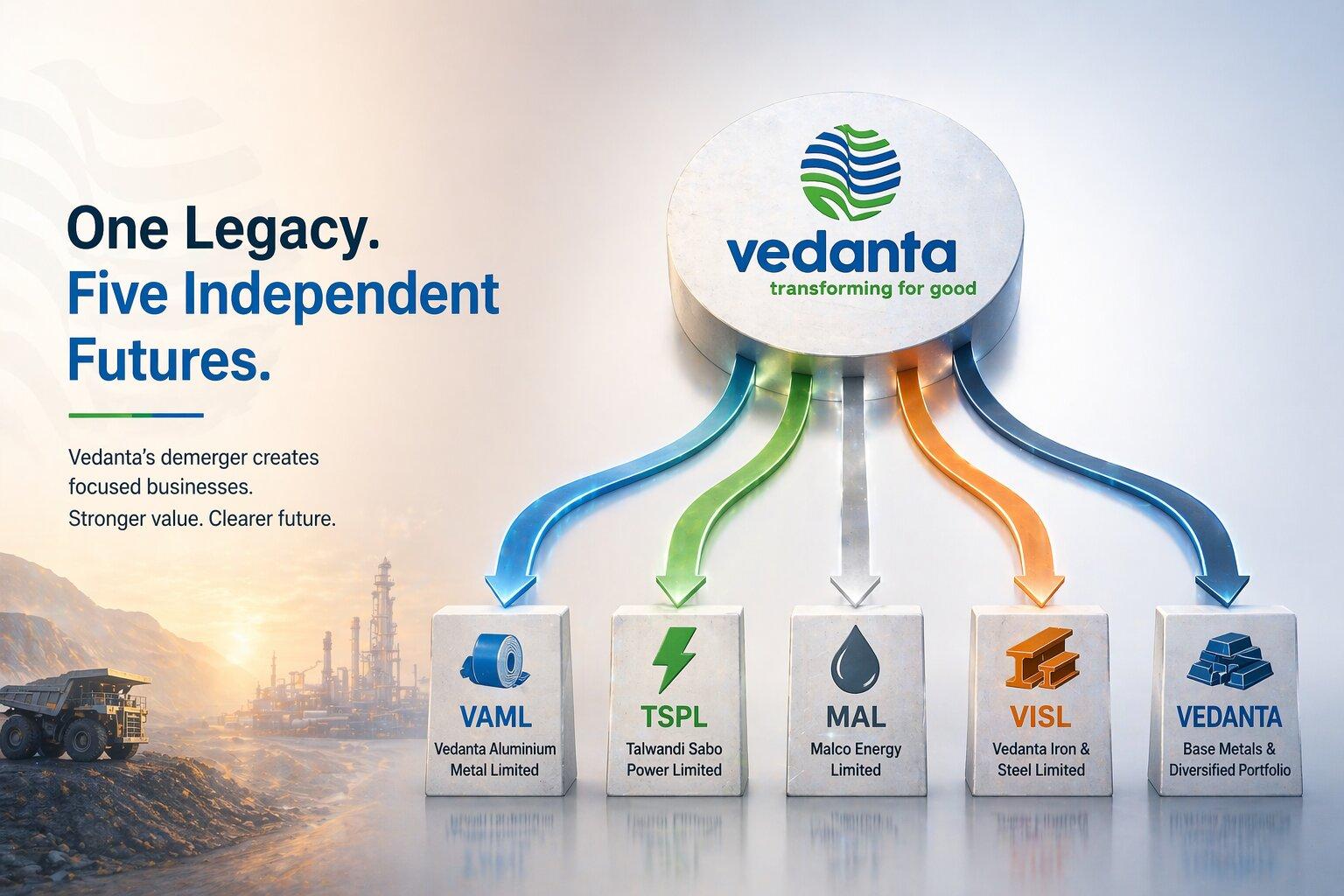
Vedanta is splitting into five independently listed entities. Shareholders on record as of May 1 receive shares in each new entity on a 1:1 basis one share each of VAML, TSPL, MEL and VISL for every Vedanta share held. The parent entity continues to exist post-demerger with its own distinct portfolio.
The four demerged entities are Vedanta Aluminium Metal Limited (VAML) covering the aluminium business, Talwandi Sabo Power Limited (TSPL) covering power, Malco Energy Limited (MAL) for oil and gas and Vedanta Iron and Steel Limited (VISL) for iron ore and steel. The parent Vedanta retains what is broadly described as the base metals and diversified portfolio.
A critical nuance here: the parent is not an empty holding company. Vedanta Limited retains its controlling stake around 60 per cent in Hindustan Zinc Limited, which is already separately listed on Indian exchanges. Hindustan Zinc is one of the most cash-generative assets in the entire Vedanta ecosystem consistent margins, low-cost zinc and silver production and a track record of strong Dividends. The parent post-demerger has a real cash flow anchor, not just passive holdco exposure.
The structural rationale for the demerger is the conglomerate discount. Investors seeking pure-play exposure to aluminium got zinc, oil and gas, power and steel alongside it different capital cycles, different risk profiles, different commodity sensitivities all bundled into one price. Markets price such bundles at a discount to what each part would attract independently. The demerger addresses this by separating each business into a directly investable entity.
The Debt: Rs 81,000 Crore
The number that anchors everything else is the debt. Vedanta carries a gross debt of approximately Rs 81,000 crore at the operating company level, with net debt at around Rs 60,600 crore. The net debt to EBITDA ratio currently stands at 1.23x, an improvement from 1.40x in 3QFY25 and the company's credit rating has been reaffirmed at AA, which provides a degree of credibility to the balance sheet trajectory. That trajectory is also supported by record operating performance: Vedanta posted its best-ever quarterly PAT of Rs 7,807 crore in the most recent quarter, up 60 per cent year-on-year, on the back of its highest-ever quarterly revenue of Rs 45,899 crore, up 19 per cent year-on-year.
This debt will be distributed across the demerged entities broadly in proportion to their cash flow capacity, which means the aluminium business the largest and most capital-intensive is likely to carry the heaviest allocation.
This creates a meaningful check on the pure-play premium narrative. None of the demerged entities will list as clean, debt-free businesses. They will each emerge as leveraged standalone companies that need to establish independent credit ratings, refinance obligations and access capital markets on their own. The group also faces over USD 2 billion in near-term maturities, adding urgency to the refinancing timeline.
The sum-of-parts valuation argument assumes each entity reprices toward sector comparable multiples after listing. That is a reasonable directional assumption. But the actual premium each entity attracts will be tempered by starting leverage ratios and a business with operational merit but a heavy debt load does not automatically receive the same multiple as a clean pure play in the same sector.
The Layer Above: Vedanta Resources
Operating company debt is only part of the picture. Vedanta Resources Limited the London based promoter holdco controlled by Anil Agarwal sits above Vedanta Limited in the ownership chain with its own debt obligations. Historically, promoter-level funding needs have influenced dividend decisions and capital allocation at the Indian listed entity level.
Post-demerger, five independently listed entities each with their own dividend policies replace one. The promoter holdco pressure does not disappear it is distributed across five dividend streams rather than one. This is a structural reality that every investor in any of the five entities needs to price into their return expectations.
The Four Businesses: What Each Actually Offers
Vedanta Aluminium Metal Limited is operationally the most attractive given India's rising aluminium demand from renewable energy infrastructure, EVs and Construction. India is structurally short on aluminium and domestic production carries a strategic premium. The risk is that VAML will likely carry the highest debt allocation of any demerged entity, creating a tension between operational quality and balance sheet weight.
Talwandi Sabo Power Limited is the least discussed but arguably the most stable. Power generates predictable cash flows that are relatively insulated from commodity cycle volatility a meaningful characteristic in a group otherwise dominated by metals and energy prices. Power valuations typically attract lower multiples than upstream metals, so TSPL may not drive rerating excitement, but earnings stability has its own value.
Malco Energy Limited brings strong current cash flows from oil and gas assets but comes with reserve depletion risk and increasing exposure to energy transition dynamics over a decade-long horizon. It is an attractive business today with greater uncertainty about the trajectory beyond five years.
Vedanta Iron and Steel Limited is the most execution dependent. The iron ore and steel business operate in a competitive, cyclical sector where scale and cost position determine outcomes. VISL's valuation upside requires demonstrated operational improvement as a standalone entity rather than being assumed from structure alone.
The Commodity Cycle Is Part of the Thesis
A significant portion of the ultimate outcome across all five entities will be determined by the global commodity cycle something entirely outside management's control. It is also worth acknowledging that the 75 per cent move in Vedanta's stock over the past year was not driven by demerger anticipation alone. A meaningful share of that rally can be credited to the ongoing upcycle in commodity markets, particularly in aluminium, zinc and silver three categories where Vedanta carries substantial exposure. Prices in these metals have been on a strong run, and that tailwind has done considerable work in the stock's re-rating independent of any structural change.
Aluminium prices, zinc demand, oil trajectories and steel margins are driven by China's industrial cycle, the US dollar and global growth. A commodity upcycle can make even imperfect execution look strong. A prolonged downturn can neutralise structural improvements.
This is not a reason to dismiss the thesis. It is a reason to be explicit that commodity cycle alignment is as important as corporate structure in determining whether the demerger delivers returns consistent with current pricing.
The Opportunity and the Overhang
The demerger solves a real structural problem. Breaking a conglomerate into independently listed pure plays removes the discount that was being applied to the bundle and gives each business the ability to attract investors seeking specific commodity exposure. The Piotroski score of 8 confirms the underlying financial health is genuine. The cash flow from Hindustan Zinc gives the parent entity credible standalone value.
What has changed from twelve months ago is the entry point. A 75 per cent rally partly structural, partly commodity-driven means the market has already done considerable work in pricing the directional improvement. At current levels, the P/E of 26.2x sits above the three-year median of 18.8x but below the industry P/E of 36.2x suggesting the discount to sector has compressed but not fully closed.
For existing shareholders, May 1 marks the culmination of a long wait and post-listing rerating across individual entities may still offer incremental upside as each business finds its sector-appropriate multiple. For new investors, the calculus is different. The question is whether the remaining gap between current pricing and full pure-play valuations justifies entry after a 75 per cent move, against a backdrop of Rs 81,000 crore in gross debt being distributed across five new balance sheets.
Vedanta is a complex business. It always has been and the demerger does not change that reality. What it does mark is one of the most complex corporate restructurings in Indian market history and regardless of how it plays out, there will be no shortage of lessons to take from it.
Disclaimer: This article is for informational purposes only and not investment advice.