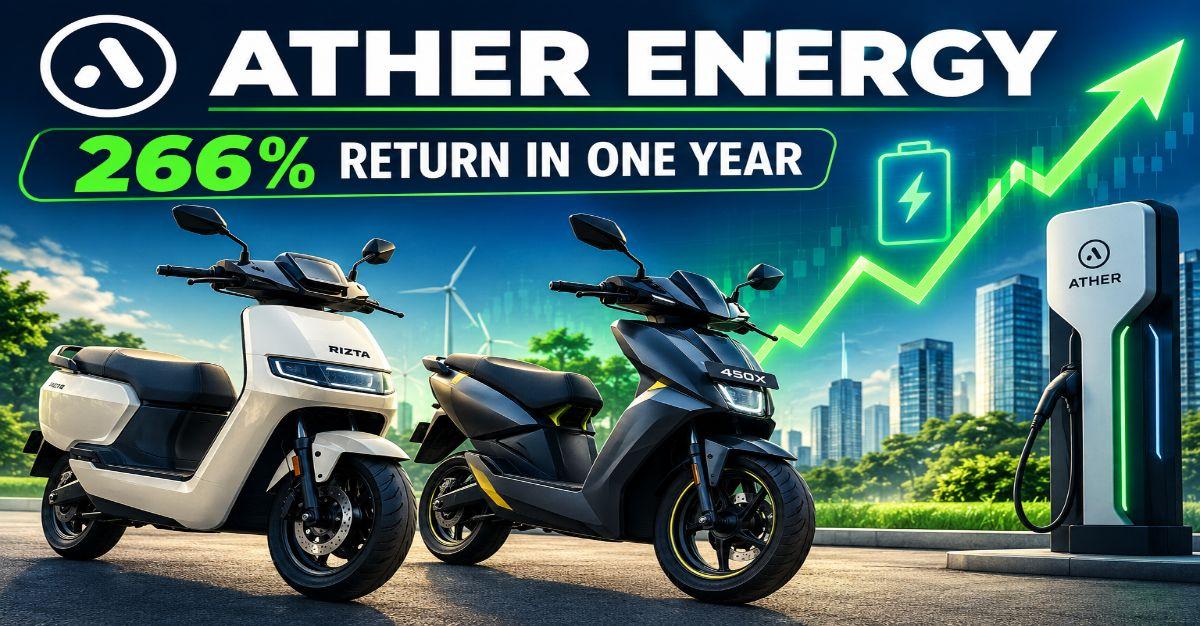
Ather Energy Has Returned 266% in One Year. ROE Is -33%. ROCE Is -20%. Free Cash Flow Is Negative. So What Is the Market Actually Buying?
 Join Us
 Follow Us
This is not a profitability story. It is a scale story. Investors are paying for the probability that Ather becomes one of India's dominant electric two-wheeler platforms before it becomes consistently profitable. Understanding that distinction is the only way to make sense of what has happened to this stock.
✨ Key Takeaways
Ather Energy hit a 52-week high of Rs 1,343 on July 16, 2026. The 52-week low was Rs 329.15 on July 28, 2025. The current price of Rs 1,281.35 represents a one-year return of 266 per cent — a multibagger by any definition. Over six months the return is 107 per cent. Over three months it is 50.63 per cent.
Now read these numbers alongside that return. ROE: negative 33 per cent. ROCE: negative 20 per cent. Free cash flow: negative. Net loss in FY26: Rs 517 crore. EBITDA: still negative at Rs -408 crore for the full year.
A stock that has returned 266 per cent in twelve months while reporting every one of these metrics in the red is not being valued on current earnings. It is being valued on the belief that Ather is becoming one of India's dominant electric two-wheeler platforms. That is a fundamentally different investment thesis and it requires a fundamentally different analytical framework.
The Electric Two-Wheeler Market
India sold approximately 2.15 crore two-wheelers on a retail registration basis in FY26. Of those, electric two-wheelers accounted for 14.02 lakh units — a penetration rate of 6.5 per cent of the overall two-wheeler market, up from 6.1 per cent in FY25. Total electric two-wheeler retail grew 21.81 per cent year-on-year from 11.51 lakh units in FY25 to 14.02 lakh units in FY26 as per FADA data.
As per Mordor Intelligence, the global electric two-wheeler market is estimated at USD 24.63 billion in 2026 and is expected to reach USD 41.51 billion by 2031 at a CAGR of 11.59 per cent. Scooters captured 94.71 per cent of market share in 2025.
The FY26 market share breakdown among significant players is as follows:
|
Company |
FY26 E2W Sales |
Market Share |
|
TVS Motor |
3,41,513 |
24.36% |
|
Bajaj Auto |
2,89,349 |
20.64% |
|
2,39,178 |
17.06% |
|
|
Ola Electric |
1,64,295 |
11.72% |
|
Hero MotoCorp |
1,44,330 |
10.30% |
|
Others |
2,23,153 |
15.92% |
The most important number in that table is not Ather's market share it is Ola Electric's decline. Ola Electric, which was once the clear volume leader, reported retail sales of 1,64,295 units in FY26 a decline of 52.28 per cent from 3,44,300 units in FY25. The leadership of the electric two-wheeler market changed materially in FY26.
What makes this industry particularly attractive is that penetration remains low despite rapid growth. Electric two-wheelers accounted for only 6.5 per cent of India's total two-wheeler sales in FY26, suggesting the transition from internal combustion engine vehicles is still in its early stages. At the same time, monthly penetration crossed 10 per cent by June 2026, supported by improving charging infrastructure, a wider product range and increasing consumer acceptance. That combination of low penetration and accelerating adoption is precisely why investors are willing to value leading EV companies on future scale rather than current profitability.
The Market Share Story: From 7.6 per cent to 18.6 per cent
This is the single biggest reason behind Ather's re-rating. In Q1 FY25, Ather held approximately 7.6 per cent market share in the electric two-wheeler segment. By Q4 FY26, that had reached 18.6 per cent — an increase of approximately 1,100 basis points within one year. Management described FY26 as a breakthrough year.
Four things drove this simultaneously.
Rizta changed what Ather was selling. Before Rizta, Ather's portfolio was the 450X and 450S — premium, sporty scooters with a relatively narrow addressable customer. Rizta entered the family scooter segment, targeting daily commuters, women buyers and first-time EV buyers. Management stated that Rizta was the primary driver of FY26 growth and had become nearly three-fourths of the company's sales mix by the end of FY26. This is the most important statement management made in FY26. Market share did not increase because Ather discounted aggressively. It increased because Ather entered a much larger addressable market with a product specifically designed for it.
Distribution doubled. Experience centres expanded from 351 to 700 within one year. Service centres also doubled. Ather shifted from being a South India-focused company to a national one. The Middle India strategy — focused on Gujarat, Maharashtra, Madhya Pradesh, Odisha and Chhattisgarh, which management identified as states with already high scooter penetration — produced results. Ather's market share in Middle India grew from approximately 4 per cent to 17 per cent.
Dealer economics drove expansion organically. Approximately 75 per cent of new dealerships were opened by existing dealers. Dealers who were already in the network voluntarily expanded because they were generating returns. Management stated they deliberately did not chase store count before the IPO, instead focusing on making existing dealers profitable first. That approach produced a network effect.
The Revenue and Margin Trajectory
|
Year |
Revenue (Rs crore) |
Operating Profit (Rs crore) |
OPM |
|
FY22 |
408 |
-260 |
-64% |
|
FY23 |
1,781 |
-708 |
-40% |
|
FY24 |
1,754 |
-685 |
-39% |
|
FY25 |
2,255 |
-581 |
-26% |
|
FY26 |
3,672 |
-408 |
-11% |
Revenue grew 63 per cent in FY26 from Rs 2,255 crore to Rs 3,672 crore. FY23 and FY24 demonstrated that Ather could build a premium EV brand. FY26 demonstrated that it could scale one. The jump from Rs 2,255 crore to Rs 3,672 crore was driven not only by higher volumes but also by a broader customer base, a successful new product and rapid nationwide distribution expansion.
The annual numbers explain the scale of growth. The quarterly numbers explain how quickly the business is improving.
|
Quarter |
Revenue (Rs crore) |
OPM |
|
Jun-24 |
360 |
-36% |
|
Sep-24 |
584 |
-24% |
|
Dec-24 |
635 |
-22% |
|
Mar-25 |
676 |
-25% |
|
Jun-25 |
645 |
-21% |
|
Sep-25 |
899 |
-15% |
|
Dec-25 |
954 |
-8% |
|
Mar-26 |
1175 |
-6% |
The direction is consistent. From -36 per cent EBITDA margin in June 2024 to -6 per cent in March 2026. Management reported EBITDA loss improving to -2.5 per cent in Q4 FY26 — an improvement of more than 2,000 basis points year-on-year. Every quarter from September 2025 onward has been a new quarterly revenue high.
The improvement is particularly noteworthy because it came despite a gradual reduction in government subsidy support. Four factors drove the gross margin expansion from 19 per cent in FY25 to 24 per cent in FY26, and from 12 per cent to 21 per cent without subsidies: lower battery costs through better sourcing, continuous value engineering in vehicle design, higher software attachment through the Pro Pack — with an attach rate of 93 per cent, the highest ever recorded — and operating leverage as fixed costs were spread over significantly higher volumes.
The Platforms That Underpin the Investment Thesis
AtherStack the software platform includes navigation, OTA updates, ride analytics, cruise control, theft protection and connected services. Management launched AtherStack 7 in FY26. The company does not disclose software revenue separately. The 93 per cent Pro Pack attach rate indicates the software offering has become effectively standard for Ather buyers.
The charging network has expanded to 6,000+ fast chargers. Management also created the LECCS charging standard with 20+ industry participants. The charging network does more than reduce range anxiety. As it expands, it strengthens Ather's ecosystem and increases customer stickiness, much like Tesla's Supercharger network did in its early years. A well-developed charging infrastructure can become a meaningful competitive advantage for an EV manufacturer scaling nationally.
Factory 3 is designed for an annual production capacity of 10 lakh units, with Phase 1 expected to commence in FY27. For perspective, Ather sold approximately 2.63 lakh vehicles in FY26, meaning the planned capacity is nearly four times its current annual sales. The new facility therefore provides enough manufacturing headroom to support several years of growth without another major greenfield investment.
Hero MotoCorp holds approximately 30 per cent of Ather and participated in the most recent preferential issue through convertible warrants. The Hero relationship provides manufacturing expertise, supply chain depth, capital support and access to one of India's largest two-wheeler ecosystems. Even without fully integrating Hero's dealer network, the strategic backing significantly reduces execution risk compared with a standalone EV startup.
The company holds 643 patents, including 283 filed during FY26. The patent count itself is not the investment thesis. What matters is that Ather continues investing heavily in battery technology, software, charging systems and power electronics, indicating that innovation remains central to its long-term competitive strategy.
The Valuation Question
Market cap stands at approximately Rs 49,000 crore. FY26 revenue was Rs 3,672 crore. Price to sales is approximately 13.4x. The company is still loss-making.
At roughly 13.4 times FY26 sales, Ather trades more like a high-growth technology company than a traditional automobile manufacturer. Investors are effectively discounting several years of future market share gains, operating leverage and eventual profitability rather than valuing the business on current earnings.
That also explains why conventional valuation metrics such as P/E, ROE and ROCE provide limited insight today. Investors are valuing Ather much like an early-stage platform business, where the debate centres on future market share, operating leverage and cash generation rather than current profitability.
What the market is pricing is not current performance — it is the probability that Ather becomes one of India's top electric two-wheeler platforms with sustained market share, eventual EBITDA profitability as Factory 3 scales, and improving unit economics.
Why Didn't TVS or Bajaj Re-rate Like Ather?
TVS Motor and Bajaj Auto remain the two largest electric two-wheeler manufacturers in India, but their businesses are already diversified and profitable. Electric vehicles contribute only a part of their overall earnings. Ather, on the other hand, is a pure-play electric mobility company. Every gain in market share, every improvement in margins and every expansion in capacity has a much larger impact on its long-term earnings potential. Investors are therefore valuing Ather on future operating leverage, while valuing TVS and Bajaj primarily on current earnings. That difference largely explains why Ather's share price has re-rated much more sharply.
The Risks
TVS, Bajaj and Hero Vida are all executing well in the same market and have significantly stronger balance sheets. Ola Electric's collapse in market share from a dominant position to 11.72 per cent is a reminder that EV market leadership is not permanent. Chinese battery pricing, subsidy policy changes, failure to utilise Factory 3 at sufficient scale, software monetisation progressing slower than expected and continued negative free cash flow are all real variables. The net loss has reduced from Rs 812 crore in FY25 to Rs 517 crore in FY26. The direction is correct. The distance to profitability remains material.
The Honest Summary
Ather did not buy market share. It earned market share — through a product that expanded its addressable market, distribution that became genuinely national, dealer economics that created organic network growth and margins that improved by over 2,000 basis points in a single year. The 266 per cent one-year return reflects the market's revised assesSMEnt of what Ather is — not a niche premium EV company, but a mass-premium national platform with a credible path to scale.
The market has already voted on Ather's ability to scale. The next vote will be on its ability to generate sustainable profits, positive free cash flow and healthy returns on capital. Until then, every quarterly result will be judged less on revenue growth and more on how efficiently that growth converts into earnings and cash generation.
Disclaimer: This article is for informational purposes only and not investment advice.