Bansal Wire Hits Record FY26 Volumes as Dadri Plant Roars
 Join Us
 Follow Us
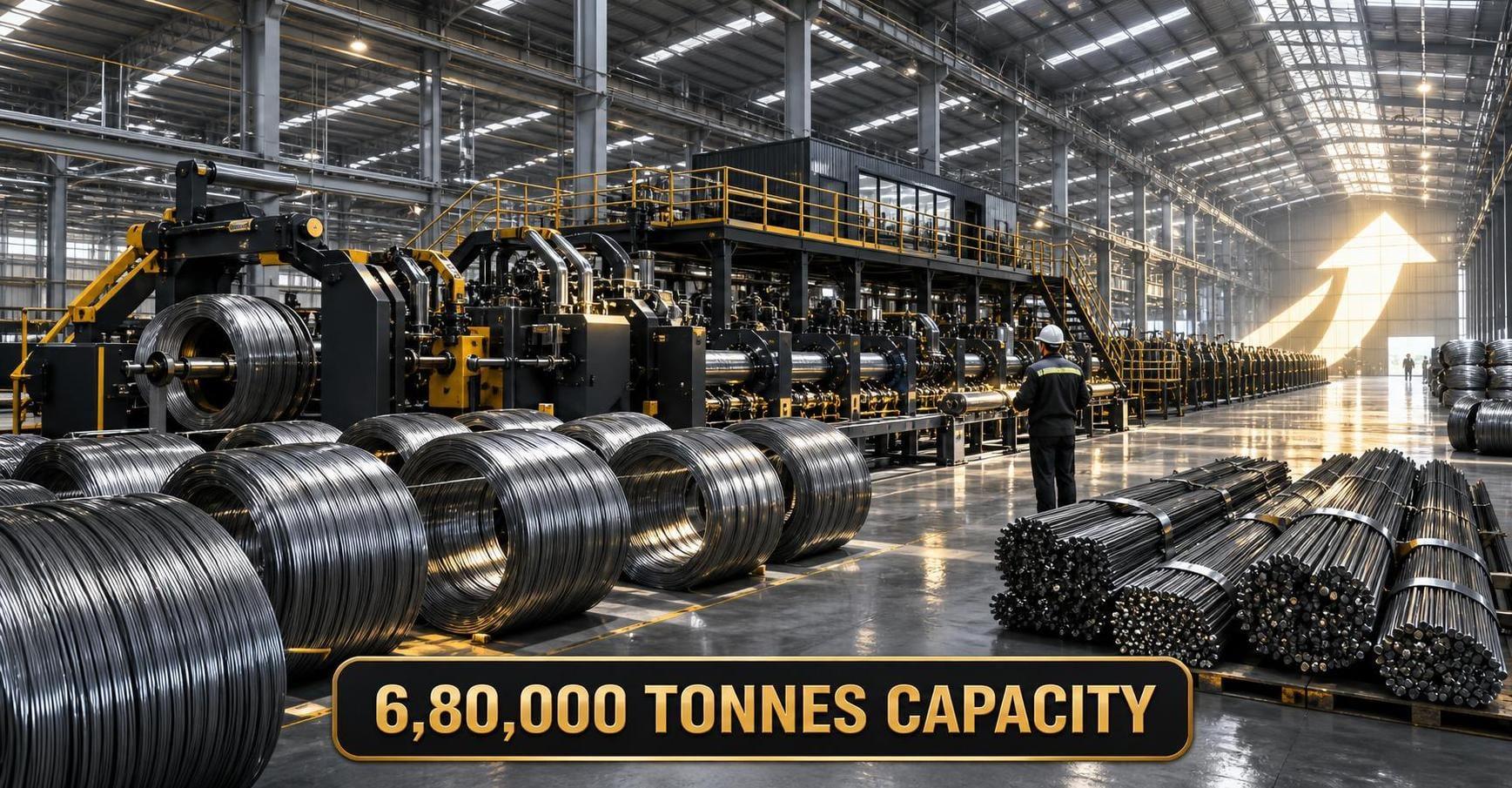
Bansal Wire Industries reported 19 per cent revenue growth in FY26 and record volumes after expanding Dadri capacity, with higher utilisation, specialty products and B2C wires set to shape its next growth phase.
✨ Key Takeaways
Bansal Wire Industries has moved into a larger-capacity growth phase after reporting its highest-ever annual sales volume of about 4,58,000 tonnes in FY2025-26, supported by the expansion of its Dadri manufacturing facility and broader product offerings.
Consolidated revenue rose 19 per cent year-on-year to Rs 4,160 crore, while EBITDA increased 17 per cent to Rs 324 crore. Profit after Tax grew 10 per cent to Rs 161 crore. The company's debt-to-equity ratio stood at 0.39 times, indicating that the latest capacity addition was undertaken without a sharp increase in leverage.
The key operational development during the year was the installation of 1,20,000 tonnes of additional annual capacity at Dadri, taking Bansal Wire's total installed capacity to about 6,80,000 tonnes per annum. The expansion represents an increase of roughly 21 per cent over the earlier capacity base and gives the company a larger platform to increase volumes without immediately requiring another major manufacturing investment.
Looking for High-Growth Stocks Below ₹100?
Explore DSIJ’s Penny Pick - a research-driven service focused on uncovering fundamentally strong low-priced stocks with long-term growth potential.
Download Service BrochureDadri has already begun contributing to output growth. Bansal Wire reported its highest quarterly volume of 1,21,000 tonnes in the third quarter, although overall utilisation during FY26 was around 70 per cent, below its historical range of 85-90 per cent. Management said it intends to retain 20-25 per cent capacity headroom at the beginning of a year to support annual growth of 20-25 per cent, suggesting that the current utilisation gap is partly linked to planned growth capacity rather than solely demand weakness.
The company's FY26 EBITDA margin was 7.8 per cent, marginally lower than 7.9 per cent in the previous year, despite the higher revenue and volume base. This makes the ramp-up of Dadri, lower conversion costs per tonne and a richer product mix important to its stated objective of achieving a double-digit EBITDA margin over the medium term.
Specialty wires are expected to be central to that effort. These products account for only about 4-5 per cent of volumes currently, but management has said they offer higher contribution margins. IHT Wires scaled ahead of plan, leading Bansal Wire to expand phase-two capacity to 15,000 tonnes from 9,000 tonnes. Commercial production of brass-coated hose wire and LRPC strands has also commenced.
The steel-cord project remains an important watchpoint. The company has secured technical approvals from two major global tyre companies and supplied its first trial product. However, commercialisation remains dependent on further trials and customer approvals. Management has indicated that meaningful sales could begin within the next three to four quarters if the qualification process progresses as expected.
Bansal Wire is also expanding its consumer-facing business in poultry, fencing and farming wires. The B2C segment contributed nearly 10 per cent of revenue and has been extended to South India, Maharashtra, Tamil Nadu, Andhra Pradesh and Telangana after gaining traction in Gujarat. Management's internal target is for about half of low-carbon wire sales to eventually come from this channel, though it has not specified a timeline.
Cash generation improved sharply during FY26, with operating cash flow of about Rs 330 crore, exceeding the company's internal target of Rs 250 crore. Management has raised its two-year operating cash-flow ambition to about Rs 800 crore and is targeting around Rs 400 crore in the current year, after generating about Rs 120 crore in the first quarter. Planned capital expenditure of Rs 200-250 crore is expected to be largely funded through internal accruals.
As of 12:54 pm on September 24, 2026, Bansal Wire shares were trading at Rs 323.65, up 2.68 per cent from the previous close of Rs 315.20. The stock was about 11.6 per cent below its 52-week high of Rs 366.25, while its one-year decline of 10.86 per cent lagged the BSE 500's 3.73 per cent decline over the same period.
The near-term test for Bansal Wire will be whether higher Dadri utilisation, specialty-wire scale-up and B2C expansion can translate into better margins and sustained cash generation while protecting returns on the capital deployed.
Disclaimer: The article is for informational purposes only and not investment advice.