BSE-Listed Companies Reclaim USD 5 Trillion Market Capitalisation
 Join Us
 Follow Us
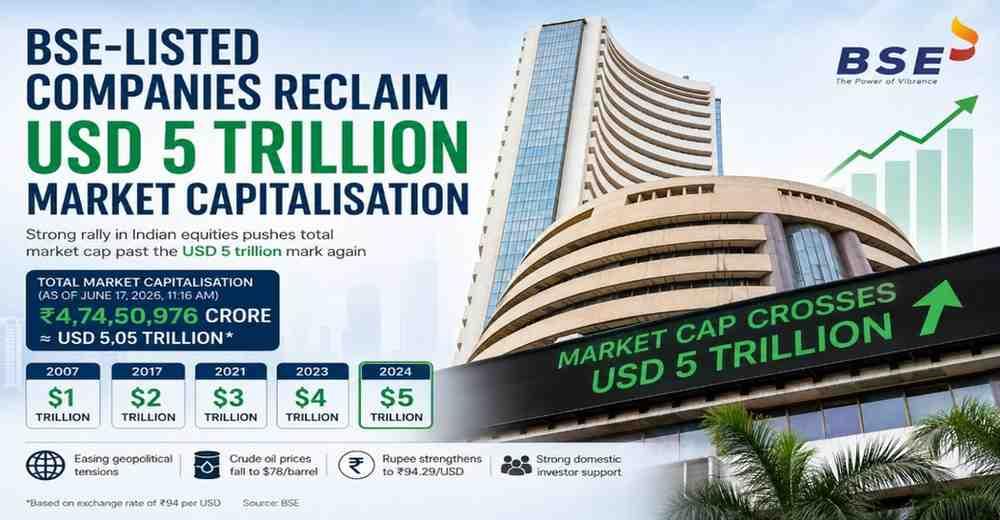
Indian Equities Return to $5 Trillion Club as Sentiment Improves.
✨ Key Takeaways
Indian equities have staged a strong recovery in recent weeks, helping the combined market capitalisation of companies listed on the Bombay Stock Exchange (BSE) reclaim the USD 5 trillion milestone.
As of 11:16 a.m. on June 17, 2026, the total market capitalisation of BSE-listed companies stood at Rs 4,74,50,976 crore. Based on an exchange rate of Rs 94 per USD, the aggregate valuation translates to approximately USD 5.05 trillion. This marks the first time since early May 2026 that the market has crossed the USD 5 trillion threshold.
The latest milestone reflects the sharp rebound witnessed across Indian equities over the past several trading sessions. Over the last four trading days alone, the combined market capitalisation of listed companies has risen by more than 6 per cent. Since the beginning of April 2026, the overall market value has increased by nearly 14 per cent.
Journey to the USD 5 Trillion Mark
The Indian equity market has expanded rapidly over the past two decades. BSE-listed companies first crossed the USD 1 trillion market capitalisation mark in 2007. The market subsequently surpassed USD 2 trillion in 2017, USD 3 trillion in 2021 and USD 4 trillion in 2023, before crossing USD 5 trillion for the first time in 2024.
The latest recovery highlights the resilience of domestic markets despite periods of heightened global uncertainty and volatility.
Market Still Below Record High
Despite the recent rally, the combined market capitalisation of BSE-listed companies remains below its all-time peak. The current valuation is approximately 11.4 per cent lower than the record high of USD 5.7 trillion achieved in September 2024.
What Drove the Rally?
A combination of supportive global developments and sustained domestic participation has contributed to the market's recent gains.
One of the key triggers was easing geopolitical tensions in the Middle East following a preliminary peace agreement between the United States and Iran, which led to the reopening of the strategically important Strait of Hormuz. The development helped ease concerns over global energy supplies, resulting in a decline in crude oil prices.
Brent crude oil prices fell to around USD 78 per barrel, providing relief to oil-importing economies such as India. Lower crude prices also supported the Indian rupee, which appreciated by 31 paise against the US dollar to Rs 94.29.
Domestic investors played an equally important role in supporting the market. While foreign institutional investors (FIIs) have remained net sellers in recent months, domestic Mutual Funds and retail investors continued to deploy capital into equities, helping absorb foreign outflows and sustain the market's upward momentum.
Outlook
The return to the USD 5 trillion mark underscores the strength of investor sentiment and the growing depth of India's capital markets. Although valuations remain below their September 2024 peak, improving global conditions, softer crude oil prices and robust domestic participation have provided fresh support to equities.
Market participants will now closely monitor whether the ongoing momentum can propel Indian equities closer to their record highs in the coming months.
Disclaimer: The article is for informational purposes only and not investment advice.