Capital Goods: Budget 2026–27 Anchors India’s Next Capex Cycle
 Join Us
 Follow Us
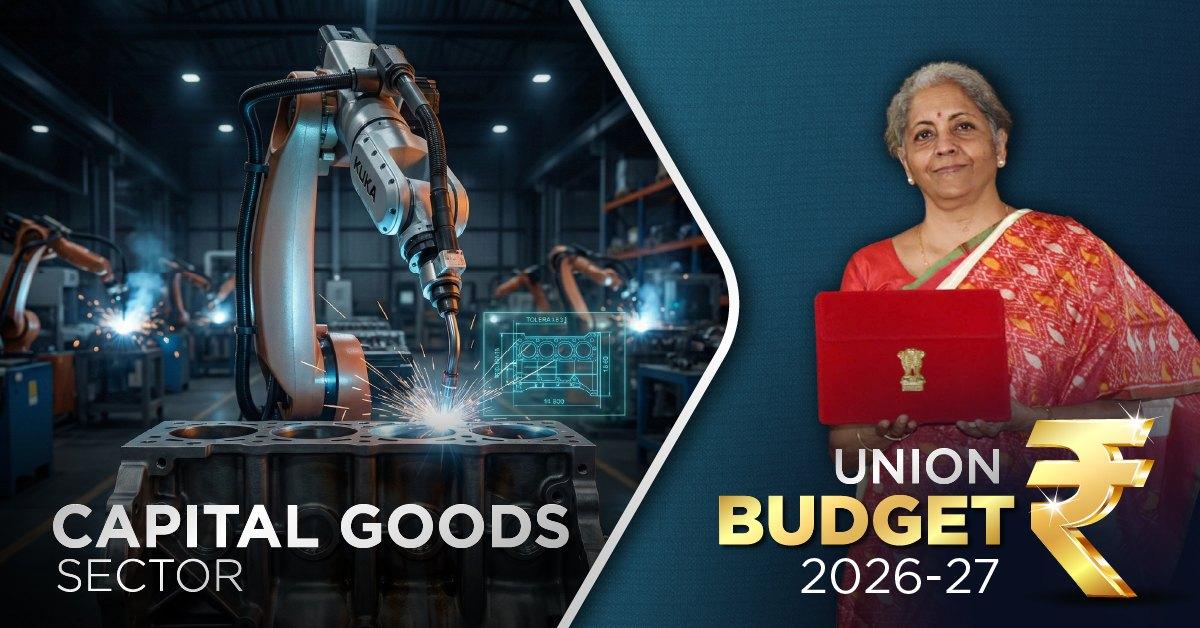
Capex Continuity and Infrastructure Spending Reinforce Long-Term Growth Visibility
✨ Key Takeaways
Capital Goods as a National Capability
Union Budget 2026–27 places capital goods at the heart of India’s productivity and infrastructure ambitions. The message is explicit: no sustained growth is possible without domestic capability in high-value equipment.
Rather than treating capital goods as a derivative beneficiary of capex, the Budget recognises it as a strategic sector in itself.
High-Value Equipment Manufacturing Gets Policy Backing
A dedicated Scheme for Enhancement of Construction and Infrastructure Equipment (CIE) has been introduced to promote domestic manufacturing of technologically advanced equipment — ranging from tunnel-boring machines and fire-fighting systems to high-precision construction tools.
This is significant because India’s infrastructure expansion increasingly requires complex, imported machinery, which exposes projects to cost overruns and supply risks.
Hi-Tech Tool Rooms: Fixing a Silent Bottleneck
The establishment of Hi-Tech Tool Rooms within CPSEs as digitally enabled precision manufacturing hubs addresses a chronic weakness in India’s industrial ecosystem — access to affordable, high-precision tooling.
For capital goods manufacturers, tooling costs and lead times are often invisible constraints. This intervention improves quality, reduces dependence on imports, and enhances global competitiveness.
Container Manufacturing and Logistics Equipment
A Rs 10,000 crore scheme over five years for container manufacturing aims to build a globally competitive logistics equipment ecosystem. This aligns with India’s export ambitions and de-risks trade from container shortages seen during global disruptions.
Duty Exemptions and Industrial Clusters
The extension of BCD exemptions on capital goods for lithium-ion cells, battery storage, critical mineral processing, and Solar glass manufacturing reduces project costs across energy and electronics supply chains.
Additionally, the revival of 200 legacy industrial clusters creates incremental demand for machine tools, automation equipment, and industrial services — providing a multi-year demand runway for capital goods companies.
Capex Multiplier in Action
Public capital expenditure has been raised to Rs 12.2 lakh crore, supported by the creation of an Infrastructure Risk Guarantee Fund. This improves lender confidence and accelerates private participation — directly benefiting EPC, machinery, and industrial equipment players.
Investment Perspective
Capital goods are no longer just cyclical plays. With Defence, energy, urban infrastructure, logistics, and manufacturing all scaling simultaneously, the sector is becoming a structural growth story. Order Books, execution capability, and balance sheet discipline not narratives will drive returns.