Union Budget 2026: A Blueprint for India’s Manufacturing Sector
 Join Us
 Follow Us
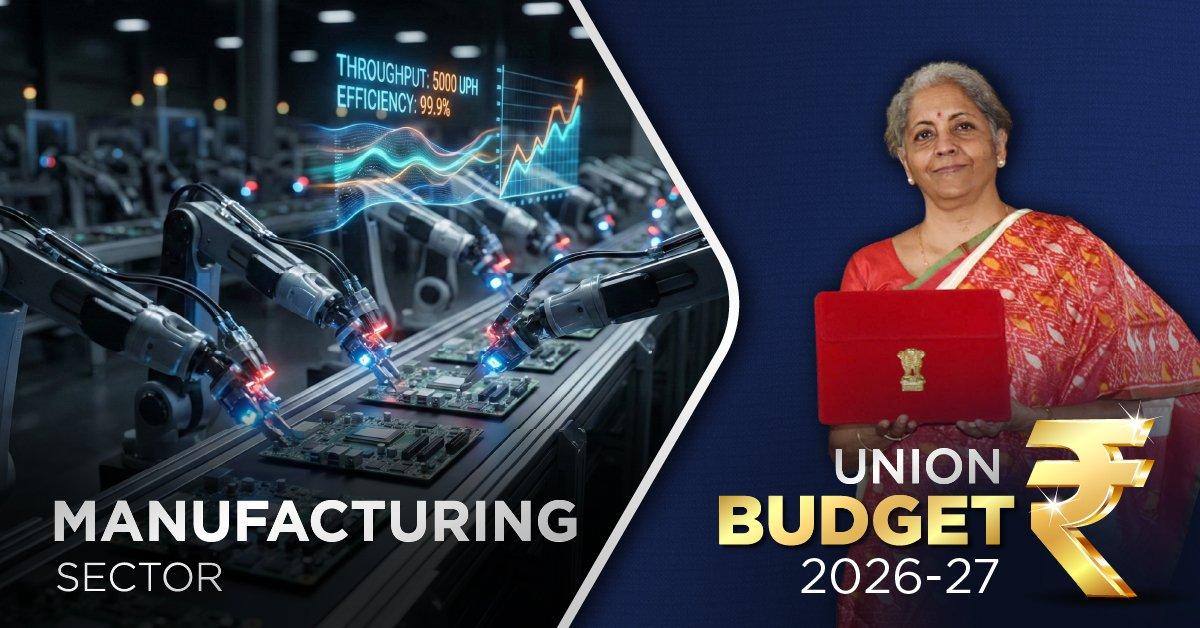
Fueling the Journey to a Global Manufacturing Superpower.
✨ Key Takeaways
The Union Budget 2026, presented by Finance Minister Nirmala Sitharaman, marks a decisive shift from pandemic-era recovery to a high-octane growth phase for the Indian manufacturing sector. With a bold vision to transform India into a global industrial hub, the budget introduces a series of strategic outlays, structural reforms, and specialised corridors designed to sharpen India’s competitive edge.
The India moves toward its goal of becoming a USD 5 trillion economy, the manufacturing sector has emerged as the engine room of this transformation. With the Union Budget 2026 on the horizon, the industry is no longer just looking for subsidies-it is looking for a "global edge." Currently contributing roughly 17 per cent to the GDP, the sector's eyes are fixed on a bold 25per cent target, fueled by the expansion of schemes into high-tech frontiers like Electronics & Semiconductors.
1. Capex Push: Fueling the Industrial Engine
In a significant move to sustain economic momentum, the government has hiked Capital Expenditure (Capex) to Rs12.2 lakh crore for FY27. This investment is largely focused on developing infrastructure in Tier-2 and Tier-3 cities-urban centers that are rapidly expanding into new manufacturing and growth hubs. This multi-fold increase from previous years aims to provide the logistical backbone required for seamless industrial operations.
2. High-Tech Frontiers: Electronics and Semiconductors
To reduce import dependency and lead in the global tech race, the budget places a massive bet on "deep-tech" manufacturing:
- ISM 2.0: The India Semiconductor Mission enters its second phase to accelerate domestic chip production.
- Electronics Component Manufacturing: The outlay for this sub-sector has been increased to Rs 40,000 crore, incentivizing innovation and large-scale assembly.
- Biopharma Shakti: A dedicated outlay of Rs 10,000 crore will establish three new specialised institutes and a biopharma-focused network, positioning India as a global pharmacy beyond just generics.
3. Strengthening the Supply Chain: Rare Earth & Chemical Parks
Recognising the importance of raw material security, the Finance Minister announced:
- Rare Earth Corridors: Specialised corridors will be established in Odisha, Kerala, Andhra Pradesh, and Tamil Nadu to promote mining and manufacturing of rare earth permanent magnets-crucial for EVs and high-tech Defence gear.
- Dedicated Chemical Parks: The Centre will support states in establishing three chemical parks via a cluster-based "plug-and-play" model to boost domestic chemical production.
- Container Manufacturing: A new scheme with a Rs 10,000 crore outlay over five years to build a globally competitive container manufacturing ecosystem.
4. Supporting the Backbone: MSMEs and Textiles
Small-scale industries received a major boost to ensure they remain competitive in global value chains:
- SME Growth Fund: A dedicated Rs 10,000 crore fund has been proposed to incentivise small enterprises and create future-ready jobs.
- Labour-Intensive Textile Boost: An integrated programme featuring the National Fibre Scheme and a Textile Expansion and Employment Scheme was launched to modernize machinery and achieve self-Reliance in both natural and man-made fibres.
5. Skill and Heritage: Mahatma Gandhi Gram Swaraj
For the traditional manufacturing segment, the Mahatma Gandhi Gram Swaraj Initiative aims to take Khadi, handloom, and handicrafts to the global stage. By streamlining training, branding, and market linkages, the government aims to empower rural youth and artisans under the "One District One Product" (ODOP) framework.
6. Tax Reforms and "Ease of Doing Business"
The budget introduces several fiscal measures to lower costs and simplify compliance for manufacturers:
- Customs Duty Exemptions: Exemption from basic customs duty (BCD) on components for aircraft manufacturing, Solar glass production (sodium antimonate), and lithium-ion cells for battery storage & parts used in the manufacture of microwave ovens.
- Trusted Importers: Recognizing regular importers with longstanding supply chains in the risk system to minimize cargo verification times.
- Non-Resident Support: A five-year income tax exemption for non-residents providing capital goods or equipment to toll manufacturers in bonded zones