Union Budget 2026: Consumer Durables Get Policy Lift
 Join Us
 Follow Us
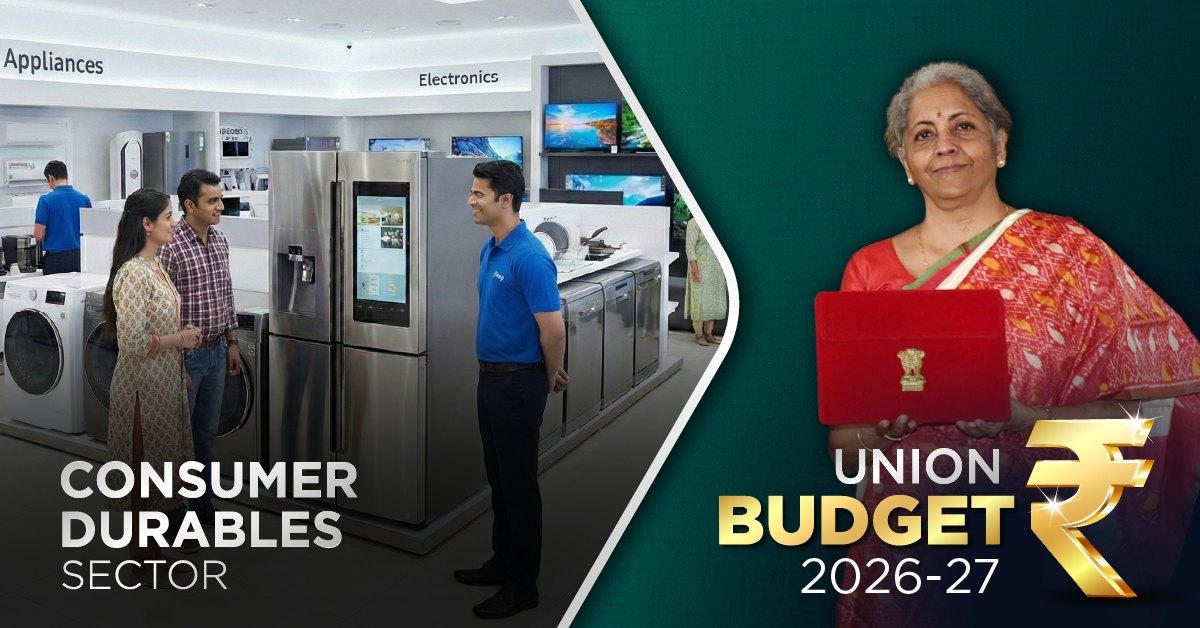
Don’t miss the most important Budget announcements for the consumer durables sector. Click here!
✨ Key Takeaways
The Union Budget has delivered a measured but meaningful boost to India’s consumer durables and household appliances sector, combining targeted duty rationalisation with large-scale manufacturing incentives and demand-side support. While no single announcement is transformational on its own, the cumulative impact of these measures strengthens the long-term investment case for companies operating across appliances, electronics components and energy-linked durables.
A key focus area is deeper domestic value addition in household appliances. To encourage local manufacturing, the government has proposed exemptions on basic customs duty for specified parts used in the manufacture of microwave ovens. This move reduces input costs and incentivises manufacturers to expand local assembly and component sourcing, aligning with India’s broader goal of reducing import dependence in consumer electronics. Over time, such measures can improve margins and scale for domestic players while attracting global manufacturers to set up India-centric supply chains.
The budget also continues strong backing for white goods through the Production Linked Incentive scheme. Air conditioners and LED lighting remain priority segments, with a proposed allocation of Rs 1,004 crore for 2026-27. The PLI framework has already triggered capacity expansion, localisation of components and entry of new players. Continued funding reinforces visibility for manufacturers and ancillaries, especially as demand for energy-efficient cooling and lighting solutions rises with urbanisation and climate-driven consumption.
Beyond direct appliance-focused measures, indirect support through electronics manufacturing incentives is equally significant. The outlay for the Electronics Components Manufacturing Scheme has been raised to Rs 40,000 crore, signalling confidence in India’s electronics ecosystem. This benefits appliance makers indirectly by strengthening the availability of domestic components, reducing supply chain risks and improving cost competitiveness. The proposal for a five-year income Tax exemption for non-residents supplying capital goods or tooling to toll manufacturers in bonded zones further enhances India’s attractiveness as a global manufacturing base for electronic goods.
Energy storage and sustainability-linked durables also gain policy support. The extension of customs duty exemptions on capital goods used in lithium-ion cell manufacturing to battery energy storage systems supports emerging applications beyond electric vehicles. This can benefit companies involved in inverters, storage solutions and renewable-linked consumer products.
Infrastructure-related household durables receive attention through a new scheme for Construction and Infrastructure Equipment. By promoting domestic manufacturing of lifts, fire-fighting systems and safety equipment, the budget supports demand from residential Real Estate and urban infrastructure projects.
On the demand side, the budget seeks to improve household purchasing power through simplified tax compliance, reduced TDS and TCS rates for small taxpayers and professionals, and broader ease-of-living measures. While indirect, these steps can support discretionary spending on consumer durables over time.
For investors, the message is clear. The policy framework continues to favour organised manufacturers with scale, technology and localisation capabilities. As manufacturing incentives align with rising domestic demand, the consumer durables sector appears well positioned for steady, long-term growth rather than short-term spikes.