Union Budget 2026: Government Bets Big on the Agri Economy
 Join Us
 Follow Us
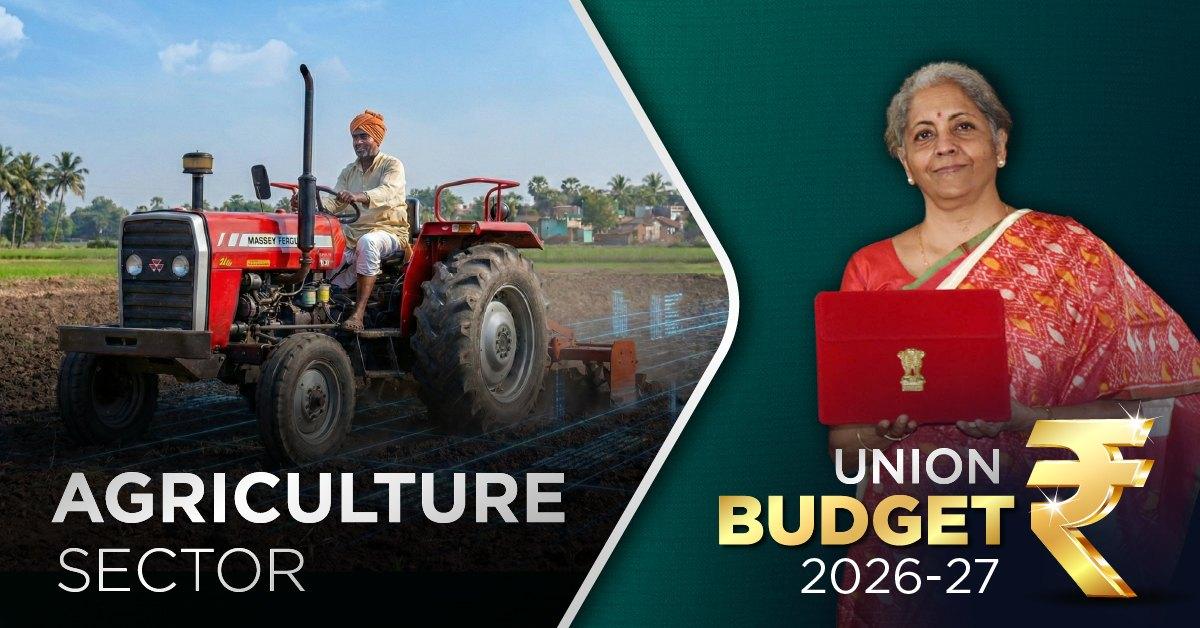
Don’t miss the most important Budget announcements and allocations for the agriculture sector. Click here!
✨ Key Takeaways
Agriculture has remained a cornerstone of India’s economy since independence, anchoring livelihoods even as industry and services expanded rapidly. Deeply woven into the country’s socio-economic fabric, the sector continues to support a large rural population, ensure food security, contribute to exports and increasingly attract private and institutional investment. Over the past decade, agriculture has undergone meaningful structural change, with policy support, supply chain reforms and technology adoption gradually shifting the focus from subsistence farming to agri-business and value-added ecosystems.
Today, agriculture contributes nearly 18 per cent to India’s GDP, with annual output estimated at about Rs 29 lakh crore at current prices. While its GDP share has moderated over time, its influence on rural demand remains significant. Rising farm incomes, supported by better yields, market access and government schemes, are driving growth in allied sectors such as FMCG, agri-inputs, tractors and farm technology. Notably, horticulture, fisheries and allied activities like dairy and poultry are outpacing headline growth, while agricultural exports have crossed USD 50 billion. Against this backdrop, the Budget’s focus on agriculture assumes critical importance for investors tracking long-term rural and consumption-led growth.
Union Budget 2026: Key Announcements Shaping the Agriculture Sector
- Boosting Farmer Incomes: Focus on increasing farmer earnings through productivity enhancement and entrepreneurship, with special emphasis on small and marginal farmers.
- Fisheries Development: Integrated development of 500 reservoirs and Amrit Sarovars, strengthening coastal fisheries value chains, and enabling market linkages involving start-ups, women-led groups, and Fish Farmer Producer Organisations (FPOs).
- Animal Husbandry and Livestock: Support for rural entrepreneurship via a credit-linked subsidy programme, modernisation and scaling of livestock enterprises, creation of integrated dairy, poultry, and livestock value chains, and promotion of Livestock Farmer Producer Organisations.
- High-Value Crops and Diversification: Support for crops like coconut, cashew, cocoa, sandalwood, agar trees, and nuts (almonds, walnuts, pine nuts) to diversify farm output and enhance incomes.
- Sector-Specific Programmes: Initiatives include a Coconut Promotion Scheme, a dedicated cashew and cocoa programme to boost exports and global branding by 2030, and a Sandalwood ecosystem push with state partnerships.
- Orchard Rejuvenation and Youth Engagement: Rejuvenation of old orchards and expansion of high-density cultivation with emphasis on value addition and youth participation.
- Technology and Co-operatives: Launch of Bharat-VISTAAR, a multilingual AI advisory tool integrating AgriStack portals and ICAR practices to improve productivity, along with extended Tax benefits for primary co-operatives supplying inputs to federal co-operatives or government bodies.