Union Budget 2026: Setting the Direction for India’s IT Services Sector
 Join Us
 Follow Us
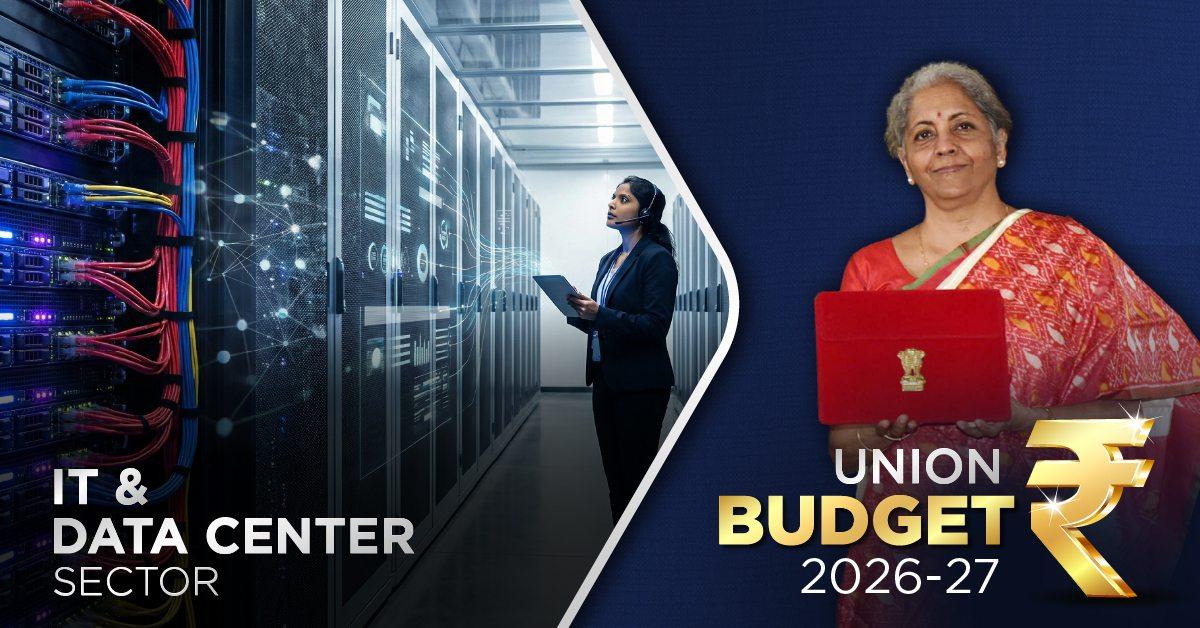
With safe-harbour changes, faster APAs and a long-run cloud incentive, FY27 positions India as both a services hub and a compute base.
✨ Key Takeaways
The technology sector sits at an interesting crossroads. On one side is the familiar engine—India’s IT services exports, built on delivery scale, talent depth and global client trust. On the other is the newer backbone—data centers, cloud infrastructure and the compute layer that increasingly powers everything from enterprise apps to AI workloads. Both are large opportunities, but both also demand policy clarity: IT needs cleaner rules to reduce prolonged disputes, while data centers need confidence that the investment cycle will be rewarded with stable demand and viable economics.
In Union Budget FY 26-27, Finance Minister Nirmala Sitharaman has delivered a clear signal: reduce friction for IT exporters, pull global cloud workloads into India, and push AI beyond jargon into real use-cases. While the headlines often get dominated by Tax rates and capex numbers, the digital economy gets a quietly consequential set of proposals—especially transfer pricing certainty, data-center economics, and AI-led public infrastructure.
What changed for IT services
- One umbrella category: Software development services, IT-enabled services, KPO and contract R&D (software) are proposed to be clubbed as “Information Technology Services” with a common safe harbor margin of 15.5 per cent.
- Bigger safe harbor eligibility: The threshold is proposed to rise from Rs 300 crore to Rs 2,000 crore for IT services.
- Less officer interface: Safe harbor approvals are proposed to shift to an automated, rule-driven process, and once opted for, can be continued for 5 years at the company’s option.
- Faster APA route: For companies opting for a Unilateral APA, the proposal is to conclude it within 2 years (extendable by 6 months on request).
- Modified returns extended: The modified return facility (linked to APA) is proposed to be extended to associated entities too.
- Why it matters: For an export-driven sector where transfer pricing can become a long-running distraction, these proposals point to more predictability and lower compliance drag—particularly relevant for scaled IT businesses and midcaps looking to grow overseas without expanding paperwork in parallel.
What changed for data centers and cloud
- Tax holiday till 2047 (global cloud via India): A tax holiday till 2047 is proposed for foreign companies providing cloud services to global customers using data centre services from India, with a condition that services to Indian customers should be via an Indian reseller entity.
- Safe harbor for related-party DC services: A safe harbor of 15 per cent on cost is proposed when the India data center service provider is a related entity.
Why it matters: The messaging is ambitious—India is not being pitched only as a domestic data-center market, but as a platform for serving global cloud demand. If the fine print and implementation align, this can support long-cycle investments across colocation, power-backed infra, fiber connectivity, and cloud ecosystem services.
Where AI shows up in the Budget speech
- AI for governance: AI applications are flagged as tools to improve governance and service delivery.
- AI alongside major R&D rails: AI Mission is listed with National Quantum Mission, Anusandhan National Research Fund, and the Research, Development and Innovation Fund.
- AI and jobs/skills: A High-Powered Standing Committee is proposed to assess how emerging technologies (including AI) affect jobs and skills.
- AI in education and training: The Terms of Reference include embedding AI in education, teacher training, and reskilling tech professionals.
- AI for agriculture advisory: Bharat-VISTAAR is announced as a multilingual AI tool integrating AgriStack and Indian Council of Agricultural Research practices for customized advisory and risk management.
- AI-enabled assistive devices: Under Divyang Sahara Yojana, ALIMCO is proposed to be supported for production scale-up, R&D and AI integration.
- AI at ports: Non-intrusive scanning with advanced imaging and AI is proposed for risk assessment, aiming to scan every container across major ports in phases.
Companies to focus: TCS, Infosys, Wipro and LTI Mindtree