Why Do Promoter Holdings Matter? What Rising and Falling Stakes Reveal About a CompanyWhy Do Promoter Holdings Matter? What Rising and Falling Stakes Reveal About a Company
 Join Us
 Follow Us

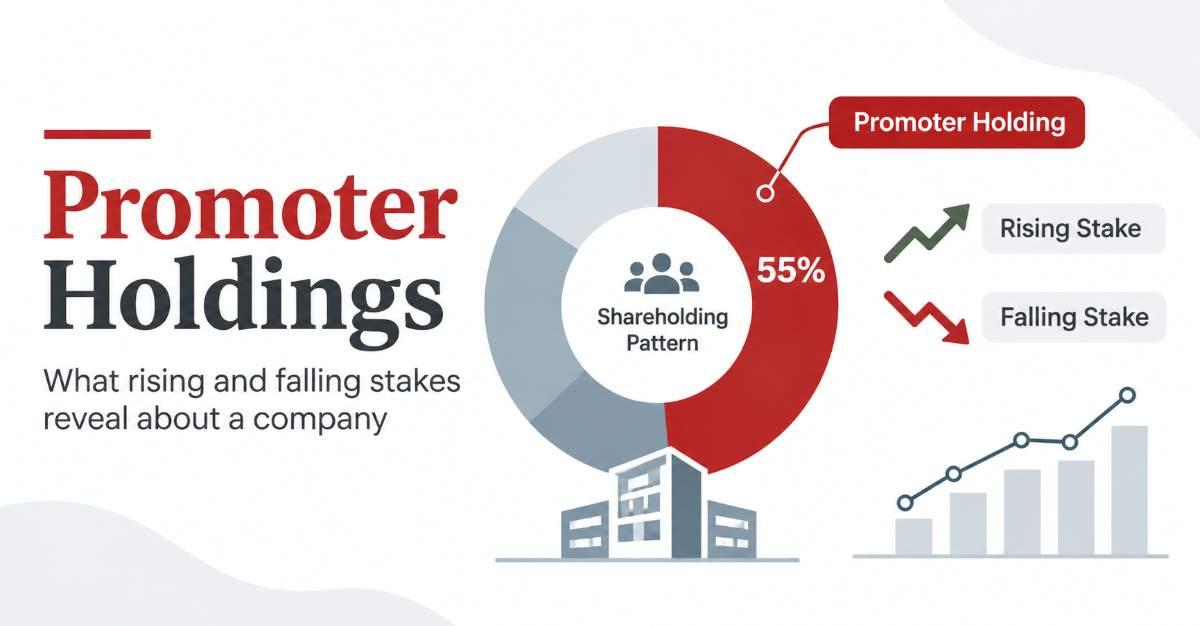
Promoter shareholding can offer valuable clues about management confidence, ownership stability and potential risks. But does a rising stake always signal good news?
✨ Key Takeaways
When analysing a stock, most investors focus on revenue growth, profitability, valuations and share price movements. However, one important indicator often receives less attention: promoter holding in stocks.
Promoters are individuals, families or entities associated with establishing or controlling a company. Their ownership can influence business decisions, corporate governance and long-term strategy.
Changes in promoter shareholding may offer insights into how those controlling the business view its prospects. However, interpreting these changes requires more than simply comparing percentages.
What Is Promoter Holding in Stocks?
Promoter holding refers to the percentage of a company's equity shares owned by its promoters and promoter group.
For example, if a company has 10 crore outstanding shares and its promoters collectively own 6 crore shares, the promoter holding stands at 60%.
A higher promoter stake generally indicates greater ownership concentration, while a lower stake means a larger portion of the company is owned by public shareholders, institutional investors or other entities.
Neither situation automatically makes a stock attractive or unattractive. The quality of management and the reasons behind ownership changes matter equally.
What Does an Increase in Promoter Holding Indicate?
An increase in promoter shareholding is often interpreted positively because promoters are committing additional capital to their own business.
There are several possible reasons behind rising promoter stakes:
- Confidence in future growth: Promoters may believe the company's earnings and business prospects will improve.
- Attractive valuations: They may consider the prevailing market price undervalued relative to long-term potential.
- Strengthening ownership: Additional purchases may help promoters consolidate their influence over the company.
For instance, suppose promoter holding increases from 48% to 52% through open-market purchases. Investors may interpret this as a sign of confidence.
However, purchases made by promoters do not guarantee future share price appreciation. Even promoters can misjudge valuations or business conditions.
Why Does Promoter Holding Decrease?
A declining promoter stake often attracts attention, particularly when the reduction continues over several quarters.
However, a promoter stake decrease is not necessarily a warning sign.
Promoters may sell shares to diversify personal investments, repay borrowings or fund other business ventures. Some companies also reduce promoter ownership to meet public shareholding requirements.
Another important factor is equity dilution.
Suppose promoters hold 60% of a company. If the company issues additional shares to institutional investors and promoters do not participate, their ownership percentage may fall even without selling a single share.
Therefore, investors should distinguish between actual promoter selling and changes caused by fresh equity issuance.
Why Is Promoter Pledging Important?
Promoter pledging is another important factor when examining a company's shareholding pattern.
Pledging occurs when promoters use their shares as collateral to obtain financing.
While borrowing against shares is not automatically negative, excessive pledging can increase financial risk.
If the stock price declines sharply, lenders may demand additional collateral. Failure to meet these requirements could result in pledged shares being sold, potentially creating further pressure on the stock price.
Investors should monitor whether pledged shares are increasing or decreasing and understand the reasons behind the borrowing.
Is High Promoter Holding Always Better?
A common misconception is that companies with higher promoter ownership are automatically safer investments.
While substantial ownership can align promoter interests with those of shareholders, excessive concentration may also create governance concerns.
A dominant promoter may exercise significant influence over board decisions, related-party transactions and capital allocation.
Conversely, several professionally managed companies operate successfully without a dominant promoter shareholder.
Investors should therefore evaluate ownership alongside corporate governance standards, business performance and financial strength.
How Can Investors Track Promoter Shareholding?
Investors can examine promoter ownership through quarterly shareholding pattern disclosures available on the NSE and BSE websites.
When reviewing these disclosures, consider the following:
1. Compare promoter holding across at least four consecutive quarters.
2. Check whether increases resulted from actual purchases or other transactions.
3. Identify whether declining stakes reflect selling, dilution or reclassification.
4. Monitor pledged shares and changes in institutional ownership.
5. Compare ownership trends with earnings growth, debt levels and cash flow.
Looking at multiple quarters is generally more meaningful than reacting to a single change.
Conclusion
Promoter shareholding can provide useful insights into ownership stability, management confidence and financial risks. Rising stakes may indicate optimism, while declining holdings may warrant closer examination.
However, promoters holding alone should never determine an investment decision.
A company with increasing promoter ownership can still face weak earnings, excessive debt or expensive valuations. Similarly, declining promoter ownership does not necessarily indicate deteriorating fundamentals.
For investors, the key is understanding why ownership has changed and whether those changes align with the company's financial performance and long-term prospects.