BSE SmallCap Index at a Six-Month High: What the Valuations Are Actually Saying
 અમારી સાથે જોડાઓ
 અમને અનુસરો
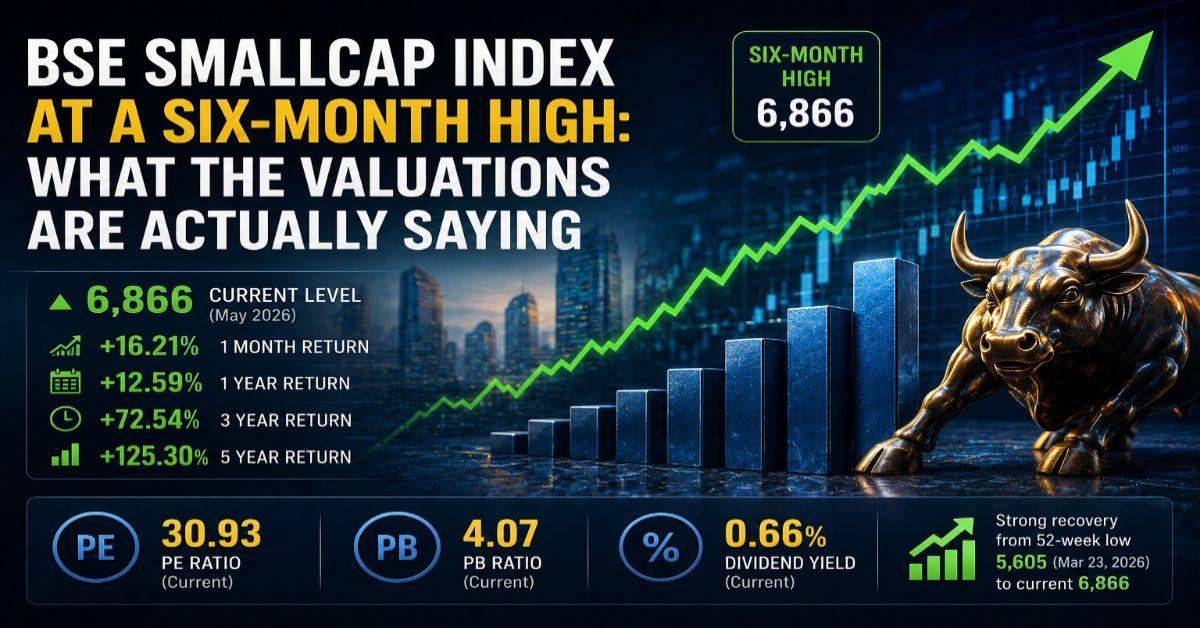
A 16% rally in one month and 125% over five years. The index is not cheap. But cheap and investable are two different things.
✨ મુખ્ય મુદ્દાઓ
The BSE 250 SmallCap index hit a fresh six-month high today, trading at approximately 6,866 — up 1.77 per cent in a single session. One month return: 16.21 per cent. One year: 12.59 per cent. Three years: 72.54 per cent. Five years: 125.30 per cent. The index had touched its 52-week low of 5,605 on March 23, 2026 and has recovered sharply since. At the current level it sits well off its 52-week high of 7,225 hit in July 2025 meaning the recent rally, while strong, has not yet reclaimed peak levels.
Before deciding what to do with those numbers, the valuation picture needs to be read carefully. The historical PE and PB data tells a more nuanced story than either the bulls or the bears are currently acknowledging.
Where Valuations Stand Today
|
Period |
PE Ratio |
PB Ratio |
Dividend Yield |
|
May 2026 (Current) |
30.93 |
4.07 |
0.66% |
|
FY 2026-27 YTD |
29.66 |
3.82 |
0.70% |
|
FY 2025-26 |
32.36 |
3.93 |
0.71% |
|
FY 2024-25 |
32.36 |
3.7 |
0.70% |
|
FY 2023-24 |
24.77 |
2.87 |
0.94% |
|
FY 2022-23 |
20.55 |
2.42 |
1.07% |
|
FY 2021-22 |
35.55 |
2.66 |
0.87% |
|
FY 2020-21 |
35.61 |
1.71 |
1.44% |
|
FY 2019-20 |
33.1 |
1.63 |
1.22% |
|
FY 2018-19 |
55.36 |
1.97 |
0.90% |
The current PE of 30.93 sits in the middle of the historical range. It is meaningfully below the 35 to 55 range seen in FY19, FY21 and FY22 — periods that represented genuine froth. It is also well above the 20 to 24 range seen in FY23 and FY24 the period when small caps were genuinely cheap and the subsequent rally from those levels produced the 72 per cent three-year return.
The honest read is that the index is neither distressed nor euphoric at current levels. It is fairly valued to mildly expensive depending on where earnings go from here.
What the PE History Actually Shows
The single most important insight from the historical table is how PE ratios behave around market cycles in small caps and it is counterintuitive.
FY 2018-19 shows a PE of 55.36 the highest in this dataset at an index level of 2,294. That was peak valuation at what turned out to be a local top before a significant correction. By FY 2019-20, the index had fallen to 1,335 while PE had dropped to 33.10. Valuations compressed through a combination of price decline and earnings disappointment simultaneously.
Then FY 2020-21 — the COVID recovery year shows PE of 35.61 at an index level of 2,878. The price had recovered but earnings had not yet caught up, making the index look expensive by PE. Investors who dismissed it as expensive at 35x in FY21 missed the subsequent move to 3,829 in FY22 and 5,792 in FY24.
The FY 2022-23 and FY 2023-24 period — PE of 20.55 and 24.77 respectively was the genuine valuation opportunity. Small caps were cheap in absolute terms and cheap relative to their own history. The three-year return of 72.54 per cent from those levels reflects exactly that.
Today at 30.93x PE, the index is not cheap in that same way. But it is not at the 55x of FY19 either. The current valuation sits at a level where returns are determined primarily by earnings delivery rather than multiple expansion. If small cap earnings grow at 15 to 20 per cent annually, a 30x PE is sustainable and the index grinds higher. If earnings disappoint, the index re-rates down quickly small caps have more valuation sensitivity than large caps because they lack the institutional ownership that provides support during corrections.
The Price-to-Book Tells a Different Story
The PB ratio deserves separate attention because it shows something the PE does not.
Current PB of 4.07 is the highest in this entire dataset going back to FY19. Even in FY18-19 when PE was at 55x, the PB was only 1.97. In FY20 and FY21 through valuations — PB was 1.63 and 1.71 respectively. The current 4.07 means the market is paying four times book value for small cap assets a level that has no historical precedent in this data series.
This is not necessarily alarming on its own. Rising PB can reflect genuinely improved return on equity across small cap companies, which has been a real feature of the post-COVID earnings cycle as many small cap businesses improved margins, reduced leverage and became more capital efficient. But it is a number worth watching. When PB contracts from these levels either through price decline or book value growth outpacing price it creates a headwind that compounds the earnings sensitivity risk.
The dividend yield of 0.66 per cent at the low end of the historical range is a secondary confirmation of elevated valuations. When dividend yields are low, it means prices have risen faster than payouts which is consistent with a market that has been in a strong re-rating phase.
The March 2026 Low and the Recovery
The 52-week low of 5,605 hit on March 23, 2026 was the inflection point that set up the current rally. From that low to today's 6,866 is a recovery of approximately 22.5 per cent in roughly six weeks. That pace of recovery is worth contextualising.
The March low coincided with the broadest global market anxiety of the year — FPI outflows, rupee weakness, HSBC and JPMorgan downgrades on India, crude oil concerns. Small caps, which are more domestically driven and less liquid than large caps, absorbed the selling pressure more acutely. The subsequent recovery reflects domestic institutional buying — SIP flows into small cap funds have remained resilient combined with improving sentiment as some of the macro concerns moderated.
The recovery from 5,605 to 6,866 in six weeks is fast. Not dangerously fast, but fast enough that investors who missed the low and are chasing the move at current levels are buying into a 22 per cent rally rather than a discounted entry point.
What This Market Requires
Small caps at current PE levels are an earnings-driven market rather than a valuation-driven one. The distinction matters for how you invest.
In a valuation-driven market like FY23 or FY24 when PE was 20 to 24x buying a diversified basket of small caps and holding through the cycle was sufficient to generate strong returns because the margin of safety was embedded in the price. Multiple expansion from cheap levels does most of the work.
At 30x PE and 4x PB, that passive approach carries more risk. The index is not distressed enough that time alone generates the return. Stock selection and earnings visibility matter more at these levels because the index needs earnings growth to justify the current price, not just sentiment improvement. Importantly, the rally beneath the index surface has not been uniform. Profitability, balance sheet quality and earnings visibility are increasingly determining which small caps sustain rerating and which revert sharply after momentum fades.
The sectors driving small cap earnings growth — manufacturing, capital goods, specialty chemicals, auto ancillaries, Logistics are genuinely in multi-year structural tailwinds from the PLI cycle, infrastructure spending and the China-plus-one supply chain shift. That is a real earnings story, not a narrative without fundamental support. But it requires execution to materialise and execution in small caps is inherently less predictable than in large cap businesses with established market positions.
The Honest AssesSMEnt
The BSE SmallCap index at 6,866 is a fresh six-month high after a sharp recovery from stressed levels. It is not the cheap index it was in FY23 or FY24. It is not the frothy index it was in FY19 or the early COVID recovery of FY21. It sits at a valuation level — 30.93x PE, 4.07x PB where the range of outcomes is wide and determined primarily by whether the earnings cycle delivers what the price is already assuming.
This is not a broad bargain anymore. It is a selective opportunity market where the quality of individual business selection matters more than it did when the whole category was cheap. The investors who made 72 per cent over three years from the FY23 lows were buying cheap. The investors buying today need a different framework one built on earnings visibility and business quality rather than valuation discount.
Disclaimer: This article is for informational purposes only and not investment advice.