HSBC, JPMorgan and Bernstein Have Downgraded India. Here Is What It Actually Means.
 અમારી સાથે જોડાઓ
 અમને અનુસરો
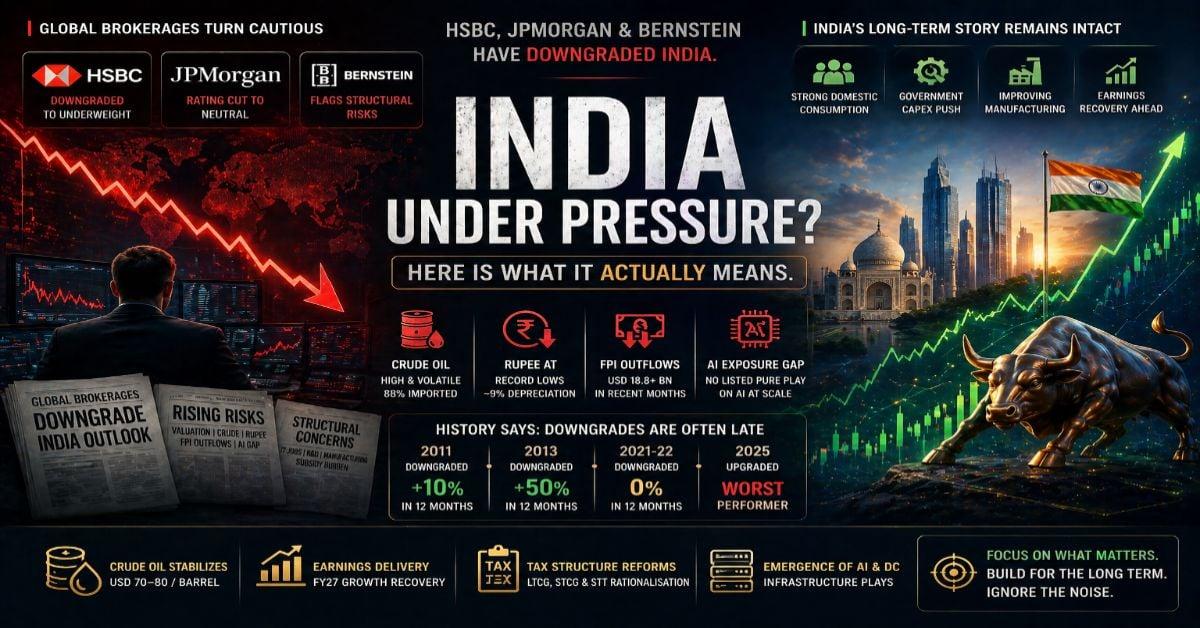
Global brokerages have downgraded India. Is it a warning or an opportunity? Here’s what history, valuations, and macro data really say.
✨ આઇ સંચાલિત સારાંશ
On April 23, 2026, HSBC downgraded Indian equities to underweight its second downgrade this month. A day later, JPMorgan cut its rating from overweight to neutral, lowered its Nifty 50 base case target for 2026 to 27,000 and outlined a bear case scenario of 20,500. Bernstein, in a separate open letter to the Prime Minister, flagged structural risks that go well beyond near-term valuation concerns. Earlier in March, UBS, Nomura, Citi and Goldman Sachs had already turned cautious.
That is effectively every major global brokerage moving in the same direction within weeks of each other. Before deciding what to do with that information, it is worth understanding what is driving it, what history says about these moments and what the genuinely valid concerns are that should not be dismissed.
Why the Downgrades Are Happening Now
The immediate triggers are a cluster of near-term macro concerns that have arrived simultaneously.
Valuations remain elevated relative to other emerging markets even after the correction of the past several months. The Sensex and Nifty are trading at approximately 18.5 times one-year forward earnings below their long-term averages of 19.8 times and 19 times respectively, which suggests large caps have moderated. But the BSE MidCap 150 at 26.84 times and BSE SmallCap 250 at 24.14 times are still significantly above historical averages. The correction in large caps has happened. The correction in broader markets is incomplete.
Crude oil prices are the second concern. India imports approximately 88 per cent of its oil requirement. Elevated crude directly impacts corporate earnings through higher input costs, pushes up inflation and widens the current account deficit simultaneously. For foreign portfolio investors running global macro models, India's sensitivity to an oil shock is a meaningful risk factor particularly given geopolitical instability in the Middle East.
The third concern is currency. The rupee has depreciated approximately 9 per cent over the past year and sits at record lows. For a foreign investor whose returns are denominated in dollars or euros, rupee weakness is a direct drag on portfolio returns even when Indian equity prices are flat. Nitin Kamath recently noted from industry conversations that the rupee situation is actively deterring foreign allocation and that FPI outflows exceeding USD 18.8 billion in recent months reflect this sentiment in hard numbers.
The fourth concern and this is the one Bernstein and JPMorgan both raised explicitly is the absence of AI related investment opportunities in India's listed market. Global capital is currently chasing AI infrastructure plays. The US markets have Nvidia, Microsoft, Alphabet and Meta. China has its own technology ecosystem. India does not yet have a listed company that represents a credible pure play on the AI economy at scale. For global fund managers rotating capital into AI themes, India simply does not have the stocks they are looking for.
The Structural Concerns That Are Genuinely Valid
Bernstein's open letter to the Prime Minister goes beyond near-term market concerns and raises issues that deserve serious attention rather than dismissal.
India's 15 million strong IT workforce faces genuine disruption from AI. This is not an abstract concern it is a structural economic risk. The IT sector has been one of India's most important engines of middle-class income creation, foreign exchange earnings and domestic consumption. If AI compresses the demand for entry and mid-level IT work, the displacement cannot simply be absorbed by manufacturing the skill sets are different and manufacturing at current scale cannot employ 15 million people. There is no easy policy answer here.
India's R&D spending at less than 1 per cent of GDP compares unfavourably with South Korea at 5 per cent and China at approximately 2.5 per cent. A country that does not invest in research does not produce the foundational technology that commands global capital. India is currently a consumer of AI models trained on Indian data. It does not have a foundational model of its own at global scale.
Manufacturing at 15 to 16 per cent of GDP remains far below where the economy needs it to be for job creation. PLI has produced early positive signs but the scale of transformation required has not yet materialised. And rising subsidy and cash transfer programmes while politically rational divert capital from productive infrastructure spending. These are legitimate structural criticisms, not noise.
What History Says About Global Brokerage Downgrades
Here is where context matters enormously.
In August 2011, Morgan Stanley cut its Sensex target by 15 per cent and Stanchart cut its India growth forecast. Twelve months later, Nifty was up 10 per cent. In August 2013, the rupee hit what was then an all-time low of 68.85, JPMorgan reduced India equity weight and Citi cut its Sensex target. Twelve months later, Nifty was up 50 per cent. In late 2021 to early 2022, Nomura went neutral, UBS moved to underweight, Morgan Stanley to equal weight and JPMorgan cut weight. Twelve months later, Nifty was flat the one case where the caution was broadly correct in direction if not in timing. And in early 2025, these same brokerages upgraded India. India went on to be one of the worst performing markets of 2025.
The pattern is consistent: global brokerages are historically late to upgrade at bottoms and late to downgrade at peaks. They follow price action and macro narrative rather than lead them. This does not mean their current concerns are wrong it means they should be evaluated on their own merits rather than treated as precise market timing signals.
When Will the Upgrades Come Back?
Global brokerages will upgrade India when the conditions that drove the downgrade reverse. The triggers to watch are specific.
Crude oil stabilising in the USD 70 to USD 80 per barrel range removes the macro pressure on earnings, inflation and the current account simultaneously. That is the single most impactful near-term catalyst because it addresses multiple concerns at once.
FY27 earnings delivery is the second. Domestic brokerages are forecasting Nifty EPS in the range of Rs 1,280 to 1,320 for FY27 with the index potentially reaching 28,000 to 31,000 by March 2027 implying 15 to 25 per cent upside from current levels. If corporate earnings recover to early double-digit growth as expected, the valuation argument against India weakens significantly.
Tax structure rationalisation specifically addressing the LTCG, STCG and STT framework that Nitin Kamath flagged as making India less attractive versus competing markets is low-hanging fruit that could directly improve FPI sentiment without requiring macroeconomic conditions to change.
And the emergence of credible listed AI infrastructure plays in India would address the specific absence of theme that JPMorgan cited. This is a multi-year process rather than a near-term catalyst, but the data centre buildout by Reliance, Adani, Airtel and Tata is creating the conditions for listed proxies to develop.
The Honest AssesSMEnt
Both things are true simultaneously. The global brokerage downgrades reflect real concerns — valuation, currency, crude sensitivity, AI exposure absence and structural growth challenges that cannot be dismissed by pointing to historical track records. And the historical track records show that clusters of simultaneous downgrades have consistently been poor timing signals for medium-term market direction.
India's long-term trajectory remains supported by domestic consumption growth, government capital expenditure and an improving manufacturing base. Much of the geopolitical and oil price risk that brokerages are flagging is already partially reflected in current prices after the correction. Large-Cap valuations at 18.5 times forward earnings are below long-term averages — not cheap, but no longer at peak premium levels.
The structural concerns Bernstein raised about IT disruption, R&D spending, manufacturing scale and subsidy burdens are the ones that deserve sustained policy attention. Those are the issues that will determine whether the upgrades that inevitably follow these downgrades lead to a durable re-rating or just another cyclical bounce.
Brokerages will upgrade India again. They always do. The question is whether India uses the intervening period to fix the things that actually need fixing.
Disclaimer: This article is for informational purposes only and not investment advice.