Avalon Technologies Has Returned 158% in One Year. The Business Behind That Move Is More Interesting Than the Stock Price
 आमच्यासोबत जोडा
 आम्हाला फॉलो करा
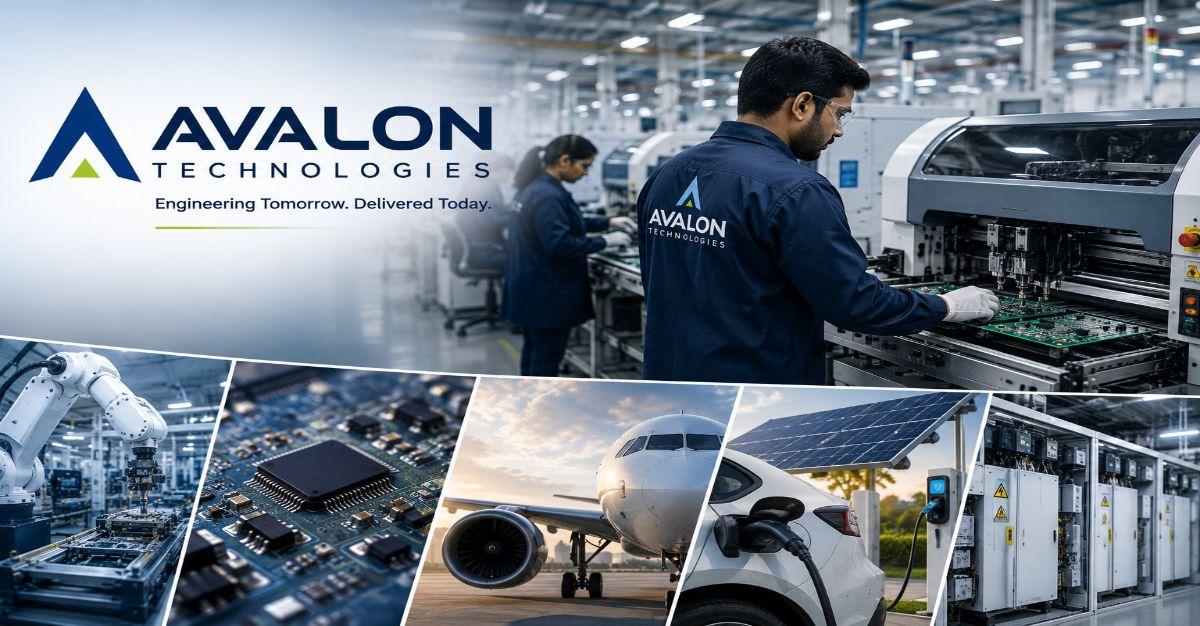
Eight consecutive quarters of operational improvement. Revenue has already crossed its earlier three-year doubling target, nearly a year ahead of schedule, while management has now set its sights on Rs 3,200 crore of revenue by FY29. The opportunity is increasingly being shaped by higher-value programmes across industrial, mobility, aerospace, clean energy and semiconductor equipment.
✨ महत्त्वाचे मुद्दे
Avalon Technologies traded at Rs 778.15 on January 29, 2026 its 52-week low. On August 20, 2026, it touched a 52-week high of Rs 2,350. The current price of Rs 2,229 represents a one-year return of 158 per cent a multibagger returns. Over three years the stock has returned 359 per cent. Over six months, 119 per cent.
Behind that price move is a business that has delivered eight consecutive quarters of sequential improvement in revenue, margins and return on capital. That consistency not a single dramatic quarter but a sustained compounding across eight periods is what makes Avalon worth examining carefully rather than dismissing as a momentum trade.
What Avalon Actually Is
Avalon is an Electronics Manufacturing Services company — but that classification understates what has changed. An EMS company assembles components for clients. What Avalon has been building is something more specific: a fully vertically integrated box-build manufacturer for complex, mission-critical applications.
Box-build manufacturing means delivering a complete finished product — not just a PCB assembly or a cable, but the entire integrated system. Box-build contribution has grown from 44.5 per cent of revenue in FY22 to 59.9 per cent in Q1 FY27. That shift matters because box-build can support greater customer engagement, deeper integration into the customer's product and potentially better economics than individual sub-assembly work.
Avalon's vertical integration — covering PCB design and assembly, cable assembly, sheet metal fabrication, injection-moulded plastics, magnetics and system integration is what enables the box-build model. Everything required to build a complex industrial or Aerospace system is done in-house rather than assembled from multiple sub-contractors.
The Financial Trajectory
|
Year |
Revenue (Rs crore) |
EBITDA (Rs crore) |
EBITDA Margin |
PAT (Rs crore) |
|
FY23 |
945 |
113 |
12% |
52 |
|
FY24 |
867 |
63 |
7% |
28 |
|
FY25 |
1098 |
115 |
10% |
63 |
|
FY26 |
1603 |
173 |
11% |
113 |
|
Q1 FY27 |
484 |
58 |
12% |
35 |
FY24 was the trough year — revenue and margins both contracted as the company absorbed investment and restructuring costs. The subsequent recovery has been consistent: FY25 returned to growth, FY26 accelerated significantly at 46 per cent revenue growth, and Q1 FY27 continued at 49.8 per cent year-on-year growth with EBITDA margin expanding to 12 per cent.
By Q1 FY27, ROCE had improved to 23.4 per cent from approximately 10 per cent two and a half years ago. The improvement indicates that Avalon is generating substantially better returns from its expanding asset base, although sustaining this level will depend on the successful ramp-up of new programmes and efficient deployment of incremental capital. Asset turns stand at 9.9x. For an EMS company that has committed to keeping capital expenditure modest, this is the key efficiency metric to track.
Q1 FY27: The Quarter That Confirmed the Trajectory
Q1 FY27 arrived with characteristics that would typically indicate seasonal softness — yet it exceeded Q4 FY26 on revenue. The Rs 484 crore result was marginally above Q4 FY26's Rs 480 crore. Management noted this as significant: a positive start rather than a seasonal dip.
Revenue breakdown by vertical: Industrial at 32 per cent grew 52 per cent year-on-year. Mobility at 25 per cent grew 36 per cent year-on-year, with Rail at approximately 15 per cent growing 37 per cent and Aerospace at approximately 8 per cent growing 47 per cent. Clean Energy at 29 per cent was a strong contributor. Management stated explicitly that all sectors are growing.
India manufacturing contributed 72 per cent of Q1 FY27 revenue and delivered EBITDA margins of 16.7 per cent and PAT margins of 11.1 per cent — the underlying profitability of the core business before the US manufacturing drag. US manufacturing contributed 28 per cent and recorded a PAT loss of approximately Rs 4 crore, narrowed substantially from approximately Rs 14 crore two years ago and approximately Rs 9 crore one year ago. Management has guided for EBITDA breakeven at US manufacturing by end of FY27 and PAT breakeven thereafter.
The Specific Programs Now Ramping
The more important question is whether Avalon's current growth is backed by identifiable programmes rather than simply management guidance. The Q1 FY27 commentary points to multiple emerging revenue pools across Semiconductor manufacturing equipment, power infrastructure, Railways, aerospace and data-centre-linked applications. Several of these programmes are already generating revenue, while others are moving from development and qualification towards commercial production.
Semiconductor manufacturing equipment: Revenue has started. Avalon disclosed it has increased its allocation with one of the world's leading wafer fabrication equipment suppliers, expanding from power box assemblies into additional products. Management stated production is ramping over the next few quarters. This is early-stage revenue contribution, not yet material at the segment level, but the customer relationship has been established and the scope is expanding.
HVDC systems: Revenue has started with a couple of customers. Management confirmed this on the call as part of the power infrastructure theme — alongside data centre-adjacent power supply customers. Scale has not yet been disclosed.
Kavach anti-collision system: On track for commercial production. This programme involved joint product development and prototyping over several years. The significance lies in the qualification and co-development involved: programmes of this nature typically create deeper customer integration and can make the supplier relationship more difficult to displace once commercial production begins.
Locomotive engine sub-systems: Production is underway.
Aerospace cabin sub-assemblies: Moving towards volume production. Avalon has also secured incremental box-build business with a leading aerospace company in the export market.
Data centres: Management clarified the current position precisely. Avalon is producing for customers who supply off-grid power into data centres — HVDC and related power infrastructure. It is working towards rack and cooling systems but has not yet won that business. Data centre adjacency through power infrastructure is real today; direct rack and server manufacturing is pipeline, not revenue.
The Manufacturing Expansion
Avalon is expanding its manufacturing footprint in Chennai, with a new facility focused on domestic demand scheduled to commence commercial production from Q2 FY27. The company is acquiring additional land to support its longer-term expansion across domestic and export opportunities, including semiconductor equipment and advanced electronics. The eventual scale and capital requirement will be important variables to monitor as the expansion progresses.
Annual capex has been approximately Rs 56 crore in FY26 and Rs 16 crore in Q1 FY27. The land acquisition will involve additional capex beyond this run rate. Management targets 8x to 10x asset turns as the sustained operating range.
Management also revised FY27 revenue growth guidance upward to 26 to 30 per cent from the earlier 24 to 27 per cent, citing strong Q1 performance and programme ramp visibility.
The Rs 3,200 Crore by FY29 Ambition
Management's previous commitment was to double revenue from FY24's Rs 867 crore to approximately Rs 1,734 crore by FY27. With TTM revenue now above that threshold, Avalon has effectively crossed its earlier revenue milestone ahead of schedule. The company has now raised its ambition, targeting approximately Rs 3,200 crore of revenue by FY29, effectively seeking to double the FY26 revenue base of Rs 1,603 crore over the next three years.
The programmes currently ramping — semiconductor equipment, HVDC, Kavach, locomotive sub-systems and aerospace box-builds — provide potential building blocks for that target, while expansion into geographies such as Southeast Asia and Europe could add another layer of growth. The key variable will be the pace at which these programmes move from qualification and pilot stages into meaningful commercial volumes.
Management was explicit that many new programme wins are not yet fully reflected in the P&L. They are either in pilot stage or awaiting commercial ramp decisions that could fall in one quarter or another based on customer timelines.
Valuation: The Right Framework for an EMS Business
For an EMS company with Avalon's profile — capital-light, vertically integrated, growing through programme wins rather than commodity volume — the relevant metrics are ROCE trajectory, EV/EBITDA and price to sales. P/E is a secondary indicator because earnings are still ramping and new programmes entering commercial production will accelerate the earnings base over FY27 and FY28.
At Rs 2,229, Avalon trades at an EV/EBITDA of 65x and a trailing P/E of 112x against a 3-year median P/E of 87.1x. These are multiples that price significant future execution rather than current earnings. ROCE of 23.4 per cent, asset turns of 9.9x and gross margins consistently in the 33 to 35 per cent guided range describe a business where the unit economics are sound — the question is purely about how fast the revenue base scales and whether margin improvement follows.
The investment case therefore depends heavily on execution. If Avalon reaches Rs 3,200 crore of revenue by FY29 while expanding EBITDA margins towards 15 per cent, today's valuation could become more reasonable on a forward earnings basis. However, if growth or margin expansion falls short, the current multiples leave relatively little room for disappointment.
Risks Worth Naming
US manufacturing is still loss-making. The path to breakeven is clear and the losses are narrowing, but execution slippage pushes the timeline. Defence remains early-stage — management explicitly stated it is looking at defence as a vertical rather than having created it, and has taken only first steps to explore the segment meaningfully. Clean energy dependency on US storage subsidies is a question management deferred to an offline discussion during the call — the IRA subsidy timeline and its impact on battery storage demand deserves monitoring. Promoter holding at 44.4 per cent is lower than most founder-led manufacturing companies and is worth tracking. Customer concentration is not publicly disclosed in detail the Order Book composition by customer would sharpen the risk picture.
The business has earned a significant re-rating alongside eight quarters of improving operational performance. The next phase is therefore straightforward to measure: can Avalon scale from Rs 1,603 crore of FY26 revenue towards Rs 3,200 crore by FY29 while maintaining or improving returns and margins? At the current valuation, execution on both growth and profitability will matter as much as the growth itself.
Disclaimer: This article is for informational purposes only and not investment advice.